


SPARK Matrix™: Mobile Threat Management (MTM)
The global Mobile Threat Management (MTM) market is evolving rapidly as enterprises increasingly rely on mobile devices for business-critical operations. According to QKS Group’s latest market research, the MTM landscape is undergoing a significant transformation driven by emerging technologies, rising cyber threats, and the growing need for comprehensive mobile security strategies.
This blog explores key MTM market trends, growth drivers, vendor landscape, and future outlook, helping technology vendors and enterprises make informed decisions.
What is Mobile Threat Management (MTM)?
Mobile Threat Management (MTM) refers to advanced security solutions designed to protect mobile devices, applications, and networks from cyber threats such as malware, phishing attacks, and unauthorized access. These solutions provide real-time threat detection, risk assessment, and automated response mechanisms to ensure enterprise-grade mobile security.
Key Mobile Threat Management Market Trends
- Rise in Mobile-Centric Cyberattacks
With the increasing use of smartphones and tablets in enterprise environments, cybercriminals are targeting mobile endpoints with zero-day malware, mobile phishing kits, and device-level exploits. This has significantly increased the demand for robust MTM solutions.
- Integration of AI and Machine Learning
Modern MTM platforms leverage AI and machine learning (ML) to enable:
- Real-time behavioral analytics
- Predictive threat detection
- Automated risk scoring
- Continuous monitoring of device activity
These capabilities help organizations proactively identify and mitigate threats before they cause damage.
- Convergence with Endpoint Security
MTM is no longer a standalone solution. Organizations are increasingly integrating MTM with:
- Endpoint Detection and Response (EDR)
- Unified Endpoint Management (UEM) / Enterprise Mobility Management (EMM)
- Security Information and Event Management (SIEM)
This convergence ensures a holistic security posture across all endpoints.
- Cloud-Based MTM Adoption
Cloud-native MTM solutions are gaining traction due to their:
- Scalability
- Ease of deployment
- Centralized policy management
- Real-time threat intelligence updates
Competitive Landscape: SPARK Matrix Analysis
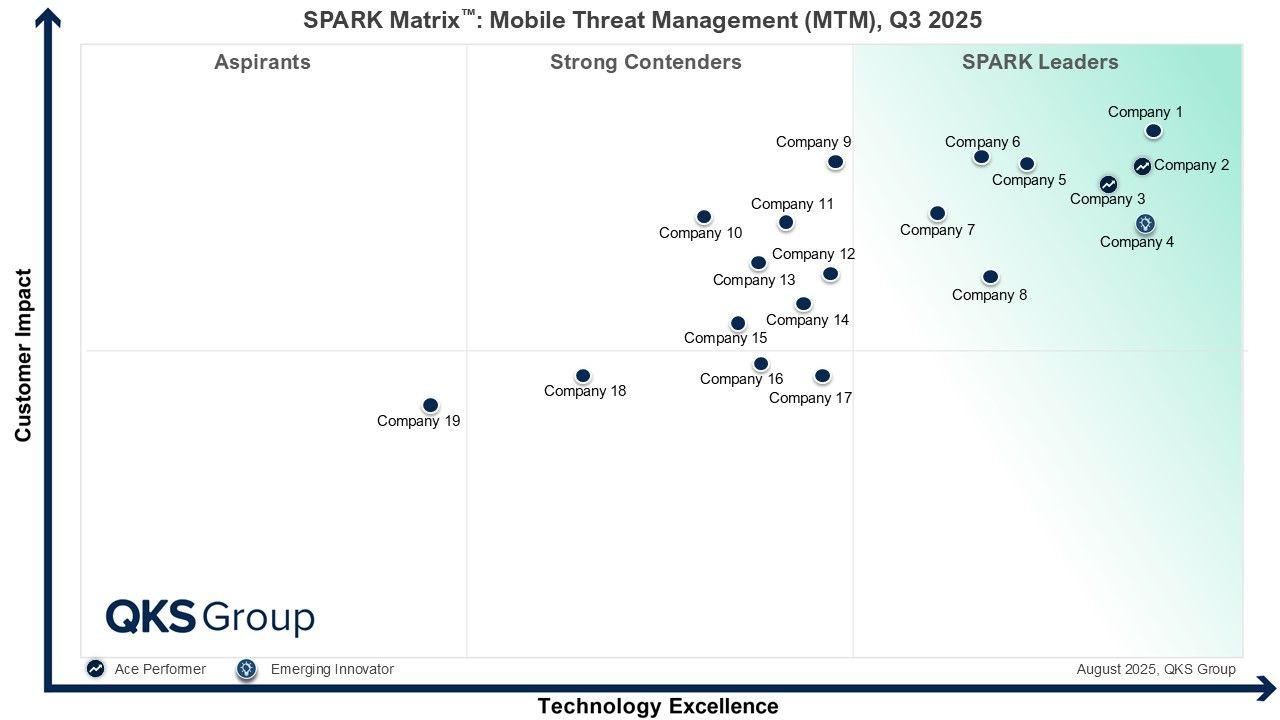
QKS Group’s proprietary SPARK Matrix analysis provides a comprehensive evaluation of leading Mobile Threat Management (MTM) vendors based on technology excellence and customer impact.
Leading MTM Vendors Include: BlackBerry, Broadcom, Check Point, Crowdstrike, Cybereason, ESET, Ivanti, Jamf, Kaspersky, Lookout, Omnissa, Palo Alto Networks, Pradeo, SentinelOne, Sophos, Tehtris , Trellix, Trend Micro and Zimperium.
These vendors are ranked and positioned based on their innovation, feature capabilities, market presence, and strategic vision.
Expert Insight: The Future of MTM
According to an Analyst at QKS Group:
Modern Mobile Threat Management solutions must go beyond traditional security frameworks by covering both on-device and network layers. Advanced platforms now combine:
- Real-time behavioral analytics
- App reputation scoring
- ML-powered anomaly detection
These technologies enable continuous risk assessment, automated isolation of compromised devices, and enforcement of adaptive security policies—all without disrupting the user experience.
However, the effectiveness of MTM solutions depends on:
- Seamless integration with enterprise security ecosystems
- Continuous tuning of detection algorithms
- Collaboration between security and IT teams
Growth Drivers of the MTM Market
Several factors are fueling the growth of the Mobile Threat Management market:
- Increasing BYOD (Bring Your Own Device) adoption
- Rising demand for zero-trust security frameworks
- Growth of remote and hybrid work environments
- Regulatory compliance requirements
- Expansion of mobile-based business applications
Future Outlook of Mobile Threat Management
The future of MTM is expected to be shaped by:
- AI-driven autonomous security systems
- Deeper integration with enterprise security stacks
- Enhanced user behavior analytics
- Increased focus on privacy and data protection
- Expansion into IoT and wearable device security
As cyber threats continue to evolve, MTM solutions will become a critical component of enterprise cybersecurity strategies.
Conclusion
The Mobile Threat Management (MTM) market is poised for substantial growth as organizations prioritize mobile security in an increasingly digital world. QKS Group’s research highlights the importance of advanced threat detection, ecosystem integration, and continuous innovation in staying ahead of emerging risks.
For technology vendors, this presents an opportunity to innovate and differentiate. For enterprises, adopting the right MTM solution is essential to ensure secure, seamless, and resilient mobile operations.

 English
 Arabic
 French
 Spanish
 Portuguese
 Deutsch
 Dutch
Dutch
 Italiano
 Russian
 Romaian
 Portuguese (Brazil)
 Greek
Greek
