


Below-Ground Walls Without the Headaches: A Practical Checklist for Getting Basements Right
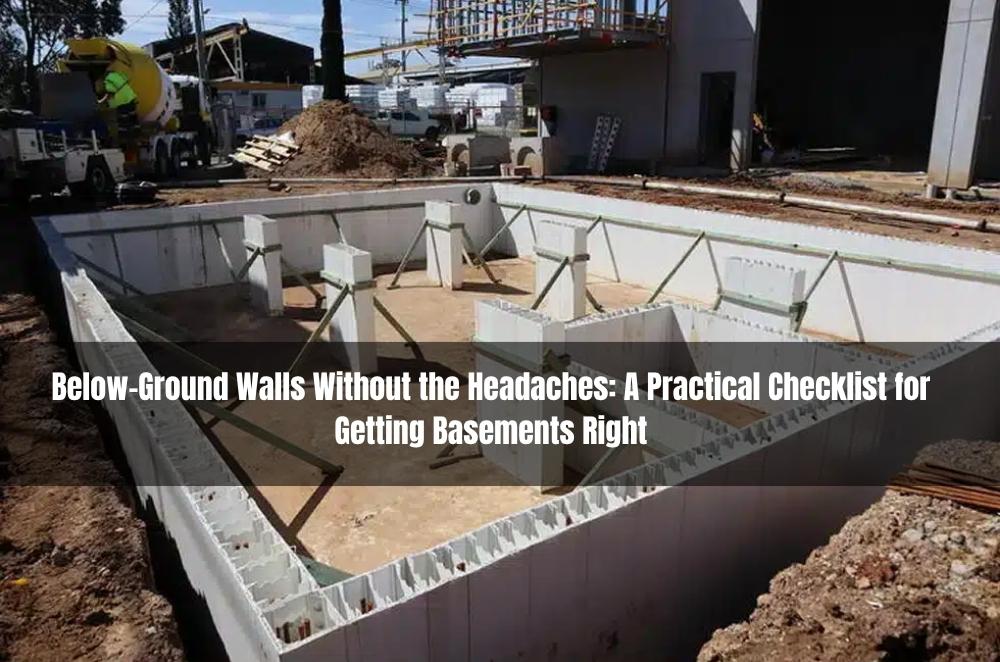
Below-ground construction has a brutal honesty to it: any shortcut you take now will eventually show up as dampness, staining, odour, cracking, or an expensive dig-up later.
If you’re planning a basement wall system for below ground work in Australia or the United States, the safest mindset is to design for water first, then structure, then speed. Wall systems can be excellent, but they only perform if joints, penetrations, drainage, and the pre-backfill sequence are treated as one integrated package.
This guide explains what matters most, where projects usually go wrong, and a simple 7–14 day action plan that reduces rework and callbacks.
What below-ground walls actually have to manage
A below-ground wall is simultaneously a retaining structure, a moisture-control interface, and a tolerance-controlled assembly.
In practical terms, it must:
-
resist lateral earth pressure and any surcharge loads (driveways, slabs, plant, stockpiles)
-
manage hydrostatic pressure, so water doesn’t build behind the wall
-
stay watertight (or water-managed) at joints, corners, and penetrations
-
integrate cleanly with the slab/footing interface and the top termination
-
survive wet/dry cycles, soil movement, and temperature swings without opening leak paths
If any one of those is ignored, the “system” becomes a collection of products rather than a functioning basement.
Start with the water story before you select the wall system
Most failures begin with one unanswered question: Where does water go during heavy rain and prolonged wet conditions?
Before you lock a system in, document:
-
surface runoff directions and any uphill catchment feeding the site
-
soil behaviour (clay, fill, perched water, groundwater likelihood)
-
drainage path from collection to discharge (and what happens if it’s blocked)
-
top-of-wall termination strategy so water can’t track behind membranes
-
how downpipes, hardscape falls, and landscaping will keep water away from the wall
A wall system can be installed perfectly and still leak if the drainage pathway is unreliable.
Where leaks usually start: joints, penetrations, and interfaces
Leaks rarely appear mid-wall. They show up where components meet and where the sequence gets rushed.
High-risk zones to detail early:
-
wall-to-slab/footing interface: continuity and waterstop strategy
-
panel-to-panel or construction joints: tolerances, sealing method, workmanship hold points
-
corners and returns: movement concentrates here, and details are often improvised
-
service penetrations: sleeves, seals, and “no late cut-in” rules
-
top termination: how waterproofing ends and how surface water is stopped from tracking behind
If these are left to “site judgment,” you’ll get site variability, and that’s what creates call-backs.
Common mistakes that create expensive below-ground failures
These patterns show up across markets because they’re process issues, not material issues.
-
relying on waterproofing without effective drainage relief
-
backfilling before waterproofing cures, protection is installed, and drains are proven to discharge
-
skipping protection boards so membranes get damaged during backfill and compaction
-
allowing late penetrations that force cutting and patching through the system
-
vague joint detailing (“seal as required”) instead of a defined method and inspection step
-
no ownership: nobody is responsible for joint prep and sign-off
-
assuming discharge will “work itself out” without verifying outlets and fall paths
The most expensive repairs are expensive because the fix requires excavation.
Decision factors: choosing the right system and delivery approach
The best system is the one that can be executed consistently on your site with your crew, not the one that reads best in a brochure.
Decision factors to weigh:
-
Water risk level: uphill lots, clay soils, and poor discharge points demand a stronger drainage + waterproofing strategy.
-
Access and staging: can waterproofing, protection, and drains be installed and inspected properly before backfill?
-
Penetration complexity: more services = more detailing risk; pre-planned sleeves and standard details become valuable.
-
Tolerance needs: if the basement is to be lined out, straightness and finish consistency matter more.
-
Crew familiarity: Systems that reduce variables help, but only if installation steps and responsibilities are clear.
-
Quality gates: can you define “stop points” (pre-pour, pre-waterproof, pre-backfill) with sign-off?
Operator Experience Moment: The most reliable below-ground builds I’ve seen treat “pre-backfill sign-off” like a hard gate, not a courtesy check. When joints are verified, membranes are continuous, protection is installed, and drains are proven to discharge before any soil goes back in, the basement stays boring. When backfill happens early to tidy the site or keep machines moving, problems get buried and return later as dampness and finishes failing.
A simple first-action plan for the next 7–14 days
Days 1–2: Write the water plan in plain language
Map runoff directions, identify uphill water sources, and document discharge points with a “what if blocked?” scenario.
Days 3–4: Lock joints and penetrations
Finalise joint detailing and sealing responsibilities. Confirm penetration locations/sleeves and set a “no late cut-ins without approval” rule.
Days 5–6: Build the sequence and inspection hold points
Schedule waterproofing install, cure time, protection, drainage install, and drainage discharge verification. Add a mandatory hold point before backfill.
Days 7–10: Create a one-page below-ground checklist
Include substrate readiness, joint prep, membrane continuity checks, corner detailing checks, penetration sealing steps, protection coverage, drain placement, and discharge proof.
Days 11–14: Run a mock pre-backfill review
Walk the team through the hold point process and define stop rules (what triggers rework before backfill is allowed).
A one-page checklist beats a ten-page spec that no one follows under pressure.
Local SMB mini-walkthrough: standardising below-ground quality across multiple jobs
A small contractor is delivering several below-ground walls across mixed soil sites.
They standardise one joint detailing method and one penetration schedule approach.
They pre-plan sleeves so no penetrations are cut in after waterproofing.
They treat protection boards as non-negotiable before any backfill.
They verify drain discharge and photograph the outlets as proof.
They track defects and update the checklist so mistakes don’t repeat.
Practical Opinions
If the drainage pathway isn’t clear, the wall system choice won’t save the basement.
Backfill timing is quality control, not a scheduling convenience.
Late penetrations are the fastest way to “design in” future leaks.
Key Takeaways
-
Below-ground success is built around water control: drainage, discharge, and continuity.
-
Most leaks begin at joints, corners, penetrations, and slab interfaces; detail these early and consistently.
-
Use hard inspection hold points (especially pre-backfill) to avoid burying defects.
-
Standardised checklists and clear ownership reduce variability and call-backs.
Common questions we hear from Australian businesses
Do we need both drainage and waterproofing for below-ground walls?
Usually, yes, because drainage reduces hydrostatic pressure while waterproofing controls seepage paths; each supports the other.
Next step: document the drainage path and discharge points first, then design waterproofing continuity around joints and penetrations.
Local note: Many Australian sites with clay or mixed fill can develop perched water after storms, increasing pressure on walls.
When is it actually safe to backfill?
In most cases, only after waterproofing has cured, protection is installed, and drainage is proven to discharge properly.
Next step: make pre-backfill sign-off a formal hold point with photos and checklist confirmation.
Local note: Australian storm bursts can expose weak discharge points quickly, so verification matters before burying the system.
Why do basements leak even when membranes are installed?
It depends; leaks often come from damaged membranes during backfill, poorly detailed joints/terminations, or late penetrations patched inconsistently.
Next step: add protection boards, lock penetration locations early, and require continuity checks at corners and interfaces.
Local note: high site traffic and tight programmes can increase shortcut risk, so assign clear ownership for checks.
How do we reduce risk when there are many service penetrations?
Usually, by pre-planning sleeves and standardising detailing, so no one is improvising seals late in the programme.
Next step: create a penetration register (location, size, sleeve type) and enforce a “no late cut-in” rule without formal review.
Local note: multi-trade coordination is a common pressure point in Australia, so one person should own penetration control.

 Arabic
 French
 Spanish
 Portuguese
 Deutsch
 Turkish
 Dutch
Dutch
 Italiano
 Russian
 Romaian
 Portuguese (Brazil)
 Greek
Greek
