


Pure Sine Wave UPS Inverter: How It Works and Why Your Critical Devices Need One
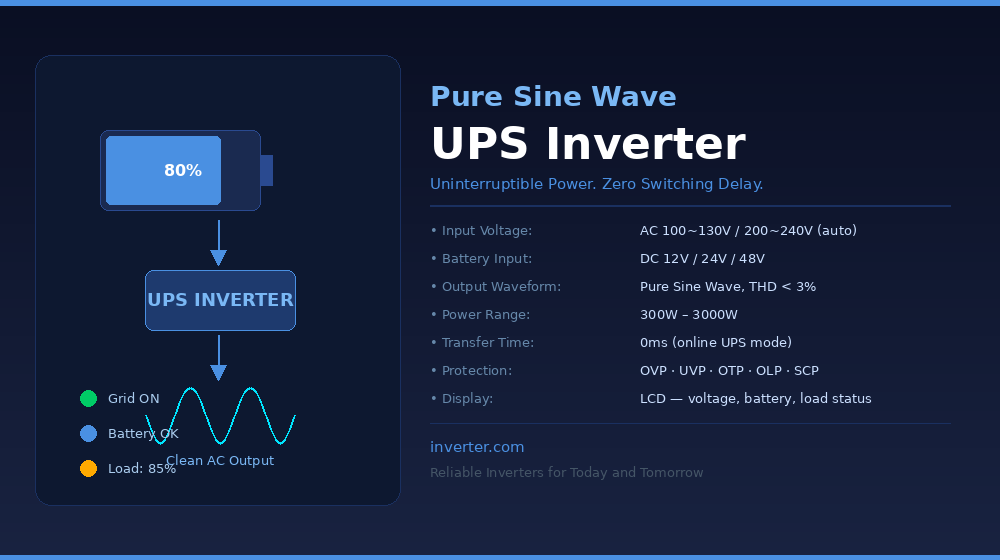
Power outages happen without warning. For most appliances, a brief interruption is a minor inconvenience. For computers, medical equipment, network infrastructure, and home automation systems, even a half-second gap in power can mean lost data, corrupted files, or equipment damage. A pure sine wave UPS inverter solves this problem by maintaining continuous, clean AC output regardless of what happens to the grid.
What Is a UPS Inverter?
A UPS (Uninterruptible Power Supply) inverter combines an inverter, battery charger, and automatic transfer switch in a single unit. When grid power is stable, it charges the connected battery bank while passing utility power through to your load. The moment grid power fails, it switches instantly to battery-backed inverter output — with a transfer time of zero milliseconds in online UPS configurations. Devices never experience an interruption.
The "pure sine wave" distinction matters here more than anywhere else. Medical devices, variable-speed motor drives, and most modern electronics are designed to operate on the smooth sinusoidal waveform produced by utility companies. A pure sine wave UPS inverter replicates that waveform precisely, with total harmonic distortion (THD) typically below 3%. Modified sine wave alternatives can cause overheating, buzzing, and outright failure in sensitive loads.
Input Flexibility: AC Grid + DC Battery
Pure sine wave UPS inverters accept two input sources simultaneously. The AC input (100–130V or 200–240V, depending on region) connects to your utility supply. The DC input — typically 12V, 24V, or 48V — connects to your battery bank. The inverter manages both automatically: charging batteries when grid power is available, drawing from batteries when it isn't.
This dual-input architecture also makes UPS inverters well-suited to solar-plus-storage systems, where the battery bank is charged by solar panels during the day, and the UPS inverter ensures no interruption during evening hours or cloudy periods.
Power Range and Sizing
UPS inverters in the pure sine wave category are available from 300W up to 3000W. Sizing correctly requires knowing your total connected load — add up the wattage of everything that must stay on during an outage — and your desired backup duration, which determines battery capacity.
A 1000W UPS inverter with a 100Ah/24V battery bank, for example, can sustain roughly one hour of full-load operation. Reducing load or increasing battery capacity extends runtime proportionally.
Protection Features
Quality units include a full suite of protections: over-voltage and under-voltage shutoff on both AC and DC inputs, short-circuit protection, overload protection with automatic recovery, over-temperature shutdown with fan-speed control, and battery low-voltage cutoff to prevent deep discharge damage. LCDs showing input voltage, battery status, load percentage, and output frequency are standard on most models.
For the full range of pure sine wave UPS inverters — with factory-direct pricing and free shipping to North America — visit Inverter.com.

 English
 Arabic
 French
 Spanish
 Portuguese
 Deutsch
 Turkish
 Dutch
Dutch
 Italiano
 Romaian
 Portuguese (Brazil)
 Greek
Greek
