


Real vs Fake Reviews: A Simple Guide to Spot the Difference
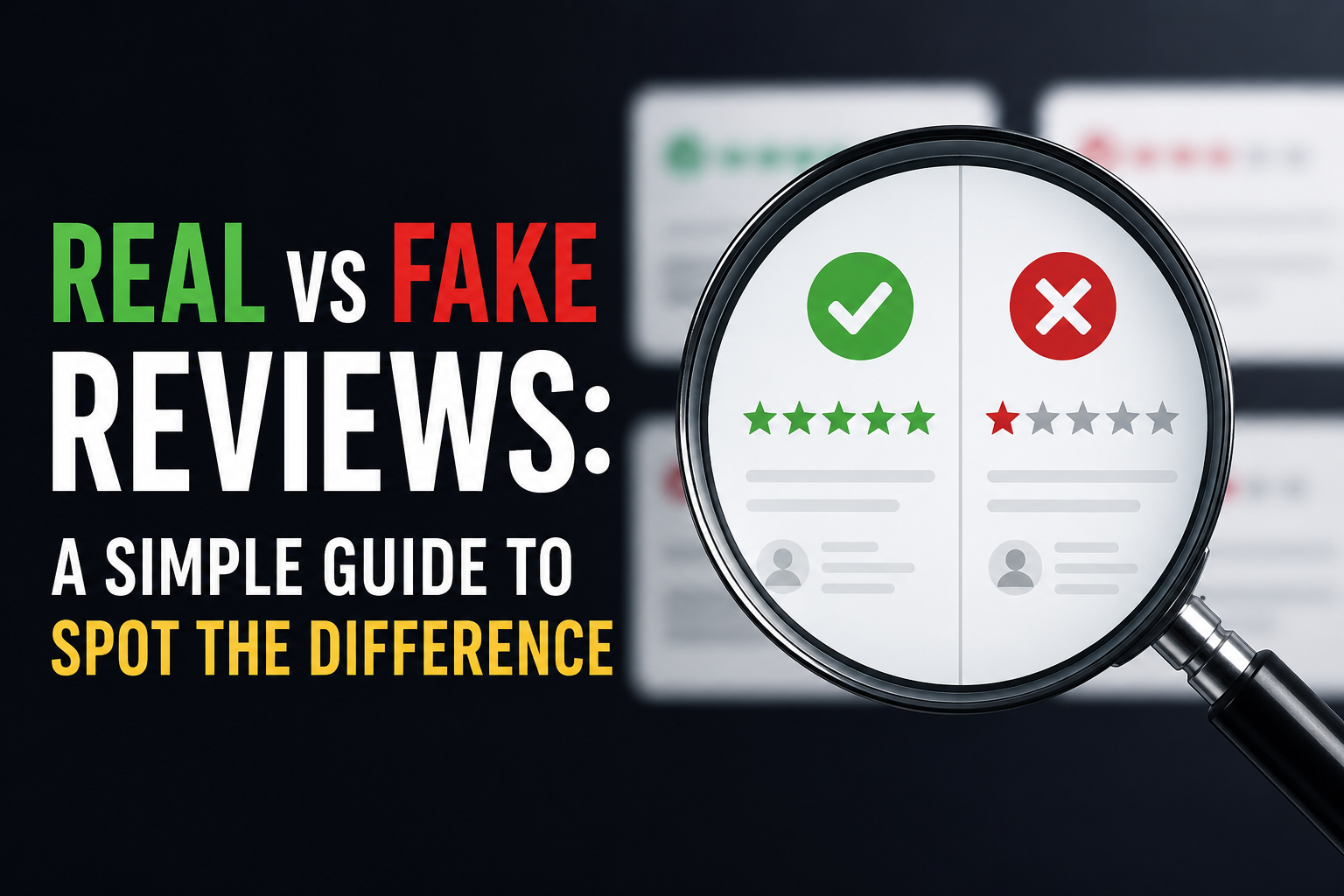
You've been there. You're about to buy something — a hotel room, a blender, a skincare serum — and you scroll through the reviews first. Naturally. But here's the uncomfortable truth: a significant portion of what you're reading may have never come from a real customer.
Online reviews shape billions of purchasing decisions every year. They've replaced word-of-mouth from friends. They've replaced expert opinions. They've become the single most trusted signal in modern commerce. And precisely because of that power, they've become a target for manipulation.
This isn't a cynical take — it's a practical one. Once you know what to look for, spotting a fake review goes from impossible to almost instinctive.
Why Fake Reviews Exist (and Why They're Hard to Remove)
Fake reviews aren’t only something shady operators cook up, nope. A lot of the time, they come from pretty sophisticated networks—review farms, people who are “helpfully” incentivized, rivals who play rough, and yes, AI-generation tools that have been trained to spit out generic admiration that sounds right. One listing on a big platform can end up with like thousands of made-up 5-star reviews propping it up as if nothing happened.
The incentive is pretty clear, really. When the average rating goes up, it usually boosts visibility, gets more clicks, and leads to more sales. A product moving from 3.8 to 4.4 stars can push conversion rates to roughly double. That’s not some small advantage; it’s basically a business lifeline.
Here’s what makes it so hard to police, though. Sites like Amazon, Google, and Yelp rely on algorithmic detection, sure. But those systems are reactive, not predictive. They tend to catch the pattern after it has already been spreading. By the time a fake review cluster gets pulled, it may have already nudged tens of thousands of buyers.
So instead of waiting for the platform to handle it, here’s what you can do yourself.
The Anatomy of a Fake Review
1. It Sounds Like an Ad, Not a Person
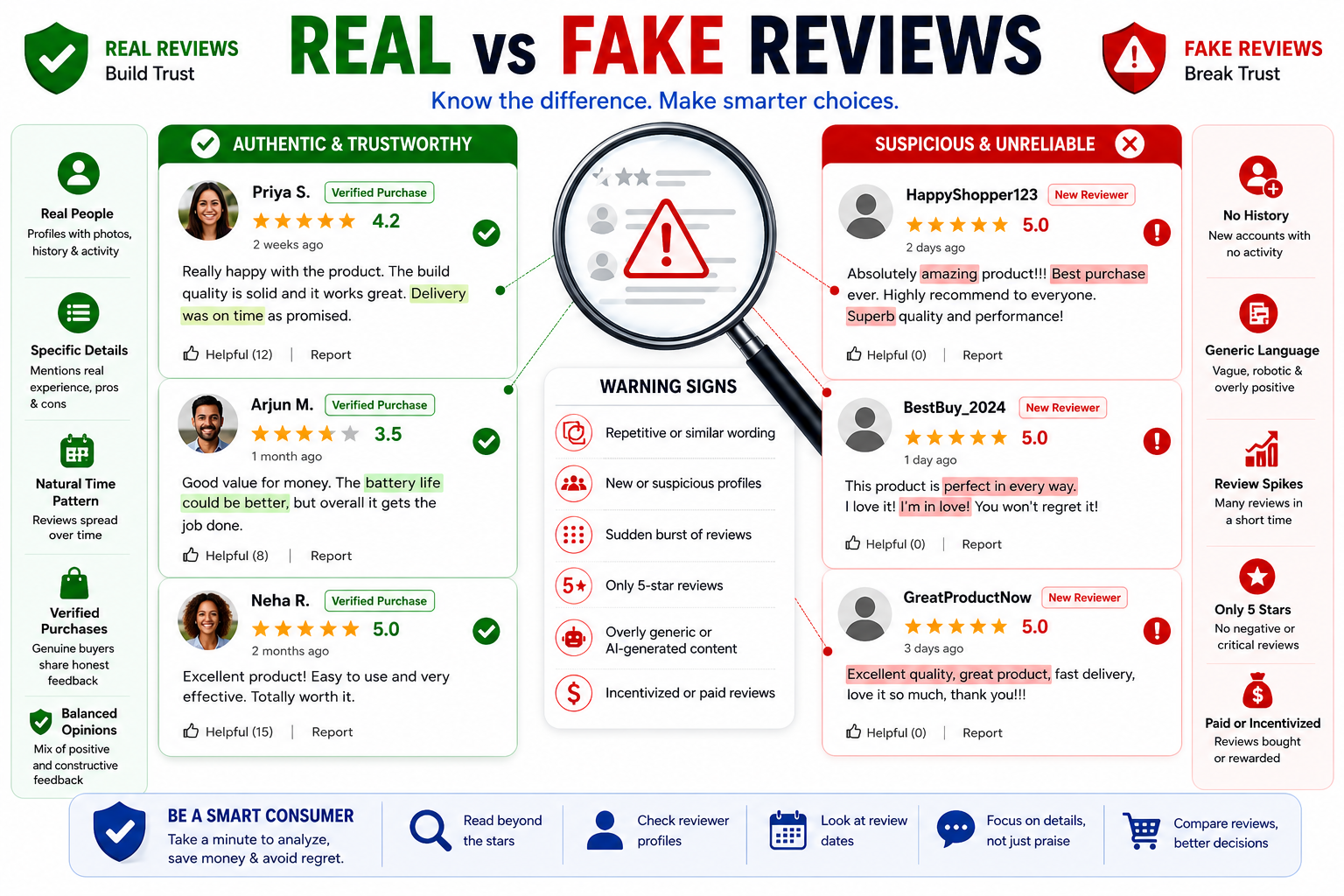
Real customers write like people who have just used a product. They mention specific frustrations, unexpected surprises, or oddly personal details. They use fragmented sentences. They compare to other products they've owned.
Fake reviews usually sound like marketing copy, all smooth and super upbeat, and kinda too complete, you know. Lines like “This product exceeded all my expectations and I would highly recommend it to anyone looking for quality!” feel off, like a siren. Honestly, nobody talks that way after getting a coffee grinder, not unless they’re reading from a script.
Another thing is the lack of real details. A person who actually bought running shoes may say something oddly specific, like the toe box feels narrow, or the insole has this strange smell straight out of the box. But a fake one just stacks compliments: “Comfortable, stylish, great quality. Five stars.”
2. The Timing Clusters Are Suspicious
Pull up the review history of a product (many platforms let you sort by date). If a product receives two or three reviews a month and then suddenly gets 47 reviews in a single week, something is off. Review bombing — whether positive or negative — leaves a fingerprint in the timestamp data.
Newly launched products with hundreds of reviews on day one are another indicator. Organic reviews take time to accumulate. A product that launched last Tuesday shouldn't have 800 reviews with a 4.9-star average unless something artificial is at play.
3. The Reviewer Profile Is Paper-Thin
Click on the reviewer's profile. What else have they reviewed? A real person leaves a scattered, opinionated trail — a three-star hotel review, a complaint about a slow delivery, a rave about their favorite headphones. Fake reviewer accounts tend to show one of two patterns: either they've reviewed nothing else, or they've reviewed dozens of unrelated products in a very short window, all with glowing five-star ratings.
Also, check the profile age. An account created last month with 60 reviews is statistically unlikely for a real human being.
4. The Language Is Oddly Generic (or Oddly Perfect)
AI-generated reviews and template-based fake reviews share a common trait: they're grammatically immaculate but semantically hollow. There's no personality. No humor. No annoyance. No hesitation.
Real reviews have typos. They go off on tangents. They mention a husband's opinion or a kid who wouldn't stop playing with the packaging. That texture of lived experience is very difficult to fake at scale.
Conversely, some fake reviews go the other direction — they misspell the product name, use broken grammar, and feel like they were translated from another language and back again. These are often the lowest-tier, cheapest review farms at work.
5. Verified Purchase Doesn't Mean What You Think
The "verified purchase" badge is reassuring but not foolproof. A common tactic involves buying cheap products at scale to earn the badge, then leaving a paid review. Some operations even sell full "verified purchase" reviews as a premium service.
It's a signal, not a guarantee. Treat it as one data point among many, not the final word.
Where to Look for a More Reliable Signal
Read the 3-star reviews. They're often the most honest. People who give three stars are neither thrilled nor furious — they're balanced. They'll tell you the things that are genuinely good and the things that fell short. This middle ground is where real experience lives.
Use review analysis tools. Services like Fakespot and ReviewMeta analyze review authenticity algorithmically. They're not perfect, but they can surface patterns — such as reviewer grade inflation or unnatural review velocity — that would take you an hour to spot manually.
Look at negative reviews carefully. A real product with real customers will have some one-star reviews that describe specific, plausible failures. If all the negative reviews sound vague or are immediately countered by suspiciously similar five-star rebuttals posted in the same week, treat that as a warning sign.
The Bigger Picture: Trust Is a Skill
Fake reviews aren't going away. If anything, they'll get more sophisticated as generative AI lowers the cost of producing believable text at scale. The arms race between review manipulation and detection is ongoing, and consumers are often the last to benefit from platform improvements.
But critical reading is a muscle. The more you practice looking past the rating number and into the texture of the reviews themselves — the specificity, the timing, the reviewer history, the emotional tone — the harder it becomes to be fooled.
Reviews are a conversation between strangers. Real ones feel like it. Fake ones feel like a brochure.
Learn to tell the difference, and you'll spend less money on things that disappoint you.
The next time a product looks suspiciously perfect, trust that instinct. Then verify it.

 English
 Arabic
 French
 Spanish
 Portuguese
 Deutsch
 Turkish
 Dutch
Dutch
 Italiano
 Russian
 Romaian
 Portuguese (Brazil)
