


Canned Salmon Market to Reach USD 10.7 Billion by 2036
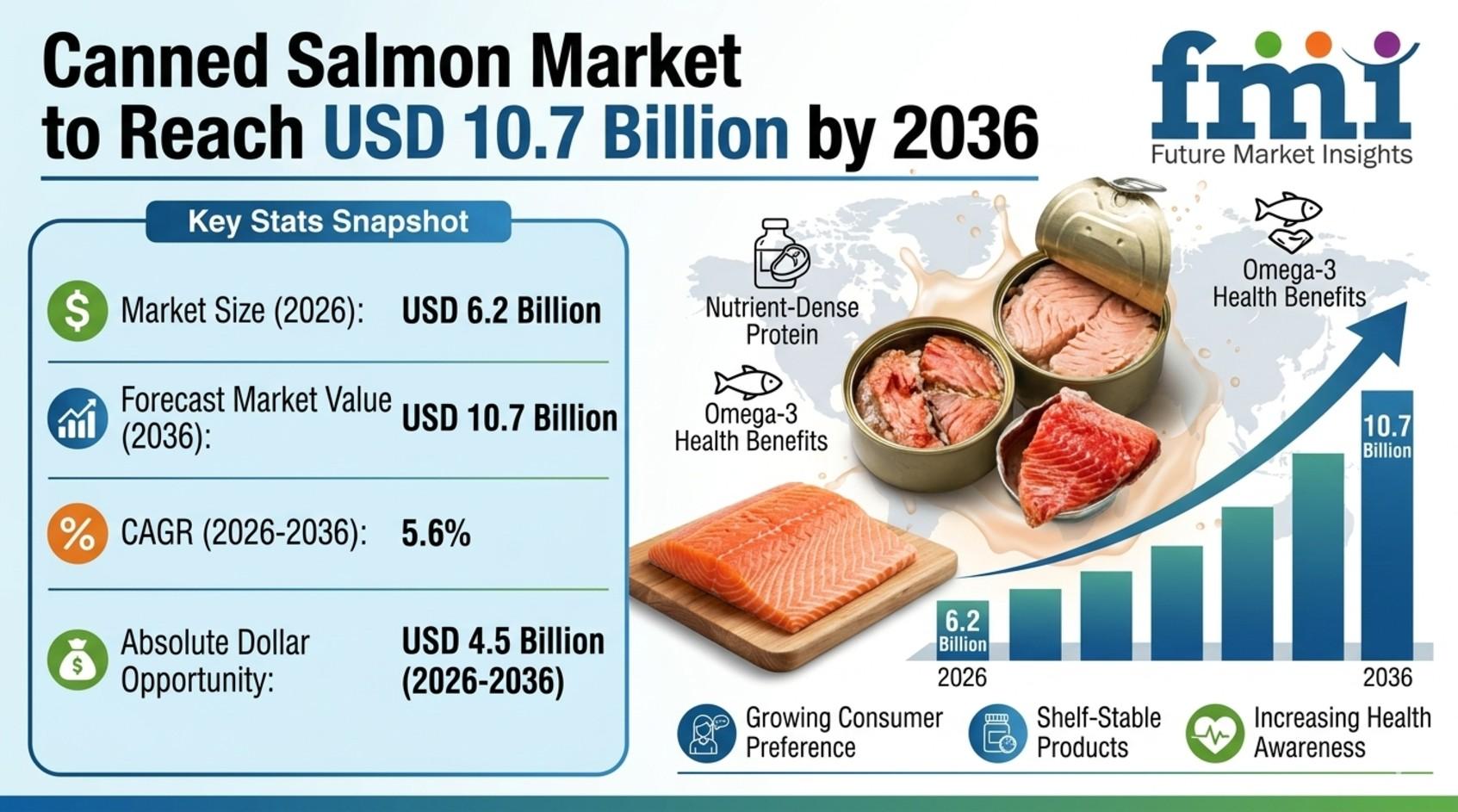
The global canned salmon market is entering a period of sustained expansion, driven by growing consumer preference for nutrient-dense, shelf-stable protein products and increasing awareness of the health benefits associated with omega-3 fatty acids. Valued at USD 6.2 billion in 2026, the market is projected to reach USD 10.7 billion by 2036, registering a CAGR of 5.6% during the forecast period. The industry is expected to generate an absolute dollar opportunity of USD 4.5 billion between 2026 and 2036.
Demand growth is being supported by changing dietary habits, rising adoption of convenient meal solutions, and the expanding role of canned seafood in retail and foodservice applications. Consumers increasingly view canned salmon as a cost-effective source of high-quality protein, vitamin D, and essential omega-3 fatty acids, positioning the category beyond its traditional pantry staple status.
Farmed salmon remains the dominant source segment, accounting for 63% of market share in 2026, while Pacific species continue to lead the species category with a 71% share. Emerging economies, particularly India, are creating significant growth opportunities as urbanization, modern retail expansion, and health-focused consumption patterns strengthen demand for packaged seafood products.
Request a Sample Report : https://www.futuremarketinsights.com/reports/sample/rep-gb-14716
Market Overview
The canned salmon market has evolved from a niche seafood preservation category into an important component of the global health and convenience food industry. Following a market valuation of USD 5.9 billion in 2025, revenues are expected to rise to USD 6.2 billion in 2026 and subsequently reach USD 10.7 billion by 2036.
The sector benefits from a unique value proposition that combines long shelf life, nutritional richness, affordability, and convenience. Unlike fresh seafood, canned salmon eliminates cold-chain dependence prior to opening, making it attractive to both consumers and institutional buyers seeking reliable protein sources.
Increasing global interest in functional nutrition, preventive healthcare, and protein-rich diets has further strengthened the category's appeal. As consumers prioritize foods that deliver measurable health benefits, canned salmon has gained recognition as a practical source of EPA and DHA omega-3 fatty acids, essential nutrients linked to cardiovascular and cognitive health.
Key Growth Drivers
One of the primary drivers shaping market expansion is the growing consumer shift toward health-oriented protein consumption. Rising awareness regarding the nutritional benefits of seafood has encouraged households to incorporate salmon into regular meal planning, particularly in regions experiencing dietary modernization.
The affordability advantage of canned salmon compared to fresh and frozen alternatives is also expanding its consumer base. For budget-conscious households, canned formats provide access to premium seafood nutrition without the price volatility often associated with fresh salmon.
Foodservice operators are increasingly incorporating canned salmon into salads, sandwiches, patties, prepared meals, and institutional catering menus. The product's extended shelf life and ease of storage reduce inventory management challenges while supporting operational efficiency.
Furthermore, expanding online grocery platforms and modern retail networks are improving product accessibility, particularly across emerging economies where seafood consumption patterns continue to evolve.
Technology & Innovation Trends
Innovation is becoming a major differentiator within the canned salmon market. Manufacturers are investing in premium product development, sustainable sourcing certifications, advanced packaging technologies, and convenience-focused formats.
The growing popularity of wild-caught sockeye salmon, smoked salmon variants, and seasoned canned formulations reflects consumer demand for premium seafood experiences. These differentiated offerings enable brands to capture higher margins while appealing to health-conscious and gourmet-oriented buyers.
Packaging innovation is also reshaping consumer engagement. Easy-open cans, retort pouches, and single-serve packaging formats are expanding consumption occasions beyond traditional home cooking. These solutions cater to on-the-go lifestyles, fitness-focused consumers, and snack-oriented eating habits.
Sustainability certifications such as Aquaculture Stewardship Council (ASC) and Marine Stewardship Council (MSC) labels are increasingly influencing purchasing decisions. As consumers become more attentive to environmental impact, certified products are gaining visibility across retail shelves and digital commerce platforms.
Market Challenges & Restraints
Despite positive growth prospects, the industry faces several operational and environmental challenges.
Aquaculture sustainability concerns remain a critical issue. Disease management, feed sourcing practices, environmental impact, and regulatory oversight continue to influence farmed salmon production costs and supply reliability. Since farmed salmon accounts for the majority of canned salmon production, disruptions within aquaculture ecosystems can affect global supply chains.
Wild salmon sourcing presents additional challenges. Seasonal harvest cycles, climate-related ecosystem changes, and fisheries management regulations contribute to fluctuations in raw material availability and pricing.
Furthermore, increasing competition from alternative shelf-stable proteins, including canned tuna, sardines, plant-based proteins, and ready-to-eat meal products, requires manufacturers to continuously differentiate their offerings through quality, nutrition, and sustainability positioning.
Segment Analysis
Source Analysis
Farmed salmon dominates the market, accounting for 63% of total source segment revenues in 2026. Atlantic salmon produced through aquaculture operations in Norway, Chile, Scotland, and Canada provides manufacturers with reliable year-round supply, consistent quality standards, and scalable production volumes.
Wild salmon continues to occupy the premium segment of the market. Species such as sockeye, chum, and pink salmon attract consumers seeking natural sourcing credentials and enhanced flavor profiles. Although supply variability limits market penetration, premium pricing opportunities remain substantial.
Species Analysis
Pacific species represent the largest species segment, commanding 71% market share in 2026. Pink salmon continues to dominate mass-market applications due to affordability, while sockeye salmon drives premium category growth through its distinctive color, texture, and nutritional reputation.
Atlantic species remain closely linked to aquaculture expansion and support large-scale retail and foodservice demand globally.
Form Analysis
Skinless and boneless canned salmon products are experiencing strong adoption due to convenience and ready-to-eat functionality. Chunks remain widely used in salads, sandwiches, and foodservice applications, while premium fillet formats target higher-income consumers and gourmet retail channels.
End-Use Analysis
Household consumption remains the largest end-use segment. Consumers frequently utilize canned salmon for sandwiches, salads, pasta dishes, and home meal preparation. Foodservice and food processing industries are also increasing procurement volumes as demand grows for prepared meals and seafood-based convenience products.
Regional Analysis
India is projected to be the fastest-growing market globally, recording a CAGR of 7.4% through 2036. Urbanization, rising disposable incomes, expanding supermarket networks, and increasing awareness of omega-3 health benefits are supporting category expansion across Tier-1 and Tier-2 cities.
Brazil follows with a CAGR of 6.5%, driven by a large consumer base, growing seafood awareness, and accelerating adoption of convenience foods. Expanding retail infrastructure is further improving product availability nationwide.
China is expected to grow at 6.2% CAGR as rising incomes, health-focused consumption trends, and robust e-commerce ecosystems encourage seafood purchases among urban consumers.
The United States remains a mature yet attractive market, expanding at 5.4% CAGR. Established canned seafood consumption patterns, combined with growing interest in premium wild-caught and sustainably sourced products, continue to support steady growth.
Japan is forecast to grow at 5.1% CAGR, benefiting from deep-rooted seafood consumption traditions and strong consumer emphasis on product quality, origin transparency, and nutritional value.
Competitive Landscape
Competition within the canned salmon market is characterized by integrated seafood supply chains, sustainability initiatives, brand strength, and distribution reach.
Large multinational seafood companies leverage vertically integrated operations spanning aquaculture, processing, packaging, and retail distribution. This integration enables greater control over raw material sourcing, quality consistency, and cost management.
Brand trust remains a critical competitive factor, particularly in premium and health-oriented product categories where consumers place significant importance on food safety, sourcing transparency, and nutritional claims.
Leading Companies Analysis
Thai Union Group maintains a leading position through its global seafood portfolio, extensive manufacturing capabilities, and integrated sourcing network. The company's scale and international retail presence provide significant competitive advantages.
Mowi ASA continues to strengthen its market influence through salmon aquaculture leadership and downstream product diversification. Its investment in certified sustainable products aligns with evolving consumer expectations.
Other influential participants include Marine Harvest, John West, Clover Leaf Seafoods, King Oscar USA, Norsk Seafood, and Stolt-Nielsen. These companies compete across multiple dimensions including product quality, sustainability certifications, geographic reach, and retail partnerships.
Investment & Strategic Developments
Industry participants are increasingly investing in premiumization, sustainability certifications, and product innovation.
In 2025, Thai Union Group introduced a premium wild-caught sockeye salmon range targeting health-conscious consumers in North America and Europe. The initiative reflects growing consumer demand for differentiated seafood offerings with strong nutritional positioning.
During the same year, Mowi ASA launched an ASC-certified canned Atlantic salmon product line designed for European and Asian retail markets. The move underscores the growing importance of sustainability credentials in influencing purchasing behavior and retailer procurement strategies.
Future Outlook
The outlook for the canned salmon market remains highly favorable through 2036. Rising global protein demand, increasing health consciousness, and expanding retail accessibility are expected to sustain long-term growth momentum.
Premium product categories including wild-caught salmon, smoked variants, organic offerings, and single-serve formats are likely to outperform the broader market as consumers seek enhanced convenience and nutritional value.
Emerging markets across Asia-Pacific and Latin America are anticipated to contribute significantly to future revenue growth, supported by urbanization, dietary diversification, and increasing disposable incomes.
Conclusion
The global canned salmon market is undergoing a significant transformation as health, convenience, and sustainability become central purchasing considerations for consumers worldwide. Expected to grow from USD 6.2 billion in 2026 to USD 10.7 billion by 2036, the sector presents substantial opportunities for manufacturers, retailers, and investors.
While supply chain sustainability and raw material availability remain important challenges, ongoing innovation, premiumization, and expanding consumer awareness of omega-3 nutrition are creating a strong foundation for long-term industry growth. Companies capable of balancing quality, sustainability, affordability, and convenience are expected to emerge as the primary beneficiaries of the next decade of market expansion.
Exclusive Discounts on Full Report: https://www.futuremarketinsights.com/reports/canned-salmon-market
Why Choose FMI : https://www.futuremarketinsights.com/why-fmi
Explore More Related Studies Published by FMI Research
Haskap Berry Powder Market : https://www.einpresswire.com/article/903533557/global-haskap-berry-powder-market-valued-at-usd-631-4m-by-2036-as-asia-pacific-vigorous-tech-accelerate-growth
Krill Oil Market : https://www.openpr.com/news/4516966/krill-oil-market-evolves-beyond-premium-supplements-why
Explore In-Depth Food & Beverage Market Insights:
https://www.futuremarketinsights.com/industry-analysis/food-and-beverage
About Future Market Insights (FMI)
Future Market Insights, Inc. (FMI) is an ESOMAR-certified, ISO 9001:2015 market research and consulting organization trusted by global enterprises and Fortune 500 companies. FMI delivers actionable market intelligence, competitive benchmarking, and strategic insights across more than 30 industries and 1,200 markets worldwide.
Contact Us:
Future Market Insights Inc.
Christiana Corporate, 200 Continental Drive,
Suite 401, Newark, Delaware - 19713, USA
T: +1-347-918-3531
For Sales Enquiries: sales@futuremarketinsights.com
Website: https://www.futuremarketinsights.com

 English
 Arabic
 French
 Spanish
 Portuguese
 Deutsch
 Turkish
 Italiano
 Russian
 Romaian
 Portuguese (Brazil)
 Greek
Greek
