


Bio-Based Polypropylene Market Forecast and 22.67% CAGR Analysis Through 2033
The global Bio-Polypropylene Industry is experiencing rapid expansion, driven by increasing environmental awareness, growing regulatory support for sustainable materials, and rising demand for low-carbon alternatives to conventional plastics. Bio-polypropylene offers the performance characteristics of traditional polypropylene while reducing dependence on fossil-based feedstocks, making it an attractive solution for packaging, automotive, consumer goods, and industrial applications.
According to prevailing industry research and market intelligence, the global Bio-Polypropylene Market is projected to grow from US$ 39 million in 2025 to US$ 200 million by 2033. The market is expected to register a CAGR of 22.67% during the forecast period from 2026 to 2033.
As major Original Equipment Manufacturers (OEMs) in the automotive sector, fast-moving consumer goods (FMCG) brands, and packaging giants seek to decarbonize their supply chains, bio-polypropylene has emerged as a premium, highly sought-after material. Significant capital is currently flowing into the development of advanced biorefineries and novel catalytic processes capable of converting biomass, used cooking oils, and starch into high-purity polymer-grade propylene.
What Is Bio-Polypropylene?
Bio-polypropylene is a type of bioplastic synthesized from renewable organic resources rather than traditional petroleum or shale gas feedstocks. The base raw materials typically include first-generation feedstocks like sugarcane, corn, and starch, as well as second-generation advanced feedstocks such as waste cooking oils, agricultural residues, and forestry waste.
Crucially, bio-polypropylene is considered a "drop-in" polymer. This means its chemical structure, thermal resistance, durability, and processing characteristics are virtually identical to conventional petrochemical-based polypropylene. Manufacturers can seamlessly integrate Bio-PP into their existing injection molding, sheet extrusion, and blown film machinery without making costly modifications to their production lines. By utilizing Bio-PP, companies can reduce the lifecycle CO₂ emissions of their plastic components by up to 60–70%.
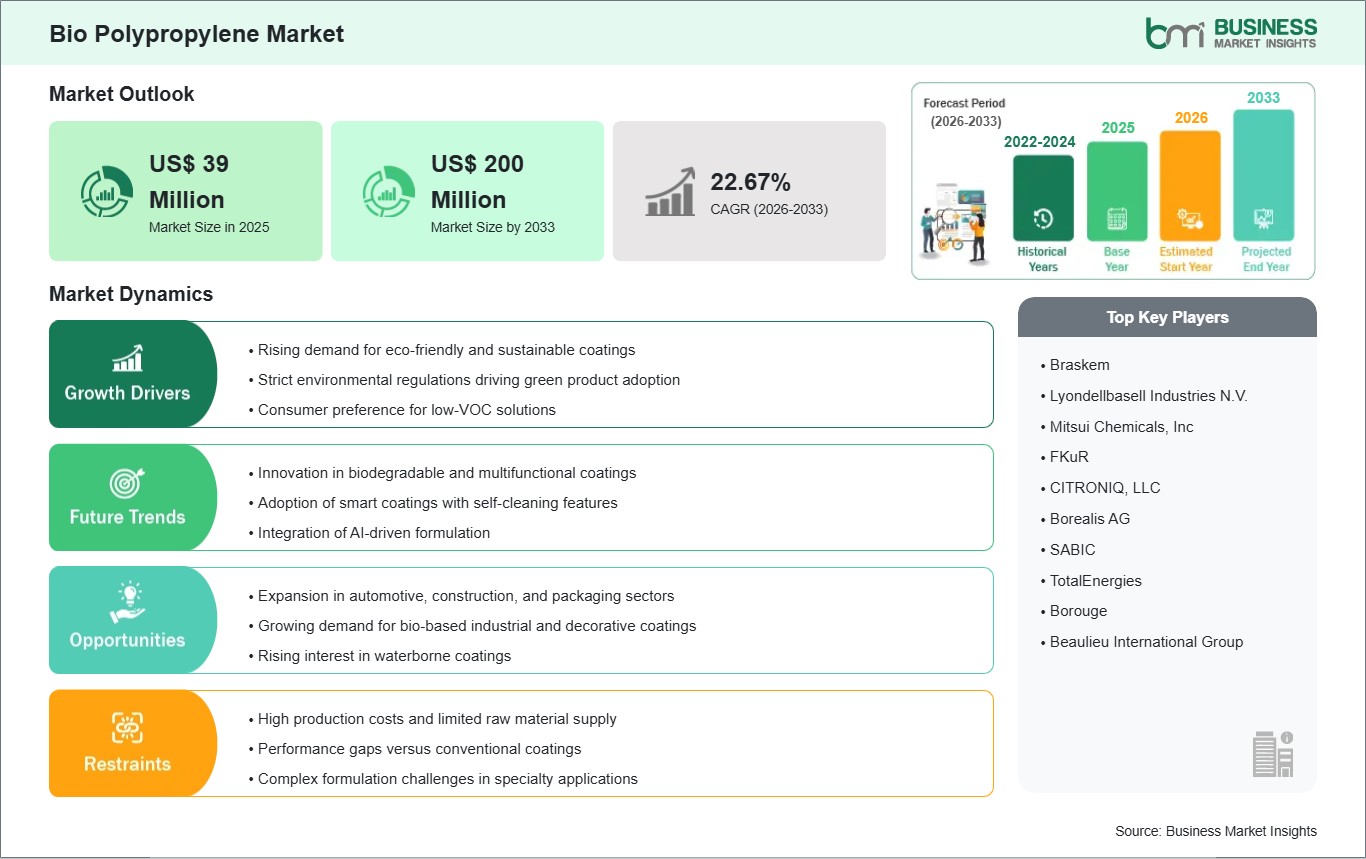
Download Sample Report: https://www.businessmarketinsights.com/sample/BMIPUB00033321
Market Drivers
The foremost driver accelerating the Bio-Polypropylene Market is the Surging Demand for Sustainable and Circular Packaging Solutions. Driven by bans on single-use petrochemical plastics and consumer backlash against plastic pollution, global food, beverage, and cosmetics brands are rapidly transitioning to bio-based packaging. Bio-PP provides the necessary moisture barrier, heat resistance, and chemical stability required for food-grade containers, closures, and flexible films, all while aligning with circular economy principles.
Another major market catalyst is the Automotive Industry’s Push for Lightweighting and Decarbonization. Modern vehicles rely heavily on polypropylene for bumpers, dashboards, interior trims, and battery casings. As automakers strive to meet stringent global emission standards, utilizing lightweight Bio-PP not only improves vehicle fuel efficiency (or EV battery range) but also significantly lowers the "Scope 3" carbon footprint of the manufacturing process itself.
Furthermore, Stringent Government Regulations and Tax Incentives are actively shaping the market landscape. Regulatory frameworks in regions like Europe such as the Green Deal and advanced carbon taxes penalize fossil-based plastics while heavily subsidizing the research, development, and scaling of biopolymer infrastructure, thereby artificially shrinking the price gap between conventional and bio-based polypropylene.
Market Segmentation
By Source Feedstock
- Edible & Non-Edible Oils (Currently holds a dominant share due to the established mass-balance supply chains and the utilization of used cooking oils and industrial residues).
- Starch & Sugarcane (A rapidly growing segment favored for its high yield, scalability, and straightforward fermentation into bio-ethanol and subsequently bio-propylene).
- Lignocellulosic Biomass (Emerging as the future of the industry, as it avoids the "food vs. fuel" debate by utilizing agricultural and timber waste).
By Production Process
- Melt Mass Polymerization (MMP) (The most widely adopted method, ensuring high-volume production with excellent polymer consistency).
- Gas Phase Polymerization (Utilized for specialized grades requiring unique molecular weight distributions).
By Application
- Packaging (The dominant segment, utilizing extruded films and rigid containers for food, cosmetics, and medical supplies).
- Automotive (The second-largest segment, heavily reliant on Bio-PP for interior and exterior lightweight molded components).
- Consumer Goods (Includes electronics casings, household appliances, and eco-friendly toys).
- Textiles & Medical Devices (Growing demand for bio-based non-woven fabrics and sterile medical equipment).
Regional Insights
- Europe currently leads the global market. The region’s dominance is underpinned by aggressive environmental policies, the European Commission’s circular economy initiatives, and heavy investments in bio-refining infrastructure in countries like Germany, France, and the Netherlands.
- Asia-Pacific is projected to be the fastest-growing region. Rapid industrialization, expanding automotive manufacturing hubs in China and India, and a growing middle class demanding eco-friendly consumer goods are driving immense volume growth.
- North America holds a substantial share, fueled by strong corporate sustainability pledges from US-based multinational FMCG brands and increasing federal support for bio-manufacturing infrastructure.
- Rest of the World (including South America) plays a vital role in the upstream supply chain, with countries like Brazil serving as primary hubs for sugarcane-based feedstock and early-stage bio-polymerization.
Top Players in the Industry
The competitive landscape features a blend of traditional petrochemical giants pivoting to green solutions and specialized biochemical innovators utilizing mass-balance approaches.
- Braskem S.A.
- LyondellBasell Industries N.V.
- Borealis AG
- Neste Oyj
- Mitsui Chemicals, Inc.
- TotalEnergies SE
- SABIC
- Biobent Polymers
- Global Bioenergies
Strategic Industry Challenges
Despite its incredible potential, the Bio-Polypropylene market faces significant hurdles. The most pressing challenge is the High Cost of Production. Bio-PP currently trades at a premium compared to its heavily subsidized, scale-optimized petrochemical counterpart. Additionally, supply chain constraints regarding the consistent availability of high-quality, second-generation feedstocks (like waste oils) present bottlenecks to rapid capacity expansion. Finally, scaling up proprietary biochemical conversion technologies from pilot plants to global commercial-scale refineries requires massive, risk-heavy capital expenditure.
Future Market Outlook
The future of the Bio-Polypropylene Market is exceptionally bright. Over the next decade, as production capacities scale up and economies of scale are realized, the price premium on Bio-PP is expected to compress. Innovations in advanced recycling and the chemical synthesis of municipal solid waste into bio-polymers will further decouple plastic production from fossil fuels. Ultimately, Bio-PP is poised to transition from a niche, premium sustainability product into a foundational commodity of the 21st-century manufacturing economy.
Frequently Asked Questions (FAQs)
Is Bio-Polypropylene biodegradable?
No. While bio-polypropylene is made from renewable biological resources, it is chemically identical to conventional polypropylene. This makes it highly durable and 100% recyclable, but it does not easily biodegrade in natural environments.
Why do companies prefer Bio-Polypropylene over other bioplastics like PLA?
Bio-PP is a "drop-in" plastic, meaning it has the exact same thermal and mechanical properties as traditional plastic. Manufacturers do not need to buy new machinery or alter their product designs to use it, unlike PLA which behaves differently under heat and stress.
What is the "Mass Balance" approach used in this industry?
The mass balance approach is a certified accounting method that allows manufacturers to mix bio-based feedstocks with fossil feedstocks in existing massive chemical plants, tracking and allocating the "green" molecules to specific final products, accelerating the transition without building entirely new facilities.
Browse More Reports:
Surface Protection Tapes Market
About Us
Business Market Insights is a market research platform that provides subscription service for industry and company reports. Our research team has extensive professional expertise in domains such as Aerospace & Defense; Automotive & Transportation; Electronics & Semiconductor; Energy & Power; Healthcare; Manufacturing & Construction; Food & Beverages; Chemicals & Materials; and Technology, Media, & Telecommunications.
Contact Us
If you have any questions about this report or would like further information, please contact us:
Contact person: Ankit Mathur
Email: sales@businessmarketinsights.com
Phone: +16467917070

 Arabic
 French
 Spanish
 Portuguese
 Deutsch
 Turkish
 Dutch
Dutch
 Italiano
 Russian
 Romaian
 Portuguese (Brazil)
 Greek
Greek
