


Automated vs Human Replies: Who Responds Better to Customer Reviews?
When a customer leaves a review — glowing, scathing, or somewhere in the middle — the clock starts ticking. How a business responds in that window can build loyalty, repair damage, or reveal exactly how much it values the people it serves. Today, businesses face a genuine fork in the road: let automation handle the response, or trust a human to craft one.
The answer is more nuanced than most advice columns let on.
The Stakes Are Higher Than You Think
Review responses are not administrative housekeeping. They are public-facing conversations — and the numbers make this impossible to ignore.
Around 93% of consumers say online reviews influence their purchase decisions, and the average shopper spends close to 14 minutes reading reviews before deciding whether to trust a business. But here's the stat that should stop every business owner in their tracks: people spend up to 49% more money at businesses that reply to reviews than at ones that stay silent. That figure reframes the entire debate. Responding isn't just good manners — it is directly tied to revenue.
Every reply to a Google review, a Trustpilot comment, or an App Store rating is visible to the next potential customer scrolling through. And yet, only about 5% of businesses actually respond to their online reviews. That gap between what customers expect and what they receive is one of the most overlooked competitive advantages in modern marketing.
What Automation Gets Right
Let's be fair to automation, because it does several things genuinely well.
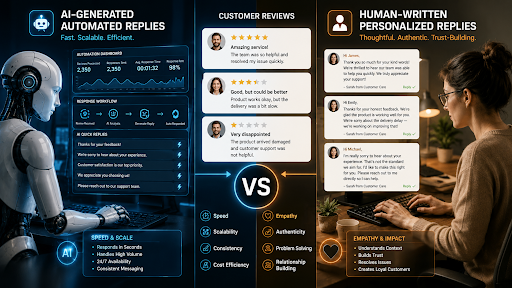
Speed is its undeniable superpower. AI-powered tools and template systems can respond to a review within minutes of it being posted — often outside of business hours when no human is at a desk. This matters more than most people realise: 53% of consumers expect a response to a negative review within a week, and one in three expects a reply within 72 hours. For high-volume businesses — a national retail chain, a busy restaurant group, a SaaS product with tens of thousands of users — manually responding to every review is simply not feasible. Automation fills that gap.
Consistency is another advantage. Automated systems don't have bad days. They don't respond curtly when stressed or forget to include a key piece of brand messaging. When working correctly, they maintain a reliable tone, hit the right compliance notes, and never accidentally say something that ends up screenshotted and shared.
For positive reviews, especially in the standard "thanks so much, we loved having you!" territory, automation is largely adequate. The emotional stakes of a five-star reply are lower, and customers don't typically expect literary craft in return for a five-star rating.
Where Automation Falls Flat
The problem surfaces the moment things get complicated — and complicated is exactly when it matters most.
Negative reviews are where automated responses genuinely struggle, and where the consequences of getting it wrong are most visible. A single unaddressed negative review can drive away up to 30 out of 50 potential customers. A template reply to a complaint about cold food, rude service, or a billing error can feel dismissive, even insulting, to a customer who took time to articulate a real grievance.
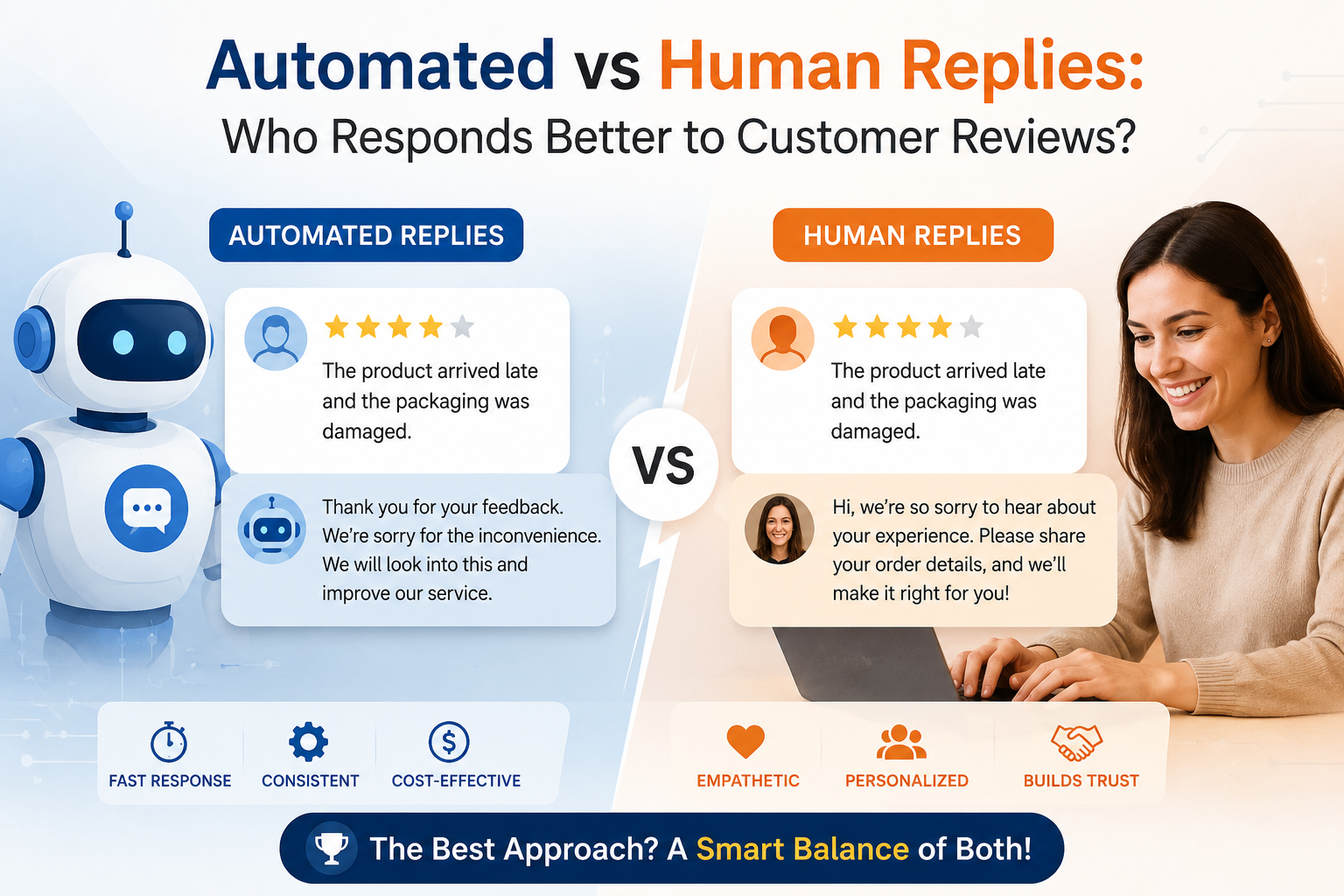
Consider the difference between these two responses to the same one-star review:
"We're sorry to hear about your experience. Customer satisfaction is our top priority, and we'd love the chance to make things right. Please reach out to support@company.com."
vs.
"We're genuinely embarrassed by what happened on your visit, and you're right to be frustrated. This isn't how we operate. I've flagged your feedback directly to our kitchen manager and would really like to talk to you personally about what we can do. Can you drop us a message?"
The first reads like it was generated. Because it probably was. The second reads like a person took a breath, felt some accountability, and responded. That difference lands harder than most businesses realise — and 50% of consumers say generic or templated review responses actively put them off.
Research published in 2026 reinforces this further. A controlled study comparing AI-generated and human-written replies to negative reviews found that human replies elicit greater trust than AI replies under standard conditions, largely because they are perceived as more authentic and more persuasive. The study found AI could match human trust levels only when responses were structured around analytical reasoning — a very specific mode that most automated tools don't default to.
Nuance is the fundamental limitation of automation. A customer who leaves a review that is 60% praise and 40% critique requires a response that acknowledges both — in the right proportion, in the right order, with the right emotional register. That is genuinely difficult to automate without it feeling clunky or tone-deaf.
What Human Responses Do Better
Humans are better at reading subtext. A reviewer who writes "I suppose the food was fine" is not satisfied. A reviewer who says "the manager was very helpful" in an otherwise negative review may be signalling something worth addressing carefully. Human respondents catch these signals and adapt.
Human responses are also better at personalisation that matters. Referencing a specific detail from the review — the name of a dish, the occasion someone mentioned, a precise issue they described — signals genuine reading and genuine care.
There's also the matter of repairing the relationship. 33% of customers who receive a response to a negative review go on to update their rating or return to the business. That's not a marginal recovery rate — that's one in three unhappy customers converted back through nothing more than a thoughtful reply. And 56% of consumers say they changed their overall opinion of a business based on how it responded to a review. Automation rarely achieves this because the emotional attunement required is simply too complex for current tools.
The business case for human-led responses is also reflected in the broader revenue picture. Harvard Business Review research found that a single-star improvement in a business's rating can increase revenue by up to 9%. Businesses that respond to at least 25% of their reviews average 35% more revenue than those that don't engage at all. And per SurveyMonkey's 2025 CX study, 79% of Americans still strongly prefer interacting with a human over an AI agent in service contexts — a preference that holds even when speed and quality are equivalent.
The Smarter Framework: Hybrid by Design
The businesses getting this right aren't picking a side — they're building a system.
A practical approach uses automation as a first filter and triage tool, with humans making the meaningful calls. Auto-responses for five-star reviews keep response rates high without draining resources. Anything below four stars, anything mentioning a specific complaint, or anything with emotional language gets routed to a human before a response goes live.
Some tools now offer AI-drafted responses that a human reviews and edits before sending — combining speed with authenticity. This middle path is increasingly the standard for customer-centric brands, and the results reflect it. One multinational bank that deployed exactly this hybrid model — AI handling transactional queries, humans managing complex interactions — saw a 94% reduction in wait times and a Net Promoter Score that climbed from 23 to 63 within months.
The Bottom Line
Automation responds faster. Humans respond better — when it counts.
The smarter question isn't which to use, but when to use each. A blanket automation policy leaves your most upset customers feeling talked at by a chatbot. A fully manual approach leaves volume unmanaged and response times lagging. The businesses building real loyalty through review responses are the ones treating them as what they actually are: not a checkbox, but a conversation.
With three in four businesses currently not replying to negative reviews at all, the bar for standing out is low. In a world where customers have more choices and less patience, that conversation might be the most underrated marketing you do all week.
Have a view on how your business handles review responses? The right system isn't one-size-fits-all — and getting it wrong is more visible than most brands realise.

 English
 Arabic
 French
 Portuguese
 Deutsch
 Turkish
 Dutch
Dutch
 Italiano
 Russian
 Romaian
 Portuguese (Brazil)
 Greek
Greek
