


Body in White (BIW) Market Size, Share and Forecast to US$ 136.78 Billion by 2033
The Body in White industry is undergoing significant modernization globally, supported by increasing investments in electric vehicle platforms, smart manufacturing facilities, and lightweight automotive engineering. Automakers are adopting advanced BIW technologies to enhance structural integrity, improve energy efficiency, and reduce overall vehicle emissions.
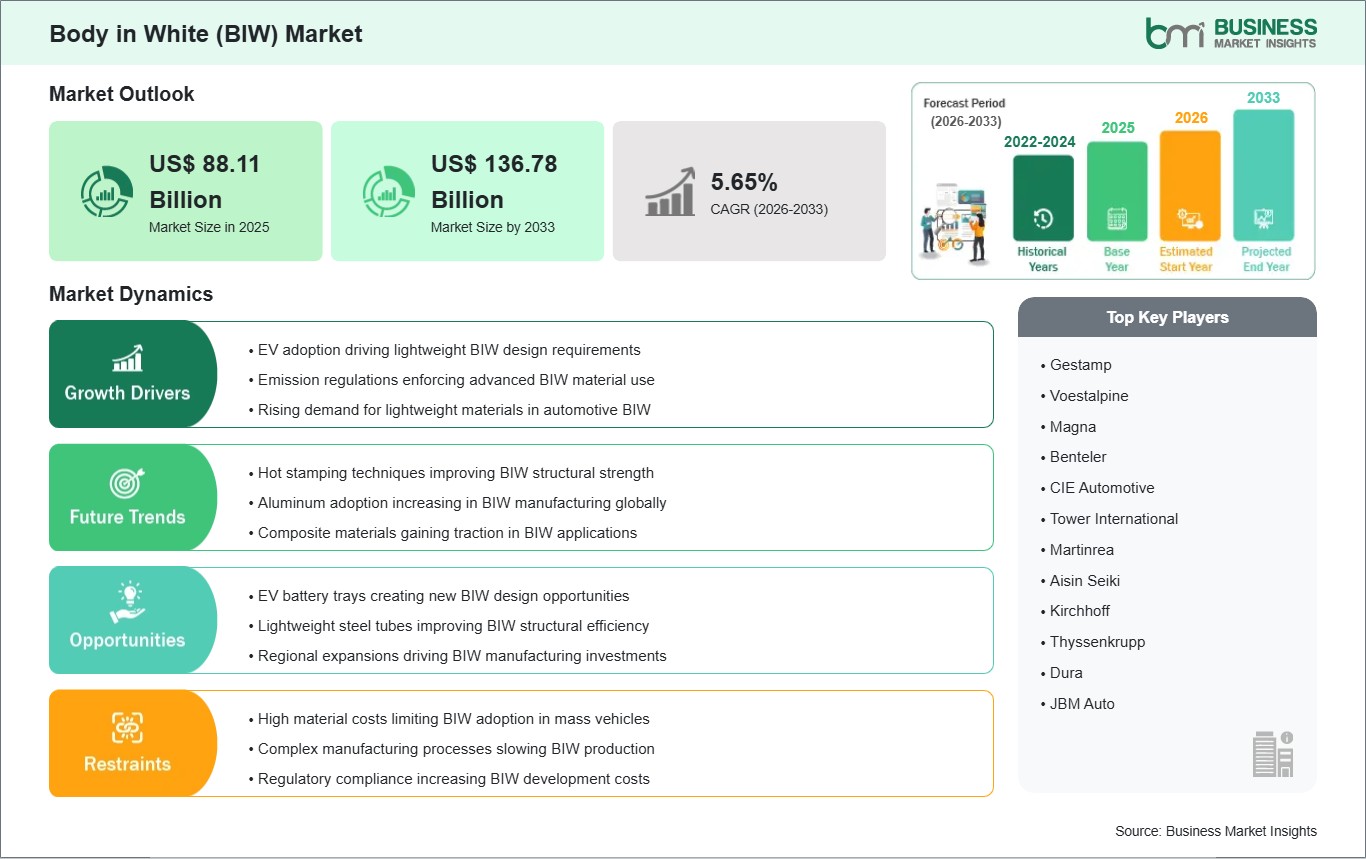
According to Business Market Insights, the global Body in White (BIW) Market is expected to increase from US$ 88.11 billion in 2025 to US$ 136.78 billion by 2033. This growth reflects a projected CAGR of 5.65% during the 2026–2033 forecast period.
Automotive manufacturers are increasingly utilizing advanced high-strength steel (AHSS), aluminum, magnesium, and carbon fiber-reinforced plastics (CFRP) to improve vehicle performance, safety, and energy efficiency. Industry analyses indicate that the BIW market continues to expand as automakers prioritize weight reduction and structural optimization strategies.
BIW structures account for a significant portion of vehicle weight and directly impact crashworthiness, durability, fuel efficiency, and manufacturing costs. The growing shift toward electric mobility is accelerating innovation in BIW design as manufacturers seek to balance battery weight with lightweight structural solutions.
Download Sample Report: https://www.businessmarketinsights.com/sample/BMIPUB00035352
What Is Body in White (BIW)?
Body in White (BIW) refers to the stage in automotive manufacturing where the vehicle body structure has been assembled through welding, riveting, bonding, and fastening processes but has not yet undergone painting or installation of moving parts such as doors, engines, trim, or electronics.
The BIW structure includes floor panels, side panels, pillars, roof systems, cross members, and reinforcement components that collectively provide structural rigidity, occupant safety, and dimensional stability. Modern BIW systems increasingly incorporate mixed-material construction techniques to reduce weight while maintaining strength and crash performance.
Market Drivers
A primary growth driver for the Body in White Market is the increasing demand for lightweight vehicles. Governments worldwide are implementing stringent fuel economy and emissions regulations, compelling automakers to reduce vehicle weight through advanced BIW materials and manufacturing processes.
The rapid expansion of electric vehicle production is another major factor accelerating market growth. EV manufacturers require lightweight BIW structures to offset battery weight and maximize vehicle range while maintaining high safety standards. This has significantly increased demand for aluminum-intensive and multi-material body architectures.
Advancements in hot stamping, laser welding, roll forming, and robotic manufacturing technologies are further improving BIW production efficiency. These innovations enable manufacturers to create stronger, lighter, and more complex body structures while reducing production costs and improving quality consistency.
Increasing consumer demand for safer vehicles is also encouraging automakers to invest in advanced BIW designs that enhance crash protection, structural integrity, and occupant safety performance.
Market Segmentation
By Material Type
- Steel
- Aluminum
- Magnesium
- Carbon Fiber Reinforced Plastic (CFRP)
- Others
By Construction Type
- Monocoque
- Frame Mounted
By Manufacturing Method
- Cold Stamping
- Hot Stamping
- Roll Forming
- Other Methods
By Vehicle Type
- Passenger Cars
- Light Commercial Vehicles
- Heavy Commercial Vehicles
- Electric Vehicles
Regional Insights
- Asia-Pacific dominates the Body in White Market due to high automotive production volumes, rapid EV manufacturing expansion, and strong investments in advanced automotive manufacturing technologies across China, Japan, South Korea, and India.
- Europe maintains a significant market share owing to stringent emissions regulations, widespread adoption of lightweight materials, and strong presence of premium automotive manufacturers.
- North America is witnessing steady growth driven by increasing electric vehicle adoption, investments in automotive innovation, and growing demand for fuel-efficient vehicles.
- Latin America is experiencing gradual market expansion supported by automotive production growth and manufacturing modernization initiatives.
- Middle East & Africa presents emerging opportunities as automotive assembly operations and industrial investments continue to expand.
Top Players in the Industry
The Body in White Market is highly competitive, with automotive manufacturers and material suppliers focusing on lightweight construction, advanced manufacturing processes, and vehicle electrification strategies.
- Toyota Motor Corporation
- Volkswagen AG
- BMW AG
- Ford Motor Company
- General Motors Company
- Hyundai Motor Group
- Stellantis N.V.
- Mercedes-Benz Group AG
- Tesla Inc.
- Honda Motor Co., Ltd.
Strategic Industry Challenges
Despite strong growth prospects, the Body in White Market faces challenges related to high manufacturing costs, material complexity, and supply chain constraints. Advanced lightweight materials such as aluminum and carbon fiber composites can significantly increase production expenses compared to traditional steel-based structures.
Additionally, integrating multiple materials within a single vehicle architecture requires specialized joining technologies and manufacturing expertise, increasing production complexity. Automotive manufacturers must balance cost efficiency with performance and sustainability requirements to remain competitive.
Future Market Outlook
The future of the Body in White Market remains highly promising as vehicle electrification, lightweighting initiatives, and advanced manufacturing technologies continue to reshape the automotive industry. The increasing use of mixed-material architectures, AI-driven manufacturing systems, and automated production lines is expected to drive significant innovation throughout the forecast period.
As electric vehicles become mainstream and regulatory requirements for emissions reduction become stricter, demand for lightweight, durable, and highly optimized BIW structures will continue to grow. Future developments in advanced materials, digital manufacturing, and sustainable production processes are expected to strengthen the market's long-term growth trajectory.
Frequently Asked Questions (FAQs)
What is Body in White (BIW)?
BIW refers to the assembled vehicle body structure before painting and installation of components such as engines, interiors, and electronics.
What is driving growth in the Body in White Market?
Key drivers include vehicle lightweighting initiatives, increasing electric vehicle production, stringent emissions regulations, and advancements in manufacturing technologies.
Which material is most commonly used in BIW manufacturing?
Steel remains the dominant material, although aluminum, magnesium, and CFRP are gaining adoption due to their lightweight properties.
Which region dominates the market?
Asia-Pacific leads the market due to its large automotive manufacturing base and rapidly growing electric vehicle production.
Browse More Reports:
Last Mile Delivery Commercial Vehicle Market
Express Air Cargo Services Market
Europe Air Cargo Services Market
South and Central America Air Cargo Services Market
About Us
Business Market Insights is a market research platform that provides subscription service for industry and company reports. Our research team has extensive professional expertise in domains such as Aerospace & Defense; Automotive & Transportation; Electronics & Semiconductor; Energy & Power; Healthcare; Manufacturing & Construction; Food & Beverages; Chemicals & Materials; and Technology, Media, & Telecommunications.
Contact Us
If you have any questions about this report or would like further information, please contact us:
Contact person: Ankit Mathur
Email: sales@businessmarketinsights.com
Phone: +16467917070

 English
 Arabic
 French
 Portuguese
 Deutsch
 Turkish
 Dutch
Dutch
 Italiano
 Russian
 Romaian
 Portuguese (Brazil)
 Greek
Greek
