


Best Sudoku Strategies for Beginners and Advanced Players
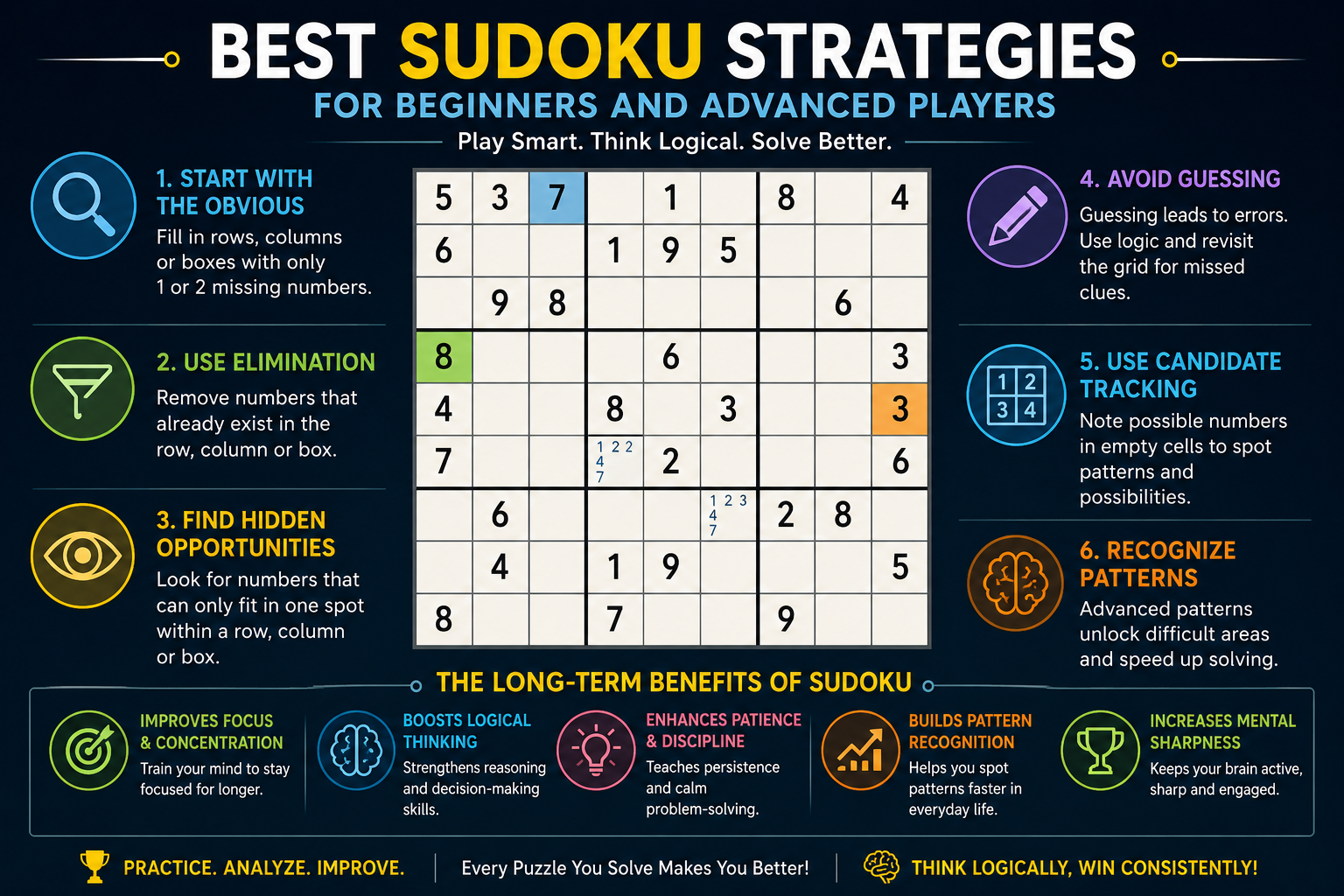
Sudoku looks simple at first glance. A grid, a few numbers, and one goal: fill every empty space correctly. Yet anyone who has spent time with a challenging puzzle knows that Sudoku is much more than placing numbers randomly. It is a game of observation, logic, patience, and strategy.
One reason Sudoku Puzzle has remained popular worldwide is that players never stop learning. Beginners discover basic techniques that help them complete their first puzzles, while experienced players continuously refine their methods to tackle more difficult grids. Understanding the right Sudoku strategies can make the experience both more enjoyable and more rewarding.
Why Strategy Matters in Sudoku
Many new players approach Sudoku by guessing whenever they get stuck. While this may occasionally lead to a correct answer, it often creates mistakes that become difficult to fix later.
Successful Sudoku players rely on logic rather than luck. Every number placed in a Sudoku grid should have a reason behind it. Developing this mindset helps players solve puzzles more efficiently and reduces frustration.
People often search for how to solve Sudoku faster, but speed is usually the result of strong logical habits rather than rushing through a puzzle. The better your strategy, the faster solutions naturally appear.
Start With the Obvious Numbers
For beginners, the best starting point is to scan the puzzle for rows, columns, or boxes that already contain several numbers.
When only one or two numbers are missing from a section, finding the correct placement becomes much easier. This simple technique helps build confidence while introducing the logic that makes Sudoku work.
Many experienced players still begin every puzzle this way. Although advanced methods exist, identifying obvious placements remains one of the most effective Sudoku solving techniques.
Instead of trying to solve the entire puzzle at once, focus on small opportunities. Every correct number creates new possibilities elsewhere in the grid.
Use the Process of Elimination
One of the most valuable skills in Sudoku is learning what cannot go in a particular cell.
Imagine an empty square where several numbers seem possible. By examining the row, column, and box connected to that square, you can eliminate numbers that already exist in those areas.
As the list of possibilities becomes smaller, the correct answer often becomes clear.
This method may seem slow initially, but it trains the brain to think logically rather than relying on guesswork. Over time, players become much faster at recognizing elimination patterns.
Look for Hidden Opportunities
After completing the easy placements, many players believe they have reached a dead end. In reality, the puzzle is often providing clues that are not immediately obvious.
For example, a number may only fit in one specific position within a 3×3 box, even though several cells appear empty. Finding these hidden placements requires careful observation.
This is where Sudoku becomes a true exercise in logical reasoning.
Many players searching for Sudoku tips for beginners overlook the importance of slowing down and studying the puzzle carefully. Often, the solution is already visible; it simply requires a different perspective.
Avoid Random Guessing
One habit that separates experienced players from beginners is the ability to resist guessing.
Guessing may feel tempting when progress slows down, but it often creates a chain of errors that damages the puzzle's logical structure.
Instead of making assumptions, revisit the grid and examine sections you may have overlooked. A missed clue is usually hiding somewhere on the board.
The most satisfying Sudoku solutions come from discovering answers through logic rather than chance.
Advanced Players Should Focus on Candidate Tracking
As puzzle difficulty increases, keeping track of possible numbers becomes increasingly important.
Many advanced players use small pencil marks or mental notes to record candidates for empty cells. This technique provides a clearer view of the puzzle and reveals relationships between different sections.
When several cells share the same limited possibilities, patterns begin to emerge. These patterns often unlock areas that previously seemed impossible to solve.
Candidate tracking is one of the reasons skilled players can handle difficult puzzles that appear overwhelming to beginners.
Learn to Recognize Patterns
Experienced Sudoku enthusiasts rarely solve puzzles one cell at a time. Instead, they look for larger patterns across rows, columns, and boxes.
Pattern recognition develops naturally through practice. The more puzzles you solve, the easier it becomes to identify familiar situations and apply appropriate solutions.
This skill is also one reason Sudoku is frequently associated with logical thinking skills. The brain gradually becomes better at spotting connections, evaluating possibilities, and making reasoned decisions.
Over time, players spend less energy searching and more energy recognizing.
Manage Your Attention Carefully
Sudoku is often described as a mental workout, and concentration plays a significant role in success.
Many mistakes occur not because the puzzle is difficult but because attention drifts. A single overlooked number can lead to incorrect conclusions and wasted time.
When solving longer or more challenging puzzles, take short breaks if necessary. Returning with fresh eyes often reveals clues that were previously missed.
Maintaining focus is particularly important for players attempting advanced grids, where small details can make a major difference.
Practice With Different Difficulty Levels
A common mistake among beginners is staying exclusively with easy puzzles. While easy grids help build confidence, improvement happens when players gradually challenge themselves.
Likewise, advanced players benefit from occasionally revisiting simpler puzzles to reinforce core techniques and improve solving speed.
People searching for Sudoku strategies often expect a secret shortcut. In reality, consistent practice across multiple difficulty levels remains one of the most effective ways to improve.
Each puzzle teaches something new, whether it's a basic observation skill or a sophisticated logical pattern.
The Long-Term Benefits of Sudoku
Beyond entertainment, Sudoku offers valuable mental exercise. Regular players often develop stronger concentration, improved pattern recognition, and better analytical thinking habits.
The puzzle encourages patience and disciplined reasoning, qualities that can be useful in many aspects of everyday life.
Perhaps the greatest lesson Sudoku teaches is that complex problems become manageable when approached step by step. Instead of focusing on the entire grid, successful players concentrate on solving one logical piece at a time.
Final Thoughts
The best Sudoku players are not necessarily the fastest or the smartest. They are the ones who trust logic, stay patient, and consistently apply effective strategies. Beginners can improve by focusing on obvious placements, elimination techniques, and careful observation, while advanced players can strengthen their skills through candidate tracking, pattern recognition, and disciplined analysis.
Whether you are solving your first puzzle or tackling expert-level challenges, the key is to approach each grid with curiosity and patience. With practice and the right strategies, every Sudoku puzzle becomes an opportunity to sharpen your thinking and enjoy the satisfaction of finding a solution through pure logic.

 Arabic
 French
 Spanish
 Portuguese
 Deutsch
 Turkish
 Dutch
Dutch
 Italiano
 Russian
 Romaian
 Portuguese (Brazil)
 Greek
Greek
