


India's Most Talked-About Road Trip: What Actually Happens on a Golden Triangle Tour
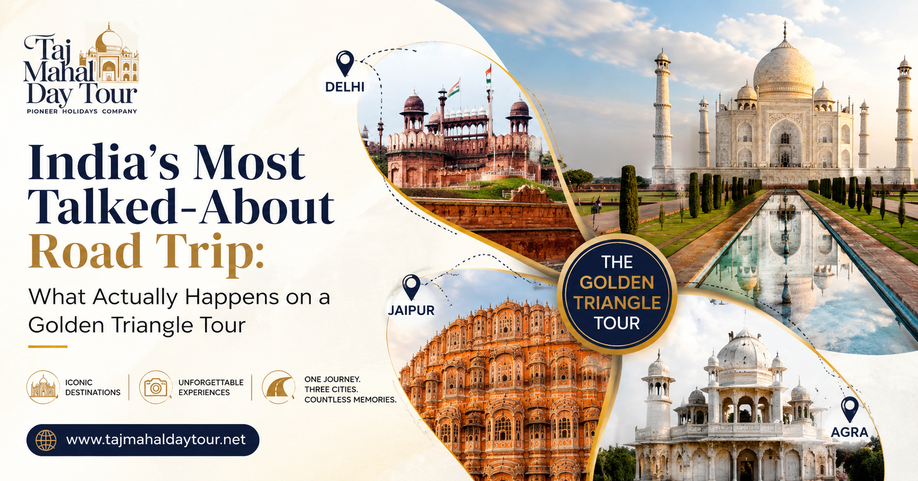
There is a trip that almost every traveler who comes to India ends up taking — not because someone forced them, but because once you hear about it, it is hard to say no. Delhi, Agra, Jaipur. Three cities. One loop. Thousands of stories.
I have been on this route more times than I can count, and every single time something happens that I did not expect. A shopkeeper who remembers me from two years ago. A sunset at the Taj that looks different from every angle. A Rajput fort that makes you feel genuinely small. This blog is my honest attempt to tell you what this journey really looks like — not the brochure version, but the real one.
Why This Route Became Famous in the First Place
The Golden Triangle Tour Packages exist because these three cities together give you something no single city can. Delhi has the chaos, the history, and the food. Agra has the Taj Mahal — which, yes, is as good as people say. And Jaipur has the color, the forts, and an energy that feels borrowed from a different century entirely.
The triangle shape is almost perfectly formed. Delhi to Agra is about 230 kilometers. Agra to Jaipur is roughly 240 kilometers. Jaipur back to Delhi is around 270 kilometers. You can do the whole loop in 4 days if you are rushing, but 6 to 7 days is when it actually starts to feel like a trip rather than a marathon.
The route became popular in the 1960s and 70s with backpackers, and since then it has only grown. Today it is one of the most booked travel circuits in all of Asia.
Day One: Landing in Delhi and Feeling Everything at Once
The first thing Delhi does is overwhelm you. Not in a bad way — in a way that wakes you up.
Old Delhi is where I always start. The lanes near Chandni Chowk are so narrow that two people walking side by side barely fit. There are cycle rickshaws, street food carts selling jalebi and chaat, wedding decoration shops, spice merchants — all within a few meters of each other.
Jama Masjid is close by, and it is one of the largest mosques in India. Standing in the courtyard at the right time of day, when the light hits the red sandstone at an angle, is genuinely one of the most peaceful moments you can have in a city that never stops moving.
Humayun's Tomb is often skipped by people who think Agra will cover their "Mughal architecture quota," but that is a mistake. This tomb is the direct architectural ancestor of the Taj Mahal. The garden layout, the dome, the inlaid stonework — it is all here, just without the crowds.
Qutub Minar is worth the trip south of the city. The iron pillar inside the complex has stood for 1,600 years and has not rusted. No one fully agrees on why.
Evening in Delhi means food. Karim's in Old Delhi has been serving the same type of mutton curry since 1913. Khan Market has cafes that would not look out of place in London. Street stalls near Connaught Place sell parathas stuffed with everything from potato to paneer.
Day Two: Agra and the One Thing Everyone Came to See
Most people who book Golden Triangle Tour Packages are, if they are honest, mostly thinking about the Taj Mahal. That is completely fine. The Taj deserves its reputation.
The drive from Delhi to Agra takes around three to four hours by road, or about two hours if you take the Gatimaan Express train.
Here is what nobody tells you before your first visit: the Taj Mahal changes depending on when you see it. Early morning, before 8 AM, the white marble catches the pale light and looks almost pink. At noon it is blinding white. In the late afternoon it turns golden. If you can possibly arrange to see it at more than one time of day, do it.
What surprised me on my first visit was how the details reward close attention. The calligraphy around the arches is carved with letters that get larger as they go higher, so that from ground level they all appear the same size. The inlaid flowers are made from dozens of different semi-precious stones — carnelian, jade, lapis lazuli, coral. The symmetry is almost unsettling in how perfect it is.
Agra Fort is two kilometers from the Taj and is significantly less visited, which means you can actually think inside it. Shah Jahan, the emperor who built the Taj for his wife Mumtaz Mahal, was later imprisoned in this fort by his own son. From one of the towers, on a clear day, you can see the white dome of the Taj in the distance. Historians believe he spent his final years staring at it from across the river.
Mehtab Bagh, a garden on the opposite bank of the Yamuna River, gives you a view of the Taj from the back and is almost always uncrowded. At sunset, this is genuinely the best angle.
For dinner in Agra, Pind Baluchi on Fatehabad Road is good, and Dasaprakash is a Mysore-style vegetarian restaurant that has been feeding tourists since 1956.
Day Three: Fatehpur Sikri and the Road to Jaipur
This is the day most people either skip or remember most vividly.
Fatehpur Sikri is a ghost city. Emperor Akbar built it in the 1570s as his new capital, and then the population abandoned it around 1585 — possibly due to water shortage, possibly because of military demands elsewhere. The city is almost completely intact. The palace complex, the mosque, the courtyards, the Buland Darwazi arch which is one of the tallest gateways in the world — all of it is still standing, perfectly preserved by the dry air and the fact that no one lives there.
Walking through it in the morning before the tour groups arrive feels like being inside a film set, except the set has been standing for 450 years.
After Fatehpur Sikri, the road continues southwest toward Jaipur. The landscape changes as you enter Rajasthan — flatter, drier, more dust-colored. You start seeing camels by the roadside, which always feels slightly unreal if you are coming from a city.
Day Four: Jaipur and Why Pink Is Actually Orange
Jaipur is called the Pink City, which confuses most first-time visitors because the walls appear to be closer to terracotta orange than pink. The color comes from a 1876 decision to paint the city's buildings for the visit of the Prince of Wales, and the tradition stuck.
The Amer Fort, about 11 kilometers from the city center, is where most mornings begin. The fort sits on a ridge above a lake, and the reflection of the walls in the water below is what people come to photograph. Inside, the Sheesh Mahal — the Hall of Mirrors — is a room whose walls and ceiling are covered in thousands of tiny mirrored glass pieces. When a single candle is lit inside, the entire room shimmers as if it is full of stars.
Jaigarh Fort, connected to Amer by a wall, holds the world's largest cannon on wheels. The cannon, named Jaivana, was fired only once in its history and reportedly sent a cannonball nearly 35 kilometers.
The City Palace in the center of Jaipur is still partially occupied by the royal family of Jaipur, which means you are walking through history that is still being lived in. The museum inside holds a robe that belonged to the largest maharaja in the dynasty's history — it is roughly the width of two average adults standing side by side.
The Jantar Mantar, an astronomical observatory built in the 1720s, contains instruments large enough to tell time to within two seconds of accuracy. The largest sundial here, the Samrat Yantra, is nearly 27 meters tall.
Jaipur's markets are where most people spend their afternoons. Johari Bazaar for gemstones and jewelry. Bapu Bazaar for textiles. Nehru Bazaar for juttis, the traditional Rajasthani leather shoes. The bargaining is expected and, once you get the rhythm of it, genuinely enjoyable.
Practical Things That Actually Matter
Best time to visit: October through March. Summers in this region can reach 45 degrees Celsius and are genuinely uncomfortable. Monsoon season (July to September) brings humidity and occasional flooding on the roads.
Getting around: Most Golden Triangle Tour Packages include a private car and driver, which is the most practical option. The driver usually knows the shortcuts, the good restaurants, and — crucially — which tourist traps to avoid. Train connections exist between all three cities and are good options if you prefer flexibility.
How many days: 4 days is the absolute minimum. 6 to 7 days allows you to actually enjoy each city rather than just photograph it. 10 days lets you add side trips to Ranthambore for tigers, Pushkar for the lake and temples, or Mathura for the Krishna temples.
Booking: tajmahaldaytour.net offers tailored Golden Triangle Tour Packages that can be customized based on your pace, budget, and interests. Whether you want a budget-friendly group tour or a private customized itinerary, working with a specialist who knows the route saves time and avoids the common mistakes first-time visitors make.
What to carry: Comfortable walking shoes are more important than most people expect. These are cities with a lot of uneven stone. A light scarf is useful for entering mosques and temples. Cash in Indian rupees is still the most practical payment method at smaller shops and food stalls.
A Few Things I Wish Someone Had Told Me Earlier
The Taj Mahal is closed every Friday. Plan around this.
In Jaipur, auto-rickshaw drivers near major tourist sites will often quote prices three to four times the actual rate. Ride-hailing apps like Ola or Uber work in Jaipur and are significantly more straightforward.
Agra's air quality has been a concern in recent years, particularly in winter when smog can sometimes obscure visibility. Check air quality forecasts if you are visiting between November and January.
In Delhi, the Metro is genuinely excellent and covers most major tourist sites. It is faster than road transport during rush hour and costs a fraction of a taxi.
Food safety matters. Street food in these cities is fantastic, but stick to stalls where food is cooked fresh in front of you and where there is a high turnover of customers. Avoid raw salads and cut fruit from unknown sources.
What People Often Say After Coming Back
The conversation I have most often with travelers who have just finished this route goes something like: "I thought I knew what to expect, and then I didn't."
That is the honest answer. The Taj Mahal is more affecting than photographs prepare you for. Old Delhi is louder and more alive than you imagined. The Amer Fort at sunrise, when the light comes over the hills and hits the walls, is a moment that sits in memory for a long time.
The Golden Triangle Tour is not just a route. It is a compressed version of something enormous — a civilization's relationship with power, beauty, religion, and everyday life, all within a few hundred kilometers. You do not need to know the history deeply to feel the weight of it. The places themselves communicate it.
Frequently Asked Questions
Q: How much do Golden Triangle Tour Packages typically cost? A: Prices vary depending on the type of tour, accommodation standard, and duration. Budget packages covering 4 to 5 days with mid-range hotels start from around $200 to $350 per person. Luxury packages with 5-star hotels, private guides, and added experiences can range from $800 to $2000 or more. It is best to get a custom quote from your tour operator based on your specific needs.
Q: Is the Golden Triangle safe for solo travelers and women traveling alone? A: The route is generally considered safe for tourists, including solo women travelers, particularly when using a reputable tour operator and staying in well-reviewed accommodations. As in any destination, standard precautions apply — being aware of your surroundings, not accepting unsolicited help at major monuments, and keeping copies of your important documents.
Q: What is the best way to get from Delhi to Agra? A: The Gatimaan Express train is the fastest at roughly 100 minutes. The Shatabdi Express is another good option. By road, the Yamuna Expressway makes it a clean 3 to 4 hour drive. If you are on a guided tour, transport is typically arranged between all three cities.
Q: Do I need a visa to visit India? A: Most nationalities can apply for an e-Visa online before travel. The process takes 3 to 5 business days and is straightforward. A few nationalities are exempt or have different arrangements, so check with the Indian consulate or embassy for your country before booking.
Q: Can I visit all three cities in just 3 days? A: Technically yes, but it means rushing through each place rather than experiencing them. You would see the Taj Mahal and move on. Three days is enough to get a sense of the route, but 6 to 7 days is the recommendation if you want actual memories rather than a checklist.
Q: What should I wear while visiting temples and mosques? A: Shoulders and knees should be covered when entering religious sites. Carrying a light scarf or shawl that can be wrapped around the lower half when entering places of worship is the most practical solution. Shoes must be removed before entering most temples, mosques, and many historical sites.
Q: Is vegetarian food easy to find on this route? A: Very easily. India has one of the largest vegetarian populations in the world, and all three cities have excellent vegetarian restaurants and street food options. Most restaurants clearly mark vegetarian dishes on their menus.
Q: Should I hire a guide at each monument, or is a private tour guide better? A: Hiring a guide at each monument separately works, but the quality is inconsistent. A private guide who travels with you across the full route — usually arranged through your tour operator — provides better context because they can connect what you saw yesterday to what you are seeing today. The historical threads between Delhi, Agra, and Jaipur run deep, and a good guide makes those connections clear.
Q: What currency should I carry, and are ATMs available? A: Indian Rupees are the local currency. ATMs are widely available in all three cities, including at airports and major tourist areas. International credit cards are accepted at larger hotels and restaurants, but cash is necessary for smaller shops, street food, and auto-rickshaws.
Q: Is it possible to add a tiger safari to the Golden Triangle route? A: Yes, Ranthambore National Park in Rajasthan is about 3 hours from Jaipur and is one of the best places in India to see Bengal tigers in the wild. Adding 2 days for Ranthambore is a popular extension to the standard Golden Triangle Tour Packages and is well worth it if wildlife is on your list.

 English
 Arabic
 French
 Spanish
 Portuguese
 Deutsch
 Turkish
 Dutch
Dutch
 Russian
 Romaian
 Portuguese (Brazil)
 Greek
Greek
