


The 5 Main Types of Water Filtration Systems Explained
Not all water filters do the same job. Some sharpen taste, some strip out near-invisible particles, and others target microorganisms you can't see at all. Choosing the right system starts with understanding what each filtration technology actually removes, and matching it to what's in your water. Here are the five most common types of water filtration systems and where each one fits.
Carbon Filtration: Better Taste and Odor
Carbon filters are the most familiar type of water filtration, and for good reason. Using activated carbon, they trap chlorine, volatile organic compounds (VOCs), and the dissolved gases that leave water smelling like a swimming pool or tasting metallic and flat. As water passes through the carbon media, contaminants bond to its highly porous surface in a process called adsorption.
This is the technology behind clearer, fresher drinking water. Carbon does an excellent job on taste and odor issues, but it isn't designed to remove dissolved minerals or microorganisms, which is why it's often paired with other stages in a complete system. If your main complaint is how your water tastes or smells, carbon is usually the first line of defense.
Reverse Osmosis: High-Purity Water
When you need the highest level of purity, reverse osmosis (RO) is the gold standard. RO works by forcing water through a semi-permeable membrane with pores so fine that they block dissolved solids, heavy metals, fluoride, nitrates, and a long list of other contaminants that slip past simpler filters.
The trade-off is that RO is slower and produces some wastewater, which is why it's most often installed at a single point of use—like an under-sink unit dedicated to drinking and cooking water. For homes that want truly polished water on demand, reverse osmosis and dedicated drinking water systems deliver results that carbon alone can't match.
Sediment Filtration: Dirt, Rust, and Debris
Sediment filters handle the physical stuff: sand, silt, dirt, rust flakes, and other suspended particles that cloud your water and clog your plumbing. They act as a mechanical screen, capturing debris before it reaches the rest of your filtration system or your appliances.
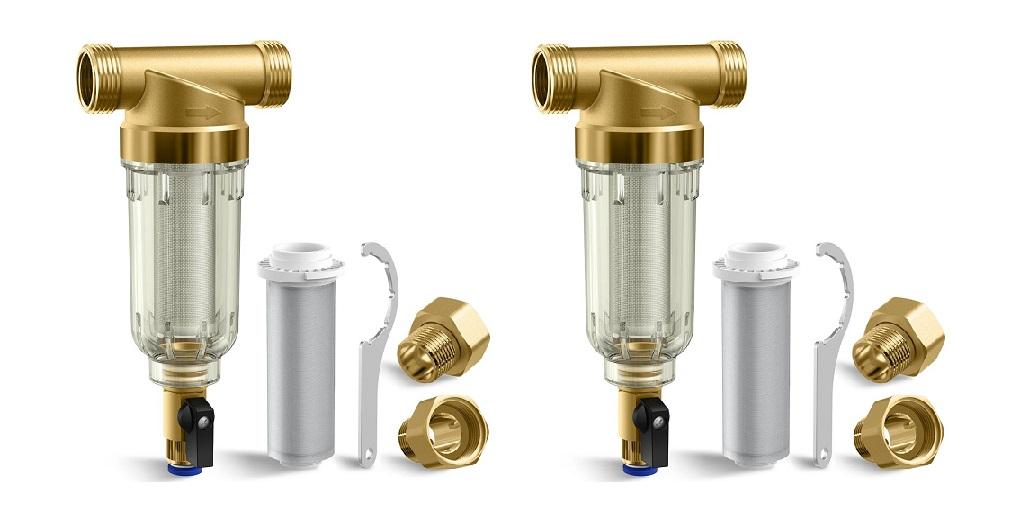
Sediment filtration is especially important for homes on well water, where untreated supplies often carry visible particulate. A spin-down sediment pre-filter protects downstream stages and extends the life of finer filters. Because sediment is usually the first thing you want to remove, this stage often sits at the front of a multi-stage whole-house setup.
UV Purification: Bacteria and Microorganism Removal
Ultraviolet (UV) purification targets what filters can't trap by size alone, living contaminants. UV light disrupts the DNA of bacteria, viruses, and other microorganisms, rendering them unable to reproduce or cause illness. It does this without adding any chemicals to your water.
UV is a critical safeguard for private wells and any supply where biological contamination is a concern. Because UV doesn't remove sediment or chemicals, it's most effective as the final stage in a system that has already cleared particulate and clarified the water, so the light can reach every microorganism.
Ion Exchange: Hard Water and Scale
Ion exchange is the technology behind water softening, and it solves a problem the other filters can't: hard water. As water flows through a bed of specialized resin beads, the beads swap out the dissolved calcium and magnesium ions that cause hardness, exchanging them for sodium or potassium ions. The result is softer water that won't leave scale deposits on your fixtures, glassware, or appliances.
Choosing the Right System for Your Home
Most homes benefit from a combination rather than a single technology, including under-sink water filters, countertop solutions, or even whole home water filters.
The best starting point is knowing what's actually in your water. Test your supply, identify your priorities (taste, purity, hardness, sediment, or microorganisms) and build a system around them. Have questions about which configuration fits your home? Get in touch with Nature's Air & Water and their team will help you find the solution that works for you.
For more information about Reverse Uv Filter For Swimming Pool and Air Purifier For Home Please visit: Nature's Air and Water, LLC.

 English
 Arabic
 French
 Spanish
 Portuguese
 Deutsch
 Turkish
 Dutch
Dutch
 Italiano
 Russian
 Romaian
 Portuguese (Brazil)
