


How to Automate SAP Data Migration Validation Without Customizing the Core
Data migration is one of the most critical phases of any SAP implementation, upgrade, or S/4HANA transformation project. While migrating data is important, validating that migrated data is accurate, complete, and consistent is equally essential. Traditionally, organizations relied on manual checks or custom ABAP developments for validation. However, modern SAP landscapes increasingly favor a Clean Core approach, where core SAP systems remain free from unnecessary customizations.
Why Automated Validation Matters
Manual validation processes are time-consuming, error-prone, and difficult to scale. As data volumes grow, organizations need automated methods to compare source and target systems, identify discrepancies, and ensure data quality before go-live.
How to Automate SAP Data Migration Validation Without Core Customization
1. Use Standard SAP APIs and CDS Views
Leverage SAP-provided APIs, CDS Views, and OData services to extract and compare migration data. This allows validation without modifying standard SAP objects.
2. Implement External Validation Tools
Modern validation platforms can connect to SAP systems through secure interfaces and automatically perform:
- Data reconciliation
- Record count verification
- Field-level comparisons
- Exception reporting
3. Automate Test Scenarios
Create reusable validation rules for:
- Master Data (Customers, Vendors, Materials)
- Transactional Data
- Financial Balances
- Open Items
Automated execution significantly reduces testing effort across multiple migration cycles.
4. Utilize SAP Migration Cockpit Outputs
SAP Migration Cockpit provides logs, error reports, and status information that can be integrated into automated validation workflows for continuous monitoring.
5. Enable Real-Time Reporting and Dashboards
Automated dashboards help project teams quickly identify mismatches, track validation progress, and resolve issues before deployment.
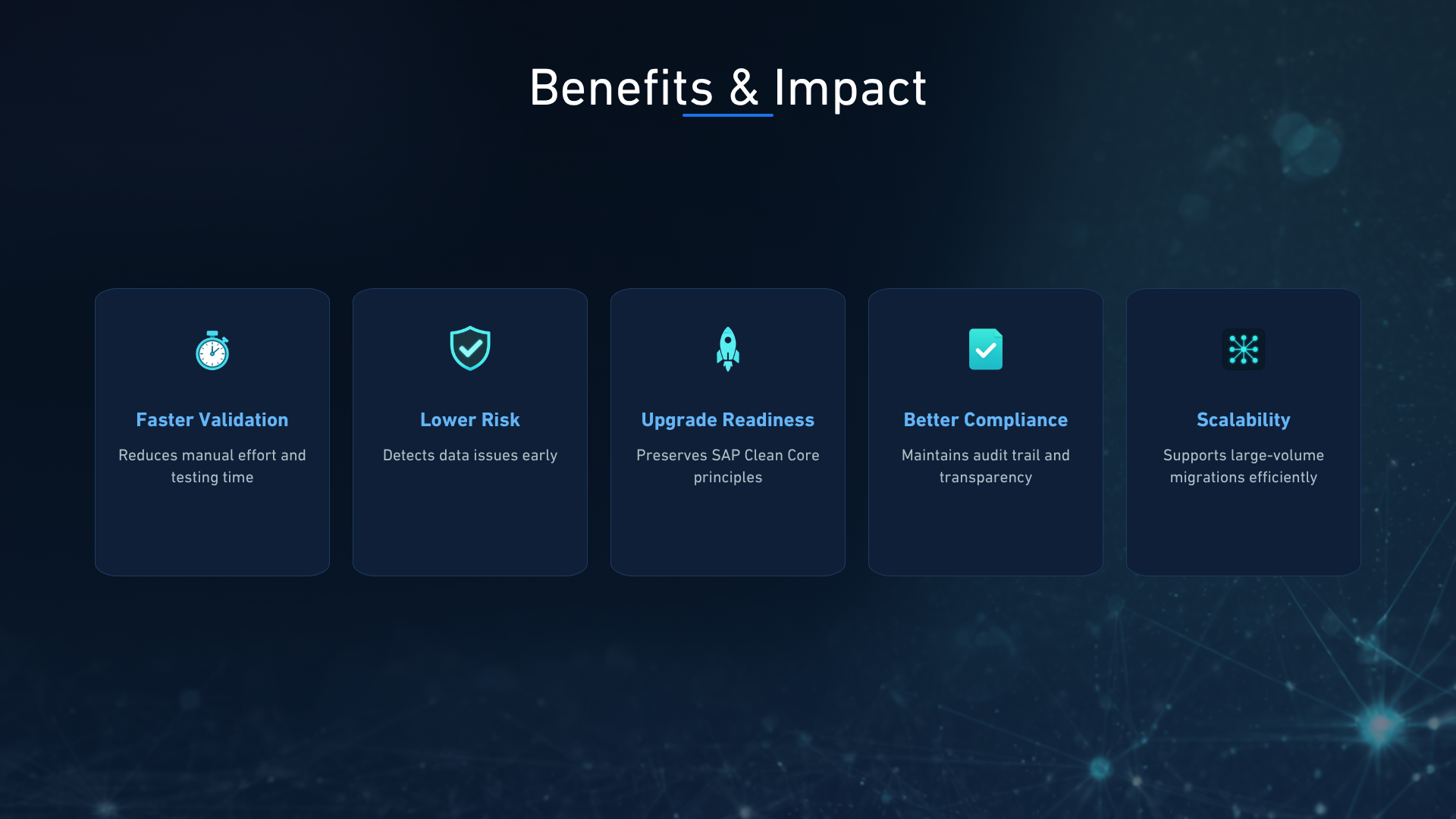
Benefits of a Clean-Core Validation Strategy
Best Practices
- Define validation rules before migration begins.
- Automate repetitive comparison tasks.
- Prioritize critical business data validation.
- Maintain centralized validation reports.
- Use non-invasive integration methods aligned with SAP Clean Core standards.
Final Thoughts
Automating SAP data migration validation without customizing the core enables organizations to accelerate migration projects while maintaining system integrity. By leveraging standard SAP capabilities, external automation tools, and reusable validation frameworks, businesses can achieve higher data quality, faster project delivery, and long-term compliance with SAP Clean Core principles.

 English
 Arabic
 French
 Spanish
 Portuguese
 Deutsch
 Turkish
 Dutch
Dutch
 Italiano
 Russian
 Romaian
 Portuguese (Brazil)
