


3D Scanning Reverse Engineering Services Process Guide
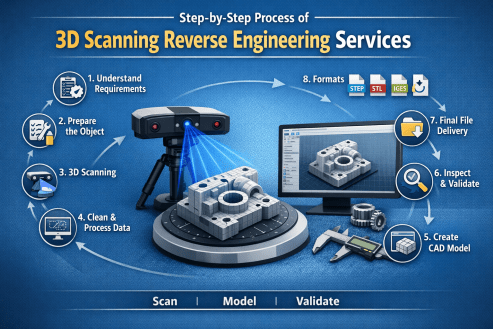
Step-by-Step Process of 3D Scanning Reverse Engineering Services
Companies today require product duplication and enhancement and complete product reconstruction. The original design and drawings of the product are not available to them. 3D scanning reverse engineering services provide essential assistance at this stage.
This technology enables the conversion of physical objects into digital 3D models which designers and manufacturers and researchers use for their work.
The blog provides a detailed explanation of the complete process which can be easily understood through its simple step-by-step presentation.
What Are 3D Scanning Reverse Engineering Services?
3D scanning reverse engineering is a process where a physical object is scanned and converted into a digital model using advanced tools.
In simple words:
You take a physical object -> scan it with a 3D scanner -> get a digital 3D model on a computer.
This is useful when:
-
You don’t have original design files
-
You want to improve a product
-
You need to recreate old or damaged parts
Step-by-Step Process of 3D Scanning Reverse Engineering Services
1. Understanding the Requirement
First, the team understands what you need.
They ask questions like:
-
Why do you need reverse engineering?
-
What level of accuracy is required?
-
What file format do you need?
This step helps in planning the whole project properly.
2. Preparing the Object
Before scanning, the object is prepared.
This may include:
-
Cleaning dust or dirt
-
Applying spray on shiny surfaces
-
Placing the object correctly
This ensures better scanning results.
3. 3D Scanning the Object
Now the actual scanning is done using special machines.
These machines capture the shape of the object and create millions of data points. This data is called a point cloud.
Different scanning methods can be used, such as:
-
Laser scanning
-
Structured light scanning
-
Photogrammetry (for large areas)
4. Cleaning the Scan Data
After scanning, the data is not perfect.
So, it is cleaned by:
-
Removing unwanted points
-
Fixing errors
-
Aligning multiple scans
This step makes the data accurate and usable.
5. Cleaning & Mesh Creation
The raw scan is converted into a usable format:
-
Noise is removed
-
Holes are filled
-
A polygon mesh (STL model) is generated
6. Creating the CAD Model
This is the most important step.
Engineers convert the mesh into a proper CAD (Computer-Aided Design) model.
They:
-
Add features
-
Create smooth surfaces
-
Make the design editable
Now, the model is ready for manufacturing or design changes.
7. Checking Accuracy
The CAD model is compared with the original scanned data.
This ensures:
-
The design is correct
-
Measurements are accurate
-
There are no major errors
8. Final Output Generation
Finally, the files are delivered in the required formats like:
-
STEP
-
IGES
-
STL
These files can be used for production, testing, or further design work.
Benefits of 3D Scanning Reverse Engineering Services
Here are some simple benefits:
-
Very high accuracy - Captures exact dimensions and complex shapes with precision
-
Saves time - Much faster than manual measurement and traditional CAD modeling
-
Cost-effective in the long run - Reduces rework, design errors, and development time
-
Recreates old or missing parts - Helps reproduce damaged, outdated, or unavailable components
-
Improves product design - Makes it easy to modify and optimize existing designs
Where Is It Used?
This technology is used in many industries, such as:
-
Manufacturing
-
Automotive
-
Aerospace
-
Healthcare
-
Architecture
It is especially useful when working with complex shapes or old parts.
Challenges to Know in 3D Scanning & Reverse Engineering Services
1. High Initial Cost
-
Professional 3D scanners and software can be expensive
-
Skilled operators are often required
-
Not always suitable for very small budgets
2. Surface Limitations
-
Shiny, transparent, or dark surfaces can be difficult to scan
-
May require surface sprays or preparation
-
Can affect accuracy if not handled properly
3. Data Processing Complexity
-
Raw scan data is large and heavy
-
Needs cleaning, alignment, and mesh fixing
-
Requires skilled reverse engineering work
4. Accuracy Depends on Equipment & Skill
-
Low-quality scanners reduce precision
-
Operator experience strongly impacts final output
-
Poor setup can lead to errors in the model
5. Time for Complex Parts
-
Very detailed or large objects take longer to scan and process
-
Multiple scan angles may be required
Conclusion
The process of 3D scanning reverse engineering services helps convert real-world objects into accurate digital models.
From scanning to final CAD design, every step is important. This technology saves time, improves accuracy, and helps businesses grow faster.
As industries move towards digital solutions, reverse engineering is becoming more important than ever.
FAQs
1. What is 3D scanning reverse engineering in simple words?
It means scanning a real object and creating its digital 3D design.
2. How accurate is this process?
It can be very accurate, even up to very small measurements (millimeter level).
3. Can old or damaged parts be recreated?
Yes, even broken or worn-out parts can be scanned and redesigned.
4. What files do you get at the end?
You get files like STEP, IGES, or STL that can be used for manufacturing.
5. Is it expensive?
It may look costly at first, but it saves money by reducing errors and saving time.
6. Who should use this service?
Anyone in manufacturing, design, or engineering who needs accurate 3D models.

 English
 Arabic
 French
 Spanish
 Portuguese
 Deutsch
 Dutch
Dutch
 Italiano
 Russian
 Romaian
 Portuguese (Brazil)
 Greek
Greek
