


The Evolution of Cricket Strategy in the T20 Era | 22Bet
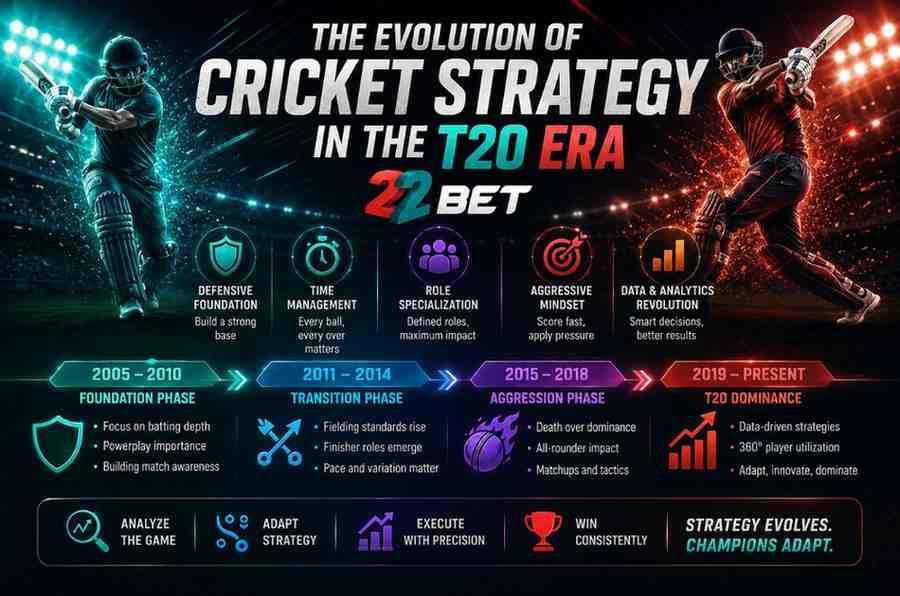
T20 cricket has changed the sport more than any format innovation since the rise of One Day Internationals. What began as a shorter, entertainment-focused version of cricket has become a strategic laboratory that influences every level of the game. Teams now rely on aggressive batting, specialized bowling roles, advanced fielding plans, and detailed analytics to gain small advantages that can decide matches.
For cricket fans and sports bettors using 22Bet, understanding how T20 strategy evolved helps explain why modern teams behave differently from teams of the past. The transformation is not only about hitting more sixes. It is about using data, matchups, and probability-based decision-making to maximize winning chances.
From Survival to Intent: The Batting Revolution
In earlier eras of limited-overs cricket, many batters treated the first few overs as a period of survival. Preserving wickets for the later stages was considered essential.
T20 cricket reversed that logic. Because each innings contains only 120 legal balls, teams discovered that wasting deliveries is often more costly than losing wickets. Modern batting strategy prioritizes intent from the start.
Key changes include:
-
Higher powerplay scoring rates.
-
Greater acceptance of calculated risk early in the innings.
-
Specialist finishers who focus on boundary hitting rather than long innings.
-
Batters training a wider range of shots, including ramps, scoops, and reverse sweeps.
The rise of aggressive opening partnerships is one of the clearest signs of this evolution. Teams increasingly aim to maximize the field restrictions rather than merely protect wickets. Do 22bet Login Now.
Powerplay Strategy Became a Separate Discipline
The first six overs of a T20 innings are no longer viewed as just the beginning of the game. They are treated as a distinct phase with specialized tactics.
Batting teams seek to exploit:
-
Only two fielders outside the circle.
-
Hard new-ball conditions.
-
Predictable pace-on deliveries.
Bowling teams respond with:
-
Attacking lengths aimed at early wickets.
-
Matchup-based bowling changes.
-
Use of swing bowlers when conditions allow.
-
Specific field placements designed to protect scoring zones.
Analytics now plays a major role here. Teams study historical powerplay performance by batter, bowler, venue, and match condition before setting plans.
The Rise of Bowling Specialists
T20 cricket forced bowlers to develop new skills. Traditional line-and-length bowling was often insufficient against modern power hitters.
Several specialized roles emerged:
|
Role |
Primary Objective |
|
Powerplay swing bowler |
Take wickets before scoring accelerates. |
|
Middle-overs spinner |
Control run rate and create pressure. |
|
Death-over specialist |
Limit boundaries in overs 16–20. |
|
Matchup bowler |
Target specific batter weaknesses. |
The most valuable T20 bowlers often combine yorkers, slower balls, cutters, wide lines, and variations in pace. Predictability is dangerous in the modern game.
Spin Bowling Evolved Rather Than Disappeared
Many observers once assumed that T20 cricket would make spin bowling less important because batters attack aggressively. Instead, spin evolved into a strategic weapon.
Successful T20 spinners typically focus on:
-
Changing pace frequently.
-
Bowling into large boundary dimensions.
-
Exploiting batters who struggle against spin.
-
Creating dots that increase pressure.
On slower surfaces, spin can dominate the middle overs and force risky shots against pace later in the innings.
Fielding Became a Core Competitive Advantage
T20 cricket dramatically increased the value of fielding. Saving 10–15 runs through athletic fielding can be equivalent to a major batting contribution.
Modern teams emphasize:
-
Boundary riding and relay throws.
-
Diving stops and quick recoveries.
-
Direct-hit run-out opportunities.
-
Specialized fielding positions based on batter tendencies.
Elite fielding units now treat field placement as a dynamic process rather than a static diagram set before the over begins.
Data and Matchups Changed Decision-Making
Perhaps the biggest strategic shift is the move toward data-driven cricket.
Teams analyze:
-
Batter performance against spin vs pace.
-
Scoring zones and wagon-wheel patterns.
-
Bowler effectiveness by phase of innings.
-
Venue-specific scoring trends.
-
Chasing success rates under different conditions.
This information influences team selection, bowling changes, batting order adjustments, and field placements.
For example, a left-arm spinner may be introduced specifically because data shows a particular right-handed batter scores slowly against that matchup.
Flexible Batting Orders Replaced Rigid Structures
Traditional batting orders were relatively fixed. T20 cricket introduced greater flexibility.
Teams increasingly promote hitters when conditions favor attack, hold anchors back when wickets fall early, and send left-right combinations to disrupt bowling plans.
The objective is to optimize matchups and scoring opportunities rather than preserve a predetermined order.
Toss Strategy Became More Condition-Driven
T20 strategy also changed how captains approach the toss.
Decisions now depend heavily on:
-
Dew forecasts in evening matches.
-
Expected pitch deterioration.
-
Boundary dimensions.
-
Weather interruptions.
-
Historical chasing records at the venue.
Many teams prefer chasing when significant dew is expected because bowling second can become difficult once the ball gets wet.
Impact on Other Formats
The influence of T20 strategy extends far beyond T20 itself.
Modern ODI cricket features faster scoring rates, more aggressive powerplay batting, greater emphasis on boundary hitting, and increased use of matchup analysis.
Even Test cricket has absorbed some T20 concepts. Teams attack more frequently, rotate strike more aggressively, and use data to target opposition weaknesses.
What This Means for Cricket Predictions on 22Bet
For sports bettors and prediction enthusiasts, the T20 strategic revolution changed what matters most in pre-match analysis.
Instead of relying only on star names or overall records, modern analysis often focuses on:
-
Powerplay matchup advantages.
-
Death-bowling quality.
-
Middle-overs spin control.
-
Venue scoring patterns.
-
Dew and weather conditions.
-
Recent form in specific innings phases.
These phase-specific indicators frequently provide more predictive value than simple win-loss history.
The Future of T20 Strategy
The next stage of evolution is likely to involve even deeper analytics, real-time tactical adjustments, AI-assisted matchup analysis, and increasingly specialized player roles.
As leagues expand and data quality improves, teams will continue searching for marginal gains. The gap between the best and average T20 sides is often measured in a few runs, a single over, or one key matchup.
Conclusion
T20 cricket transformed strategy from a largely instinct-driven approach into a highly analytical, phase-based contest. Batting became more aggressive, bowling more specialized, fielding more valuable, and decision-making increasingly data-driven.
Understanding this evolution helps explain modern cricket tactics and provides useful context for match analysis on 22bet App. The teams that succeed consistently are rarely just the most talented. They are usually the teams that manage powerplays, middle overs, death overs, matchups, and conditions more effectively than their opponents.
That is the true legacy of the T20 era: cricket became a game of probabilities, preparation, and strategic optimization as much as raw skill.

 English
 Arabic
 French
 Spanish
 Portuguese
 Turkish
 Dutch
Dutch
 Italiano
 Russian
 Romaian
 Portuguese (Brazil)
 Greek
Greek
