


Ferrite EMI Suppression Core Market Expands as 5G Infrastructure, EV Power Electronics, and IoT Devices Drive Global Demand
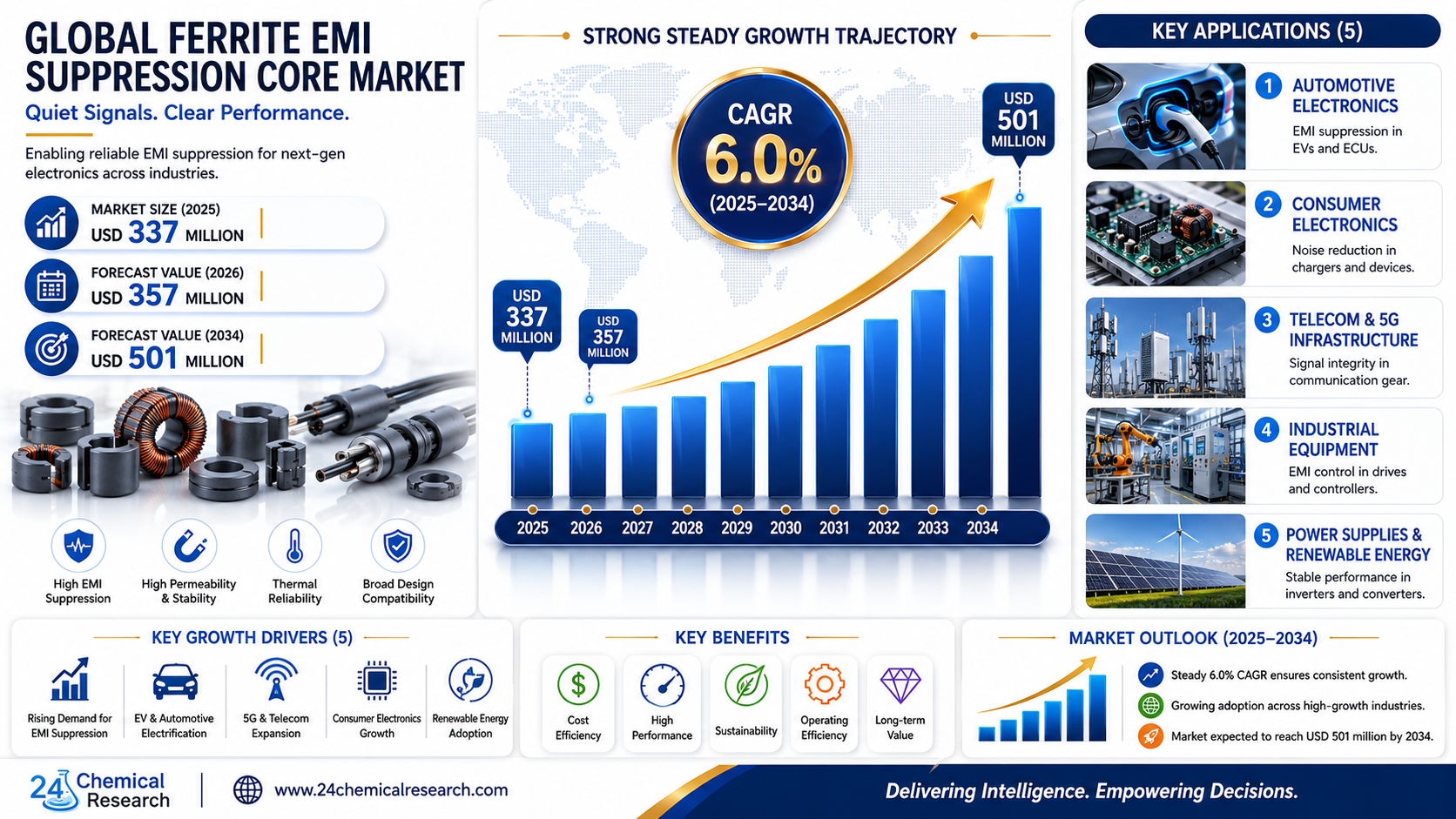
Ferrite EMI suppression cores are passive electronic components made from ferrimagnetic ceramic materials. These components are designed to reduce electromagnetic interference, commonly known as EMI, by absorbing or attenuating high-frequency noise currents that can disturb electronic circuits, weaken signal integrity, and cause devices to fail electromagnetic compatibility requirements.
In modern electronics, EMI suppression is no longer optional. Smartphones, electric vehicles, industrial automation systems, 5G base stations, power supplies, communication equipment, and connected devices all operate in increasingly dense electromagnetic environments. As electronic devices become smaller, faster, and more power-intensive, they generate more unwanted electrical noise. Ferrite EMI suppression cores help control this noise without requiring complex active circuitry, making them one of the most widely used and cost-effective solutions for EMC compliance.
Ferrite cores are available in different material compositions, including Manganese-Zinc (Mn-Zn), Nickel-Zinc (Ni-Zn), Magnesium-Zinc (Mg-Zn), and other specialty ferrite formulations. Each material type is engineered for specific frequency ranges, magnetic permeability levels, temperature conditions, and end-use requirements. This material diversity allows design engineers to select the right ferrite core for applications ranging from consumer electronics and telecom infrastructure to automotive power electronics, industrial drives, and defense-grade systems.
Get Full Report Here:
https://www.24chemicalresearch.com/reports/307131/ferrite-emi-suppression-core-market
Market Dynamics:
The Ferrite EMI Suppression Core market is shaped by strong demand from telecommunications, electric vehicles, consumer electronics, industrial automation, and connected infrastructure. At the same time, the market continues to face challenges related to high-frequency performance limits, raw material concentration, regulatory compliance, and competition from alternative EMI suppression technologies.
Key Market Highlights
● Ferrite EMI suppression cores are critical for reducing high-frequency noise and helping electronic systems meet EMC standards.
● 5G infrastructure is creating strong demand for high-performance Mn-Zn and Ni-Zn ferrite cores used in base stations, RF modules, and communication equipment.
● Electric vehicles are increasing ferrite core demand due to the growing use of inverters, onboard chargers, battery management systems, and electronic control units.
● Consumer electronics remain the largest unit-volume application segment, supported by smartphones, laptops, tablets, wearables, and smart home devices.
● Asia-Pacific dominates global production and consumption, led by China, Japan, South Korea, and emerging Southeast Asian electronics manufacturing hubs.
● Automotive applications are among the fastest-growing demand areas as EV production and electronic content per vehicle continue to rise.
● Industrial IoT, smart factories, advanced materials, and application-specific ferrite formulations represent major future opportunities.
Powerful Market Drivers Propelling Expansion
-
Surging Demand from 5G Infrastructure and Telecommunications:
The global rollout of 5G networks is one of the most important growth drivers for the Ferrite EMI Suppression Core market. 5G base stations, antenna systems, RF front-end modules, fiber-optic network equipment, and high-frequency communication devices operate in complex electromagnetic environments where signal clarity is essential.
As network equipment handles higher data speeds, wider bandwidths, and more densely packed frequency bands, the risk of electromagnetic interference increases. Ferrite EMI suppression cores help reduce conducted emissions and protect signal pathways from high-frequency noise. This is especially important in telecommunications infrastructure, where even small disturbances can affect data transmission quality, network reliability, and regulatory compliance.
Mn-Zn and Ni-Zn ferrite cores are widely used in telecom systems because they offer different advantages across frequency ranges. Mn-Zn ferrites are commonly used for lower-frequency noise suppression, while Ni-Zn ferrites are preferred for higher-frequency applications. As telecom operators continue deploying 5G networks across North America, Europe, Asia-Pacific, and emerging markets, demand for high-performance ferrite EMI suppression solutions is expected to remain strong.
The communications industry has become one of the most technically demanding end-user segments for ferrite core manufacturers. Equipment makers are increasingly looking for smaller, more efficient, thermally stable, and application-specific EMI suppression components that can support next-generation communication systems.
-
Automotive Electrification and the Rise of EV Power Electronics:
The transition from internal combustion engine vehicles to electric vehicles is changing the role of EMI suppression components in the automotive industry. Modern electric vehicles contain a high density of electronic systems, including inverters, onboard chargers, DC-DC converters, battery management systems, sensors, electronic control units, infotainment systems, and advanced driver assistance systems.
Each of these systems can generate or be affected by electromagnetic noise. In EVs, high-voltage power electronics switch rapidly, creating conducted and radiated emissions that must be controlled to ensure safe operation, communication reliability, and regulatory compliance. Ferrite EMI suppression cores help reduce this interference across power lines, signal cables, charging systems, and control circuits.
The automotive sector contributes approximately 25% of total ferrite core demand, and this share is expected to rise as EV adoption increases. Electric vehicle production is forecast to exceed 30 million units annually by 2030, and each EV typically requires more EMI suppression components than a conventional vehicle because of its higher electronic content.
Automotive OEMs and tier-one suppliers are increasingly working with ferrite core manufacturers to secure reliable, automotive-grade components. These components must meet strict requirements for temperature stability, vibration resistance, long operating life, and performance consistency. As a result, suppliers capable of delivering application-specific ferrite cores for EV power electronics are positioned for long-term growth.
-
Electronics Miniaturization and the IoT Revolution:
Electronics miniaturization is making EMI suppression more important than ever. Smartphones, laptops, tablets, wearables, smart home systems, industrial sensors, medical devices, and connected infrastructure systems are becoming smaller while operating at higher clock speeds and with greater wireless sensitivity.
Global smartphone shipments exceeding 1.3 billion units annually highlight the scale of demand generated by consumer electronics alone. Beyond smartphones, the rapid expansion of IoT devices is creating a large and distributed demand base for compact EMI suppression components. Each connected device must manage electrical noise while maintaining wireless communication performance, battery efficiency, and compact design.
Ferrite EMI suppression cores are widely used because they can provide effective noise filtering in compact formats. Manufacturers have responded to miniaturization trends by developing bead cores, chip ferrites, and surface-mount-compatible ferrite components suitable for high-density printed circuit board assembly.
As devices continue to shrink and become more connected, tolerance for electromagnetic noise is declining. This is pushing ferrite core manufacturers to improve material performance, reduce component size, and support high-frequency functionality without compromising reliability.
Download FREE Sample Report:
https://www.24chemicalresearch.com/download-sample/307131/ferrite-emi-suppression-core-market
Significant Market Restraints Challenging Adoption
Despite the market's solid fundamentals, several structural challenges continue to temper growth and complicate the operational landscape for manufacturers and end-users alike.
-
Performance Limitations at Gigahertz-Range Frequencies:
Ferrite EMI suppression cores deliver strong performance across a broad range of frequencies, but their effectiveness can decline in applications operating above 1 GHz. This limitation is becoming increasingly important as wireless communication systems, radar equipment, satellite communication hardware, high-speed data interfaces, and next-generation 5G millimeter-wave technologies move into higher frequency ranges.
Traditional ferrite materials may not always provide adequate suppression at microwave and millimeter-wave frequencies. In such cases, engineers may need to combine ferrite cores with other EMI management solutions, including multilayer chip inductors, conductive gaskets, absorptive shielding materials, EMI shielding films, and specialized laminates.
This creates an application-specific restraint for the Ferrite EMI Suppression Core market. While ferrites remain highly relevant in power electronics, consumer electronics, automotive systems, industrial equipment, and many telecom applications, manufacturers must continue investing in advanced material formulations to extend performance into higher frequency ranges.
-
Supply Chain Concentration and Raw Material Vulnerabilities:
Ferrite core production depends on stable access to oxide raw materials such as iron oxide, manganese oxide, nickel oxide, zinc oxide, and other specialty additives. It also requires specialized pressing, sintering, grinding, coating, and controlled atmosphere processing capabilities.
China controls approximately 80% of global ferrite production capacity, creating a significant concentration risk for manufacturers and end-users outside the region. Any disruption caused by geopolitical tensions, trade policy changes, logistics bottlenecks, energy costs, or raw material price volatility can affect global supply availability and pricing.
This supply chain structure is particularly important for electronics manufacturers that depend on consistent, high-volume ferrite core supply. OEMs and component distributors are increasingly evaluating supplier diversification strategies, but building new ferrite production capacity outside established hubs requires major capital investment, technical expertise, and long qualification timelines.
As a result, geographic diversification of ferrite core manufacturing remains a long-term priority rather than an immediate solution. Companies with stable raw material sourcing, vertically integrated operations, and regional production flexibility are likely to gain a competitive advantage.
Critical Market Challenges Requiring Innovation
Beyond the structural restraints outlined above, the Ferrite EMI Suppression Core market faces operational and technical challenges that require sustained investment in process development, product validation, and application engineering.
Compliance with international EMC standards such as CISPR, FCC Part 15, and the European Union’s Electromagnetic Compatibility Directive requires manufacturers to continuously test and validate their components against updated regulatory requirements. These compliance procedures can add 15-20% to product development and certification costs.
This challenge is especially difficult for small and medium-sized producers that may not have large compliance engineering teams, advanced testing laboratories, or global certification expertise. Larger manufacturers with established testing infrastructure and technical support capabilities are better positioned to serve multinational OEMs.
Competition from alternative EMI suppression technologies is also increasing. EMI shielding compounds, conductive polymer coatings, absorptive laminates, multilayer chip components, and advanced shielding materials are gaining attention in some cost-sensitive consumer electronics applications.
These alternatives are unlikely to fully replace ferrite EMI suppression cores in demanding applications such as automotive power electronics, industrial motor drives, telecommunications equipment, or defense electronics. However, they can reduce margins in high-volume consumer electronics markets where cost pressure is intense.
To remain competitive, ferrite core manufacturers must differentiate through performance reliability, temperature stability, miniaturization, application support, and total cost of ownership rather than competing only on unit price.
Vast Market Opportunities on the Horizon
-
Industrial IoT and Smart Manufacturing Expansion:
The rapid expansion of Industrial Internet of Things applications represents a major opportunity for Ferrite EMI Suppression Core manufacturers. Industrial environments are among the most challenging settings for electromagnetic compatibility because they combine high-power motor drives, switching power supplies, variable-frequency drives, robotics, automation controllers, wireless sensors, and communication systems in close proximity.
The Industrial IoT market is forecast to reach USD 100 billion by 2026, creating strong demand for reliable EMI suppression solutions in smart factories, energy substations, process control facilities, logistics automation, and industrial monitoring systems.
Ferrite cores are well suited for industrial applications because they provide robust EMI suppression, thermal stability, and long operational life. Wide-temperature-range Mn-Zn ferrite formulations are especially useful in harsh industrial environments where equipment must operate continuously under electrical noise, heat, vibration, and mechanical stress.
As factories become more connected and automated, the need for stable signal transmission and power quality will continue to rise. This creates a strong long-term opportunity for ferrite EMI suppression components used in industrial drives, control cabinets, robotics, sensors, and power conversion systems.
-
Advanced Materials Innovation Unlocking New Application Frontiers:
Material innovation is opening new opportunities in the Ferrite EMI Suppression Core market. Next-generation ferrite formulations, including nanotechnology-enabled compositions and advanced sintered materials, are being developed to improve permeability, frequency response, thermal stability, and suppression efficiency.
Some advanced ferrite materials are showing 30-40% improvement in permeability and loss characteristics compared with conventional sintered ferrites in targeted frequency ranges. These improvements are particularly valuable in applications where standard ferrite materials struggle to meet high-frequency or high-temperature requirements.
Aerospace and defense sectors are especially interested in advanced ferrite solutions because performance, reliability, and qualification consistency are more important than unit cost. Applications in radar systems, satellite communication, avionics, military electronics, and high-reliability power systems require EMI suppression components that can operate under extreme conditions.
The ability to deliver effective EMI suppression at elevated temperatures, under vibration, and across upper UHF or specialized frequency ranges could expand the addressable market for manufacturers capable of commercializing advanced ferrite formulations at scale.
-
Strategic Collaborations Accelerating Application-Specific Development:
A growing trend in the Ferrite EMI Suppression Core market is the formation of strategic partnerships between ferrite manufacturers and OEM customers. These collaborations allow material suppliers and end users to work together early in the product development process.
Such partnerships are valuable because EMI suppression challenges are often application-specific. A ferrite core used in an EV inverter may need different thermal, magnetic, and mechanical properties than one used in a 5G base station or an industrial motor drive. Early collaboration helps OEMs select optimized materials, reduce redesign cycles, improve first-pass validation success, and shorten time-to-market.
For ferrite core manufacturers, co-development partnerships can lead to long-term supply agreements and stronger customer relationships. Once a ferrite component is designed into an automotive, telecom, or industrial system, qualification requirements can create multi-year business opportunities.
This partnership model is becoming increasingly common in automotive and telecommunications applications, where reliability requirements, performance standards, and qualification timelines are more demanding than in general consumer electronics.
In-Depth Segment Analysis: Where is the Growth Concentrated?
By Type:
The market is segmented into:
● Mn-Zn
● Ni-Zn
● Mg-Zn
● Other specialty ferrite compositions
Mn-Zn ferrite cores currently lead the market because of their high permeability and strong performance at lower frequencies up to approximately 10 MHz. These properties make them suitable for power supply filtering, automotive electronics, industrial EMI suppression, transformers, inductive components, and noise filtering in power conversion systems.
Mn-Zn ferrites are widely preferred where strong magnetic response and effective low-frequency noise attenuation are required. Their use is especially important in automotive power systems, industrial drives, power supplies, and energy conversion equipment.
Ni-Zn ferrites perform better at higher frequencies and are commonly used in RF applications, telecommunications equipment, data communication systems, and compact electronic devices. Their higher electrical resistivity makes them useful for suppressing high-frequency noise while reducing eddy current losses.
Mg-Zn ferrites represent a smaller but technically important segment. They are gaining traction in applications that require specific combinations of temperature stability, frequency response, and material performance. Specialty ferrite compositions are expected to expand as manufacturers develop customized solutions for automotive, telecom, aerospace, and industrial customers.
By Application:
Application segments include:
● Communications Industry
● Consumer Electronics
● Automotive
● Other industrial and specialty end markets
The Communications Industry segment is one of the most technically demanding areas for Ferrite EMI Suppression Core adoption. 5G base stations, fiber-optic network equipment, satellite communication systems, routers, RF modules, and telecom power systems require ferrite cores that meet strict EMC specifications and deliver consistent performance under high-frequency operating conditions.
The Consumer Electronics segment is the largest in terms of unit volume. Smartphones, laptops, tablets, wearables, smart speakers, gaming devices, smart home products, and chargers all require compact EMI suppression components. High-volume production and miniaturized designs make this segment highly competitive, but demand remains steady due to continuous device replacement and increasing connectivity.
The Automotive segment is showing the strongest growth momentum. Rising electronic content per vehicle, EV adoption, charging infrastructure, advanced driver assistance systems, infotainment platforms, and onboard power electronics are increasing demand for automotive-grade ferrite cores.
Other industrial and specialty end markets include motor drives, factory automation equipment, renewable energy systems, medical electronics, aerospace electronics, defense systems, and power conversion equipment. These applications often require higher reliability and longer product lifecycles than consumer electronics.
By End-User Industry:
The end-user landscape includes:
● Telecom Operators
● Electronics Manufacturers
● Automotive OEMs
● Industrial End-Users
Telecom Operators and network equipment vendors account for a significant share of high-value ferrite EMI suppression core demand. Network infrastructure must comply with international emissions limits while delivering high-speed, uninterrupted connectivity. This makes ferrite components important in base stations, transmission equipment, fiber networks, and RF systems.
Electronics Manufacturers represent the broadest and most diverse customer base. This category includes producers of smartphones, computers, appliances, wearable devices, servers, chargers, smart home systems, and consumer IoT products. The segment generates large unit demand and requires compact, cost-effective EMI suppression solutions.
Automotive OEMs are the fastest-growing end-user category. Electric vehicles and connected vehicles require reliable EMI suppression across power electronics, safety systems, charging circuits, infotainment, sensors, and control units. Automotive customers also demand strict qualification standards, making supplier reliability critical.
Industrial end-users, including manufacturers of motor drives, process control systems, power conversion equipment, robotics, and automation platforms, represent a stable and growing demand segment. These customers require ferrite cores with strong durability, thermal stability, and long-term operational reliability.
Download FREE Sample Report:
https://www.24chemicalresearch.com/download-sample/307131/ferrite-emi-suppression-core-market
Frequently Asked Questions
What are Ferrite EMI Suppression Cores used for?
Ferrite EMI suppression cores are used to reduce high-frequency electromagnetic noise in electronic circuits, cables, power lines, communication systems, and automotive electronics. They help improve signal integrity, reduce conducted emissions, and support compliance with electromagnetic compatibility standards in consumer electronics, telecom equipment, EVs, industrial systems, and power electronics.
What factors are driving the Ferrite EMI Suppression Core market?
The Ferrite EMI Suppression Core market is driven by 5G network deployment, electric vehicle production, electronics miniaturization, IoT device growth, industrial automation, and stricter EMC compliance requirements. Rising use of high-frequency electronics and power conversion systems is increasing the need for reliable EMI suppression components across multiple industries.
Which type of ferrite core dominates the market?
Mn-Zn ferrite cores currently dominate the market because they offer high permeability and strong performance in lower frequency ranges up to around 10 MHz. They are widely used in power supply filtering, automotive electronics, industrial EMI suppression, and power conversion applications where effective low-frequency noise attenuation is required.
Which region leads the Ferrite EMI Suppression Core market?
Asia-Pacific leads the global Ferrite EMI Suppression Core market because it is both the largest production base and the biggest consumption region. China dominates manufacturing capacity, while Japan and South Korea contribute advanced material expertise and strong demand from electronics, automotive, telecom, and semiconductor industries.
What challenges affect the Ferrite EMI Suppression Core industry?
Key challenges include performance limitations at gigahertz-range frequencies, supply chain concentration, raw material vulnerabilities, regulatory compliance costs, and competition from alternative EMI suppression technologies. Manufacturers must invest in advanced materials, testing capabilities, supplier diversification, and application-specific product development to remain competitive.
Competitive Landscape:
The global Ferrite EMI Suppression Core market is moderately consolidated and characterized by a mix of large, vertically integrated electronic component manufacturers and focused specialty producers. Leading companies compete on material performance, production scale, product reliability, technical support, and the ability to meet demanding qualification standards in automotive, telecommunications, industrial, and electronics applications.
TDK Corporation (Japan), DMEGC (China), and Yageo Corporation through its KEMET brand (Taiwan) collectively command a leading share of the global market. Their competitive strength comes from extensive materials science expertise, large-scale sintering and pressing capacity, established distribution networks, and strong application engineering support for major OEM customers.
List of Key Ferrite EMI Suppression Core Companies Profiled:
● TDK Corporation (Japan)
● DMEGC (China)
● TDG Holding Co., Ltd. (China)
● Yageo Corporation (KEMET) (Taiwan)
● Nantong Guanyouda Magnet Co., Ltd. (China)
● Acme Electronics Corporation (Taiwan)
● Laird Technologies (UK)
● Samwha Electronics (South Korea)
● KITAGAWA INDUSTRIES (Japan)
● Careful Magnetism & Electron Group (China)
● JFE Ferrite Group (Japan)
The competitive strategy across the market is strongly focused on research and development. Manufacturers are investing in improved ferrite formulations that can deliver better EMI suppression performance at elevated frequencies and operating temperatures. This is especially important as 5G infrastructure, electric vehicles, industrial automation, and high-speed electronics push component performance requirements higher.
Strategic co-development partnerships are becoming more important, especially in automotive and telecommunications applications. OEMs increasingly require ferrite suppliers to participate early in product design, testing, and validation. This allows manufacturers to provide application-specific ferrite cores that meet technical requirements more effectively than standard catalog products.
Specialty manufacturers such as KITAGAWA INDUSTRIES and Nantong Guanyouda Magnet have built defensible positions by developing tailored solutions for demanding EMI challenges in 5G infrastructure and EV power electronics. These application-specific segments offer stronger margins because qualification engineers often prioritize performance, reliability, and design fit over lowest unit cost.
Regional Analysis: A Global Footprint with Distinct Leaders
● Asia-Pacific:
Asia-Pacific dominates the global Ferrite EMI Suppression Core market as both the world’s primary production base and the largest consumption region. The region benefits from extensive electronics manufacturing capacity, integrated raw material supply chains, cost-competitive production, and strong demand from consumer electronics, automotive, telecommunications, and industrial sectors.
China hosts the world’s largest concentration of ferrite core manufacturing capacity. The country benefits from strong domestic electronics production, automotive manufacturing, raw material availability, and established processing infrastructure. China’s role in global ferrite production makes it central to the overall supply chain.
Japan maintains technological leadership in high-performance ferrite cores. Companies such as TDK Corporation and JFE Ferrite Group produce advanced ferrite components for automotive, industrial, telecom, and specialty electronics applications. Japanese manufacturers often command premium pricing because of their quality standards, material expertise, and strong reliability performance.
South Korea contributes strong demand through its semiconductor, display, telecommunications equipment, battery, and electronics industries. The country’s advanced manufacturing ecosystem creates consistent need for precision EMI suppression components.
Southeast Asian countries, including Vietnam and Malaysia, are emerging as increasingly important production bases as electronics manufacturers diversify their supply chains beyond China. This regional shift is expected to support broader Asia-Pacific growth in ferrite core production and consumption.
● North America:
North America represents a significant and high-value market for Ferrite EMI Suppression Cores. Demand is supported by telecommunications infrastructure, automotive production, defense electronics, aerospace systems, industrial automation, data centers, and high-performance electronics.
The United States leads regional demand because of strict FCC emissions regulations and strong adoption of advanced electronic systems. Compliance with FCC Part 15 and related standards creates a consistent requirement for certified EMI suppression solutions across consumer, industrial, telecom, and automotive products sold in the U.S. market.
Defense and aerospace applications represent premium demand areas. These sectors require ferrite cores that meet rigorous qualification standards for temperature resistance, reliability, vibration tolerance, and electromagnetic performance. In these applications, performance and reliability usually take priority over unit cost.
The automotive industry’s presence in the U.S. Midwest, combined with the ongoing transition toward electric vehicle production, is increasing demand for automotive-grade ferrite cores. EV power electronics, onboard chargers, battery systems, and electronic control units require EMI suppression components that can meet AEC-Q200 qualification standards and long-term reliability expectations.
● Europe:
Europe’s Ferrite EMI Suppression Core market is strongly shaped by the European Union’s Electromagnetic Compatibility Directive, which establishes mandatory emissions and immunity requirements for electronic and electrical equipment sold in the EU single market.
Germany leads regional demand because of its world-class automotive OEMs, industrial machinery producers, automation companies, and power electronics manufacturers. These industries require reliable EMI suppression solutions for vehicles, factory equipment, renewable energy systems, and industrial control platforms.
France, the United Kingdom, Italy, and other European countries also contribute demand through aerospace, defense, telecom, medical electronics, and industrial applications. Europe’s strong emphasis on product safety, regulatory compliance, and engineering quality supports demand for high-performance ferrite cores.
Sustainable manufacturing is becoming more relevant in European procurement decisions. Buyers are increasingly evaluating suppliers based on responsible raw material sourcing, energy-efficient production processes, environmental compliance, and long-term supply reliability.
● South America and Middle East & Africa:
South America and the Middle East & Africa represent emerging and largely import-dependent markets for Ferrite EMI Suppression Cores. These regions currently account for a smaller share of global demand but offer long-term growth potential as electronics manufacturing, telecom infrastructure, industrial automation, and connected device adoption continue to expand.
Brazil leads South American demand due to its domestic electronics assembly, automotive manufacturing, industrial equipment, and consumer electronics markets. As local manufacturing capacity grows, demand for EMI suppression components is expected to increase.
In the Middle East, telecommunications infrastructure investment is creating incremental demand for ferrite cores used in network equipment, power systems, and communication devices. Smart city projects, industrial diversification, and digital infrastructure development may further support future demand.
Africa remains an emerging market, but rising mobile connectivity, consumer electronics penetration, renewable energy systems, and telecom infrastructure expansion could create gradual opportunities for EMI suppression component suppliers.
Get Full Report Here:
https://www.24chemicalresearch.com/reports/307131/ferrite-emi-suppression-core-market
Download FREE Sample Report:
https://www.24chemicalresearch.com/download-sample/307131/ferrite-emi-suppression-core-market
Need More In-Depth Market Intelligence?
The complete report provides detailed insights into:
✔ Regional demand forecasts
✔ Production capacity analysis
✔ Pricing trends
✔ Competitive landscape
✔ Supply chain developments
✔ Emerging opportunities
✔ Segment-wise growth outlook
✔ Technology and application trends
✔ Company-level market positioning
Access the Full Report:
https://www.24chemicalresearch.com/reports/307131/ferrite-emi-suppression-core-market
About 24chemicalresearch
Founded in 2015, 24chemicalresearch has rapidly established itself as a trusted provider of chemical market intelligence, serving clients including over 30 Fortune 500 companies. The company provides data-driven insights through rigorous research methodologies, helping businesses understand government policy, emerging technologies, competitive landscapes, production capacity, pricing movements, and supply chain developments.
● Plant-level capacity tracking
● Real-time price monitoring
● Techno-economic feasibility studies
International: +1(332) 2424 294 | Asia: +91 9169162030

 English
 Arabic
 Spanish
 Portuguese
 Deutsch
 Turkish
 Dutch
Dutch
 Italiano
 Russian
 Romaian
 Portuguese (Brazil)
 Greek
Greek
