Electric resistance welding (ERW) is one of the most widely used metal joining technologies in modern manufacturing, offering high-speed, clean, and repeatable welds for mass production environments. For OEMs, automotive suppliers, appliance manufacturers, and industrial automation integrators, ERW provides a cost-efficient and highly controllable solution for joining sheet metals and components without filler materials.
As a global manufacturer of resistance welding systems, Heron Welder specializes in advanced electric resistance welding equipment, including spot, projection, seam, MFDC, and capacitor discharge welding machines, designed for precision-driven industrial production lines.
What is Electric Resistance Welding?
Electric resistance welding is a solid-state welding process in which heat is generated by passing a high electrical current through the contact resistance between two or more metal surfaces. The heat produced softens or melts the material locally, while pressure from electrodes fuses the metals together to form a strong joint.
Unlike arc welding processes, ERW does not require consumables such as filler wire or shielding gas. Instead, it relies on the combination of:
- Electrical current
- Mechanical pressure
- Resistance heating at the interface
This makes it ideal for high-volume, automated production environments where consistency and speed are critical.
How Electric Resistance Welding Works (Principle)
The core principle of electric resistance welding is based on Joule heating, which is defined by the equation:
Q=I2RtQ = I^2 R tQ=I2Rt
Where:
- Q = heat generated
- I = welding current
- R = electrical resistance at the joint interface
- t = time of current flow
When current passes through two clamped metal sheets, resistance at the interface generates intense localized heat. Under electrode pressure, the material reaches a plastic or molten state and forms a fusion weld upon cooling.
Key process stages include:
- Clamping of workpieces between electrodes
- Application of pressure
- Flow of high current
- Formation of weld nugget
- Cooling under pressure
The result is a strong metallurgical bond with minimal distortion.
Types of Electric Resistance Welding Processes
Electric resistance welding includes several specialized methods, each suited to specific industrial requirements:
1. Spot Welding
Spot welding is the most common ERW process, used for joining overlapping sheet metals at discrete points. It is widely used in automotive body manufacturing, electrical enclosures, and appliance production.
2. Seam Welding
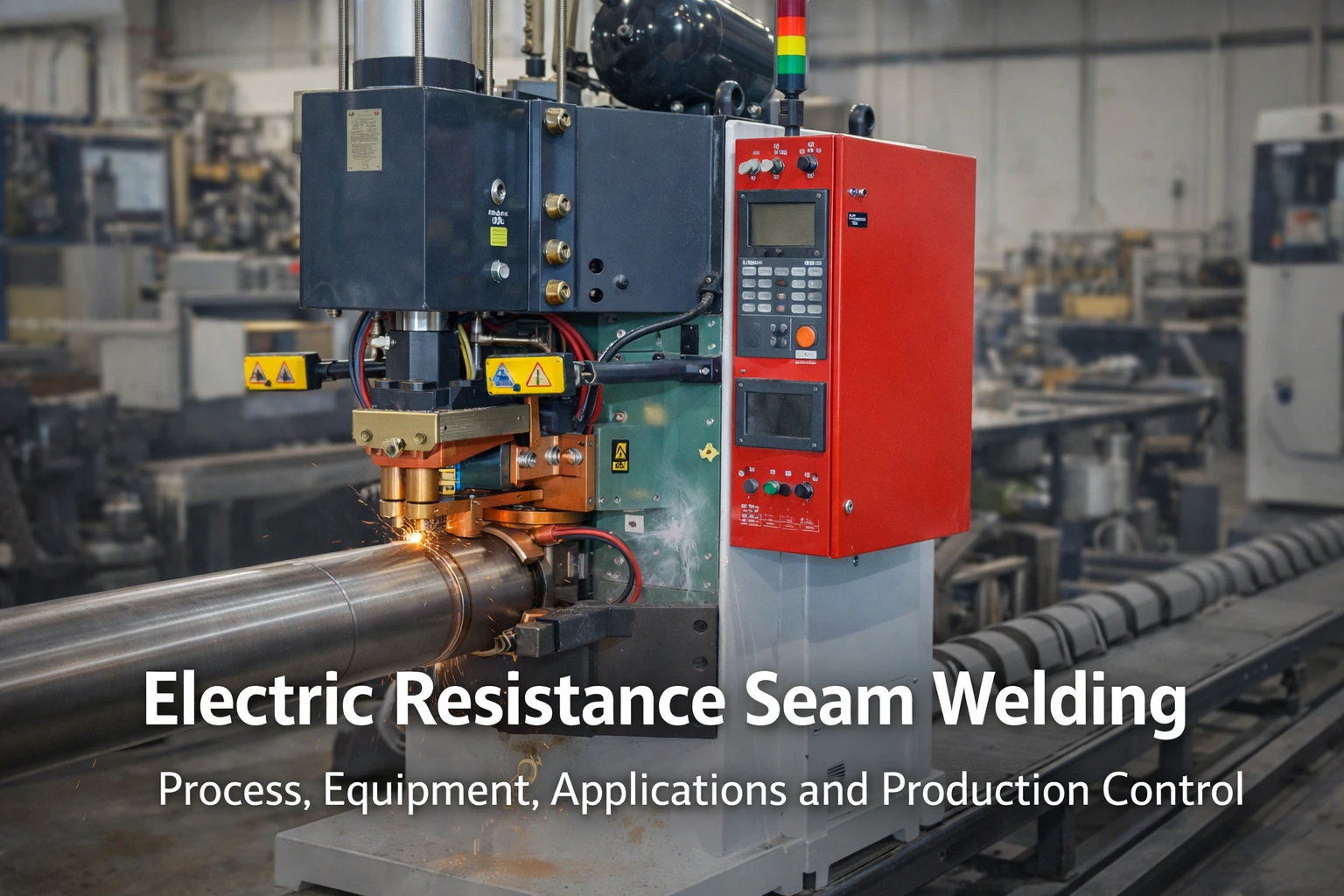
Seam welding uses rotating wheel electrodes to create continuous weld seams. It is ideal for fuel tanks, pressure vessels, and leak-proof containers.
3. Projection Welding
Projection welding concentrates current at pre-formed projections on the workpiece, enabling multiple welds in a single cycle. It is commonly used for fasteners, nuts, and stamped parts.
4. MFDC Resistance Welding
Medium Frequency Direct Current (MFDC) welding systems improve energy efficiency, reduce transformer size, and enhance weld control. They are widely used in modern automated production lines.
5. Capacitor Discharge Welding
This method delivers a rapid burst of energy stored in capacitors, enabling precision welding of small or delicate components with minimal heat impact.
Key Components of an ERW System
A modern electric resistance welding setup includes several critical components:
Welding Electrodes
Typically made of copper alloys, electrodes deliver current and pressure to the workpiece while resisting wear and deformation.
Welding Transformer
The transformer steps down voltage and increases current to generate the required heat at the weld interface.
Control System
Advanced controllers regulate current, time, and pressure to ensure repeatability and weld quality consistency.
Welding Guns and Fixtures
Robotic or manual welding guns apply force and position electrodes accurately, especially in automated production environments.
Heron Welder integrates all these components into intelligent systems designed for industrial scalability and precision.
Industrial Applications of Electric Resistance Welding
Electric resistance welding plays a critical role in multiple manufacturing sectors:
Automotive Industry
Used extensively in car body assembly, chassis components, battery trays, and structural reinforcements.
Electric Vehicle Manufacturing
ERW supports EV production through battery pack assembly, busbar welding, and lightweight structural joining.
Home Appliances
Refrigerators, washing machines, and air conditioners rely on resistance welding for durable sheet metal assembly.
HVAC and Electrical Equipment
Used for ducting systems, control cabinets, busbars, and electrical enclosures.
Metal Fabrication and Industrial Equipment
Supports mass production of brackets, frames, panels, and mechanical assemblies.
Advantages of Electric Resistance Welding
Electric resistance welding offers several key advantages for industrial manufacturers:
- High production speed suitable for automation
- No filler materials required
- Clean welding process with minimal fumes
- Excellent repeatability and consistency
- Low energy consumption (especially MFDC systems)
- Strong mechanical joints with good fatigue resistance
- Easy integration into robotic production lines
These benefits make ERW a preferred choice for OEMs aiming to improve efficiency and reduce manufacturing costs.
Electric Resistance Welding vs Other Welding Methods
Compared to arc welding and laser welding, electric resistance welding offers distinct advantages in specific use cases.
- Versus Arc Welding: ERW is faster, cleaner, and more suitable for thin sheet metals, while arc welding is better for thick or structural sections.
- Versus Laser Welding: Laser welding provides high precision but requires high capital investment and strict joint preparation. ERW offers a more cost-effective solution for mass production.
- Versus Mechanical Fastening: ERW eliminates the need for rivets, bolts, or adhesives, reducing material costs and assembly time.
For high-volume production environments, ERW delivers an optimal balance of speed, cost, and quality.
Best Practices for High-Quality Resistance Welding
To achieve consistent and defect-free welds, manufacturers should follow these best practices:
Optimize Welding Parameters
Carefully control current, time, and electrode force to match material type and thickness.
Maintain Electrode Condition
Regular dressing and replacement of electrodes ensure stable current flow and weld quality.
Ensure Proper Surface Preparation
Clean surfaces free from oil, rust, or coatings improve electrical contact and weld consistency.
Use Advanced Control Systems
Digital controllers and MFDC technology enhance precision and reduce process variability.
Integrate Automation
Robotic welding systems improve repeatability, reduce human error, and increase throughput.
Heron Welder: Advanced Electric Resistance Welding Solutions
Heron Welder delivers a full range of industrial resistance welding technologies designed for modern manufacturing environments. From standalone spot welding machines to fully automated production lines, Heron systems are engineered for:
- High-speed automotive production
- Precision EV component assembly
- Heavy-duty industrial fabrication
- Smart factory automation integration
With a strong focus on engineering innovation, Heron Welder provides customized solutions that align with OEM requirements, production targets, and Industry 4.0 standards. Our systems are designed to improve productivity, reduce operational costs, and ensure long-term weld reliability.
FAQs About Electric Resistance Welding
1. What materials can be joined using electric resistance welding?
Electric resistance welding is commonly used for steel, stainless steel, aluminum alloys, and coated metals, depending on machine configuration and process control.
2. Is electric resistance welding suitable for automation?
Yes, ERW is highly compatible with robotic and automated production lines, making it ideal for high-volume manufacturing industries.
3. What is the main advantage of resistance welding over arc welding?
The main advantage is speed and consistency. ERW requires no filler material and produces clean, repeatable welds with minimal post-processing.
4. How does MFDC improve resistance welding performance?
MFDC systems offer better control of welding current, improved energy efficiency, and more stable weld quality compared to traditional AC systems.
5. What industries benefit most from ERW technology?
Automotive, EV manufacturing, appliance production, HVAC systems, and electrical equipment industries benefit most from electric resistance welding.
Conclusion & Call to Action
Electric resistance welding remains a cornerstone of modern industrial manufacturing, offering unmatched efficiency, precision, and scalability for mass production environments. As industries continue to evolve toward automation and smart factories, ERW technologies are becoming even more essential for maintaining competitiveness and product quality.
Heron Welder stands at the forefront of this evolution, delivering advanced resistance welding machines and customized automation solutions tailored to global manufacturing demands.
If you are looking to improve production efficiency, upgrade welding quality, or build a fully automated welding line, contact Heron Welder to request a technical consultation or customized quotation for your next project.




 English
 Arabic
 French
 Spanish
 Portuguese
 Deutsch
 Turkish
 Dutch
Dutch
 Italiano
 Russian
 Romaian
 Greek
Greek
