


Why Is the Soft Contact Lens Materials Market Expected to Reach USD 12.8 Billion by 2032?
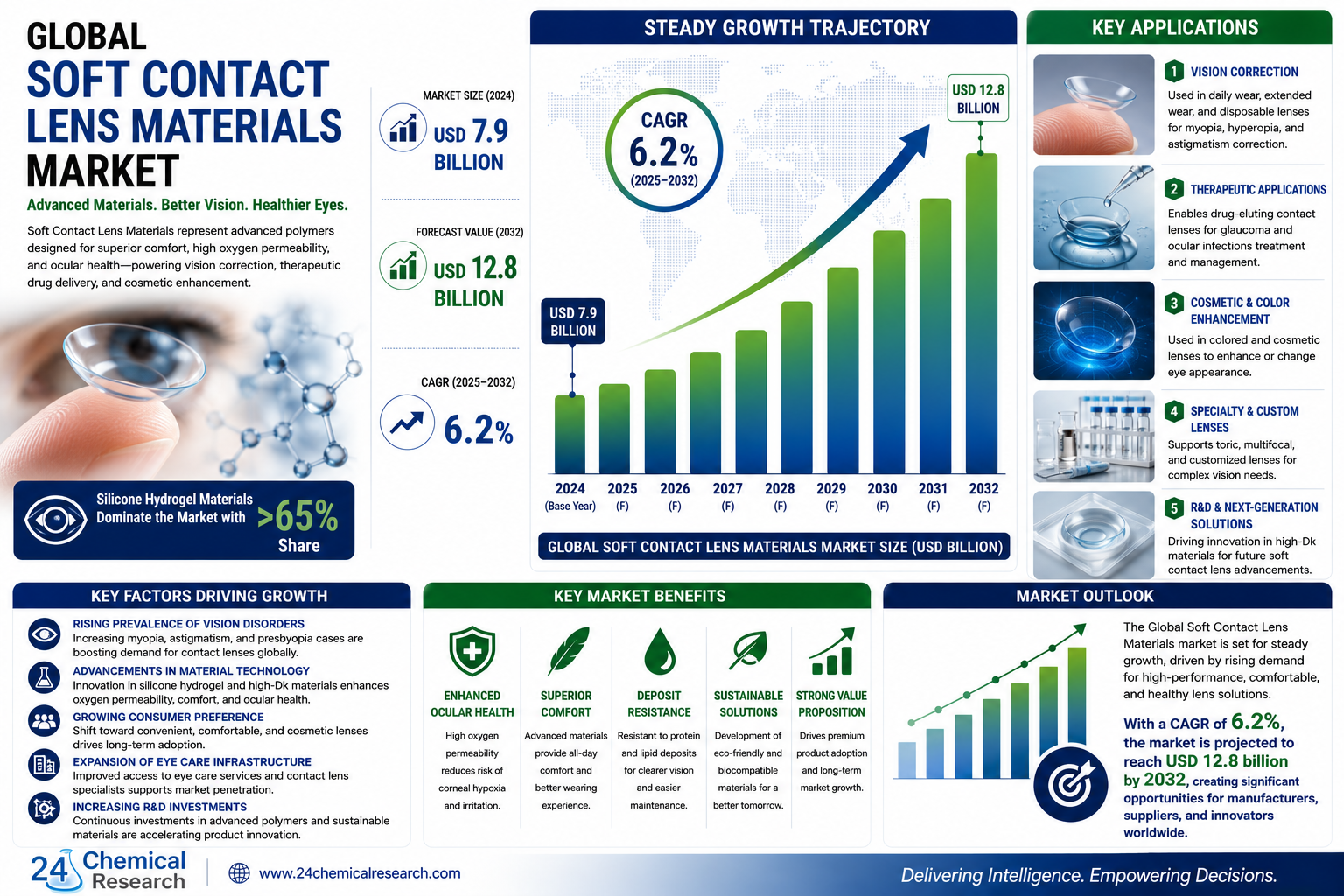
Global Soft Contact Lens Materials market was valued at USD 7.9 billion in 2024 and is projected to reach USD 12.8 billion by 2032, exhibiting a steady CAGR of 6.2% during the forecast period.
Soft Contact Lens Materials represent a sophisticated class of advanced polymers engineered for direct ocular application, supporting vision correction, therapeutic drug delivery, and cosmetic enhancement. These materials have evolved from traditional hydrogel formulations into advanced siloxane-based polymers that deliver high oxygen permeability, superior comfort, improved wettability, and better resistance to protein and lipid deposits.
This evolution reflects the growing need for materials that support corneal health, long wear comfort, and enhanced user experience. The cornea depends on atmospheric oxygen for metabolic health, making oxygen transmissibility one of the most important performance criteria in modern contact lens material development. The shift toward next-generation silicone hydrogels, which now command a dominant market share of over 65%, highlights the industry's focus on improving ocular safety, comfort, and long-term wearability.
Soft contact lens materials are widely used in spherical lenses, toric lenses, multifocal lenses, daily disposable lenses, cosmetic lenses, therapeutic lenses, and emerging smart contact lens platforms. Rising prevalence of myopia, presbyopia, astigmatism, and lifestyle-driven cosmetic lens adoption continues to support strong market expansion.
Get Full Report Here:
https://www.24chemicalresearch.com/reports/265431/global-soft-contact-lens-materials-market-2024-2030-570
Download FREE Sample Report:
https://www.24chemicalresearch.com/download-sample/265431/global-soft-contact-lens-materials-market-2024-2030-570
Market Dynamics
Powerful Market Drivers Propelling Expansion
1. Rising Global Prevalence of Myopia and Presbyopia
The rising global prevalence of myopia and presbyopia remains one of the strongest drivers of the Soft Contact Lens Materials market. Myopia has become a major public health concern, particularly in Asia-Pacific, where prevalence rates among young adults can exceed 80%. The World Health Organization estimates that nearly 2.6 billion people worldwide live with myopia, with the number projected to rise to 3.3 billion by 2030.
Soft contact lenses offer a convenient, effective, and cosmetically preferred alternative to spectacles. Daily disposable lenses are gaining strong traction due to their hygiene benefits, convenience, and reduced risk of complications associated with lens cleaning and storage. This is increasing demand for advanced soft contact lens materials that combine comfort, oxygen permeability, and deposit resistance.
Presbyopia is another major growth factor. As the global population ages, demand for multifocal and presbyopia-correcting soft lenses continues to increase. With over 1.8 billion people expected to be aged 60 or older by 2030, manufacturers are investing in advanced materials that support stable optics, long wear comfort, and improved moisture retention. This demographic shift creates a reliable long-term growth opportunity for soft contact lens material suppliers.
2. Technological Innovations in Material Science
Material science innovation continues to shape the Soft Contact Lens Materials market. The transition from low-Dk hydrogel materials such as poly(HEMA) to high-Dk silicone hydrogels has transformed modern contact lens performance. Silicone hydrogel materials offer oxygen permeability that can be 5 to 10 times higher than traditional hydrogels, helping reduce the risk of hypoxic-related complications such as corneal neovascularization by up to 70%.
Recent innovations are focused on improving wettability, lubricity, and all-day comfort. The incorporation of internal wetting agents such as polyvinylpyrrolidone (PVP) into the polymer matrix has significantly improved surface moisture retention and reduced end-of-day dryness complaints by 30-40% according to clinical studies.
The development of materials with modulus values below 0.7 MPa has also improved initial comfort and adaptability, helping address one of the key barriers to new contact lens user adoption. Manufacturers are increasingly investing in surface modification, plasma coating, water-gradient designs, and advanced polymer chemistry to create lenses that provide both physiological safety and premium comfort.
3. Growing Acceptance and Cosmetic Applications
Beyond vision correction, cosmetic and lifestyle contact lenses are creating strong market growth opportunities. The global cosmetic contact lens segment has become a multi-billion-dollar market driven by fashion trends, social media influence, entertainment applications, and rising consumer interest in aesthetic eye enhancement.
Modern cosmetic lens materials are engineered with safe encapsulated pigments that do not leach onto the ocular surface. These materials are also designed to maintain high oxygen transmissibility and comfort during wear. The growing use of plano, or non-prescription, colored lenses for aesthetic purposes is attracting a younger demographic to contact lens wear.
Demand for cosmetic contact lenses has seen a compound annual growth rate exceeding 8%, significantly outpacing the broader soft contact lens materials market. As consumers increasingly view contact lenses as both corrective and lifestyle products, manufacturers are developing materials that balance beauty, safety, oxygen flow, comfort, and regulatory compliance.
Significant Market Restraints Challenging Adoption
1. High Cost of Advanced Materials and Manufacturing
The development and production of next-generation silicone hydrogel materials involve complex polymerization processes, advanced purification systems, and strict quality control requirements. Production costs are typically 25-35% higher than those of conventional hydrogel materials.
The purification of raw siloxane macromers and precise control over phase separation required to create optimal oxygen-transmission structures add significant manufacturing expense. These higher costs are passed through the value chain, making advanced lenses less affordable in price-sensitive emerging markets.
2. Stringent Regulatory Hurdles and Compliance Costs
Soft contact lenses and their materials are classified as medical devices and must comply with strict regulatory approval processes. Bodies such as the U.S. FDA and the European Union's MDR require extensive testing for biocompatibility, physicochemical properties, stability, and safety.
A single new material formulation can require regulatory investment exceeding $1-2 million and approval timelines of 3-5 years. The ISO 18369 series also sets strict standards for ocular implants and contact lens materials. These regulatory barriers increase costs and limit rapid innovation, particularly for smaller companies.
Critical Market Challenges Requiring Innovation
The Soft Contact Lens Materials market faces several technical and commercial challenges as manufacturers move from laboratory-scale polymer development to mass production. Achieving consistent material properties across large production batches remains a major concern. Variations in monomer purity, polymerization conditions, curing behavior, or hydration processes can create inconsistencies in oxygen permeability, modulus, wettability, and optical clarity.
In early-stage manufacturing, rejection rates can reach 10-15%, increasing production costs and slowing commercialization. Maintaining uniformity is especially difficult in silicone hydrogel materials because siloxane components are inherently hydrophobic, even though they provide excellent oxygen transmission.
Surface wettability remains a key innovation challenge. A material may deliver high oxygen permeability but still cause discomfort if the lens surface dries during wear. Plasma coatings, internal wetting agents, and surface treatments help address this issue, but coating degradation and lens spoilage can still affect product performance.
Patient compliance is another critical challenge. Studies indicate that 40-50% of contact lens wearers do not fully follow recommended hygiene, replacement, or wear schedules. Poor compliance can increase the risk of microbial keratitis and other adverse events. This creates a need for safer daily disposable lenses, improved materials, better patient education, and more forgiving lens technologies.
Manufacturers must therefore balance comfort, safety, affordability, oxygen transmission, wettability, durability, and regulatory approval requirements. Companies that can solve these challenges through advanced materials, improved manufacturing control, and user-friendly lens designs are expected to gain a strong competitive advantage.
Vast Market Opportunities on the Horizon
1. Therapeutic and Drug-Delivery Applications
Soft contact lenses are increasingly being explored as advanced ocular drug delivery platforms. Drug-eluting lenses can provide controlled pharmaceutical release for conditions such as glaucoma, dry eye disease, and post-surgical recovery.
Compared with traditional eye drops, which lose a large portion of active ingredients due to blinking and tear drainage, therapeutic contact lenses can improve drug residence time and patient compliance. The global ophthalmic drugs market, valued at over $35 billion, presents a major adjacent opportunity for lens manufacturers that can successfully commercialize combination products.
2. Integration with Digital Health and Smart Technology
Smart contact lens technology represents a major long-term opportunity. Prototypes embedded with miniaturized sensors have demonstrated potential for monitoring intraocular pressure in glaucoma patients and tracking non-invasive glucose levels for diabetics.
Although smart lenses remain largely in the research and development phase, the ability to collect continuous physiological data from the tear film could transform chronic disease monitoring. Successful commercialization could create a premium, high-value market segment for advanced soft contact lens materials.
3. Expansion in Emerging Economies
Asia-Pacific, Latin America, and the Middle East & Africa offer substantial growth opportunities. Rising disposable incomes, increasing awareness of vision care, greater access to optometrists, and growing myopia prevalence are expanding the user base for soft contact lenses.
Companies that develop cost-optimized materials, localized product strategies, and affordable distribution models can capture significant demand in these underpenetrated markets. Emerging economies are expected to become increasingly important for long-term market expansion.
In-Depth Segment Analysis
By Type
The market is segmented into Poly(Hydroxyethyl Methacrylate) (PHEMA), HEMA Hybrid Material, and Non-HEMA Material.
Non-HEMA materials, particularly Silicone Hydrogel Materials, currently lead the market and are expected to maintain dominance throughout the forecast period. Silicone hydrogels offer oxygen permeability that can be 5 to 10 times higher than traditional PHEMA hydrogels, making them critical for maintaining corneal health, especially in extended-wear and daily disposable lenses.
HEMA Hybrid Materials remain commercially relevant because they provide improved performance over conventional hydrogels while maintaining a more affordable cost structure than pure silicone hydrogel materials. These materials serve as bridge technologies in markets where cost sensitivity remains high.
PHEMA materials continue to serve specific applications where affordability, softness, and proven performance are valued, although their growth is slower compared with advanced silicone-based materials.
By Application
The market is segmented into Soft Contact Lenses, Corneal Contact Lenses, and Others.
Soft Contact Lenses dominate the market and represent the largest application segment. This includes spherical lenses, toric lenses for astigmatism, multifocal lenses for presbyopia, daily wear lenses, extended wear lenses, and daily disposable lenses.
Daily disposable lenses are the strongest growth driver within this segment because they reduce risks linked to lens cleaning, storage, and non-compliance. Their convenience and hygiene benefits make them increasingly popular among both new and experienced users.
Corneal Contact Lenses represent a smaller and more specialized segment, mainly serving specific clinical and vision correction needs. Other applications include therapeutic lenses, cosmetic lenses, and emerging smart lens platforms.
By End-User Industry
The end-user landscape is defined by vision correction, therapeutic need, and lifestyle preference.
Corrective Lens Wearers form the core revenue base, including users with myopia, hyperopia, astigmatism, and presbyopia. This segment benefits from growing vision care awareness and rising diagnosis rates worldwide.
Cosmetic Lens Wearers represent a high-growth segment driven by fashion trends, social media influence, and increasing demand for colored and lifestyle lenses.
Therapeutic Lens Users represent a specialized but important niche, including patients using bandage lenses, ocular surface protection lenses, and drug-delivery lens platforms. Distribution channels include optometrists, ophthalmologists, optical retail stores, and online retailers.
Market Segmentation and Key Players
Johnson & Johnson Vision (U.S.)
Alcon (Switzerland/U.S.)
CooperVision (U.S.)
Bausch + Lomb (U.S.)
Contamac (U.K.) - A leading independent material supplier
BenQ Materials (Taiwan)
Menicon (Japan)
St. Shine Optical (Taiwan)
Hydron (China)
Nice Group (China)
The global Soft Contact Lens Materials market is highly consolidated, with Johnson & Johnson Vision, Alcon, CooperVision, and Bausch + Lomb collectively commanding over 85% of the global market share. Their leadership is supported by extensive R&D capabilities, broad intellectual property portfolios, strong manufacturing infrastructure, and established relationships with eye care professionals worldwide.
Competition is centered on comfort, oxygen permeability, wettability, deposit resistance, daily disposable innovation, multifocal performance, smart lens development, and patient safety. Major companies are investing heavily in silicone hydrogel chemistry, water-gradient technologies, surface modification, and digital health integration.
Market positioning is also influenced by prescription behavior, brand trust, professional recommendations, and pricing strategies. Price competition is particularly strong in the daily disposable segment, while premium innovation remains important in silicone hydrogel, multifocal, cosmetic, and therapeutic lens categories.
Regional Analysis
North America
North America is one of the largest and most mature markets for Soft Contact Lens Materials. High consumer awareness, strong purchasing power, advanced healthcare infrastructure, and early adoption of daily disposable silicone hydrogel lenses support regional demand.
The United States remains a key growth contributor due to high contact lens penetration, strong optometry networks, and the presence of major global lens manufacturers. Demand for premium lenses, multifocal lenses, and innovative materials continues to rise across the region.
Europe
Europe represents another major mature market, supported by strong eye care infrastructure, widespread use of advanced contact lenses, and strict product quality standards. The region benefits from high adoption of silicone hydrogel lenses and daily disposable modalities.
European consumers increasingly prioritize comfort, safety, and convenience, supporting demand for high-performance materials. Regulatory standards also encourage manufacturers to maintain strong safety and biocompatibility profiles.
Asia-Pacific
Asia-Pacific is the fastest-growing regional market, driven by high and increasing prevalence of myopia, a massive population base, rising disposable incomes, and improving access to vision care. Countries such as China, Japan, and South Korea are major consumers and also important manufacturing hubs.
The region includes both premium markets, where advanced silicone hydrogel and cosmetic lenses are popular, and value-oriented markets, where affordability plays a major role. Rising awareness of eye health and expanding retail and online distribution are expected to support continued market growth.
Latin America
Latin America presents significant long-term growth potential as vision care awareness improves and disposable incomes rise. Contact lens penetration remains lower than in North America and Europe, creating room for expansion.
Brazil, Mexico, and other major regional markets are expected to benefit from increasing access to optometrists, retail optical chains, and online lens purchasing platforms. Price sensitivity remains a challenge, making affordable yet comfortable materials important for growth.
Middle East & Africa
The Middle East & Africa region represents an emerging frontier for Soft Contact Lens Materials. Improving healthcare expenditure, expanding urban populations, and rising interest in cosmetic lenses are supporting gradual market development.
The Gulf region shows demand for premium and cosmetic lenses, while parts of Africa remain underpenetrated due to affordability and access limitations. Long-term growth will depend on improved distribution networks, professional eye care access, and consumer education.
Frequently Asked Questions (FAQs)
What are Soft Contact Lens Materials?
Soft Contact Lens Materials are advanced polymers used to manufacture lenses for vision correction, cosmetic enhancement, and therapeutic eye care. These materials include hydrogels, HEMA hybrids, and silicone hydrogels designed for comfort, oxygen permeability, and ocular safety.
What is driving growth in the Soft Contact Lens Materials market?
Market growth is driven by rising myopia and presbyopia prevalence, silicone hydrogel innovation, demand for daily disposable lenses, cosmetic lens adoption, and emerging therapeutic and smart lens applications.
Which industries use Soft Contact Lens Materials?
Soft Contact Lens Materials are used by contact lens manufacturers, eye care companies, optical retailers, ophthalmology providers, therapeutic lens developers, and cosmetic lens producers.
What are the major applications of Soft Contact Lens Materials?
Major applications include soft contact lenses, toric lenses, multifocal lenses, daily disposable lenses, cosmetic lenses, therapeutic bandage lenses, drug-delivery lenses, and emerging smart contact lenses.
Which region dominates the Soft Contact Lens Materials market?
North America and Europe together account for over 60% of global revenue, while Asia-Pacific is the fastest-growing region due to high myopia prevalence, rising disposable incomes, and expanding access to vision care.
About 24chemicalresearch
Founded in 2015, 24chemicalresearch has rapidly established itself as a leader in chemical market intelligence, serving clients including over 30 Fortune 500 companies. We provide data-driven insights through rigorous research methodologies, addressing key industry factors such as government policy, emerging technologies, and competitive landscapes.
• Plant-level capacity tracking
• Real-time price monitoring
• Techno-economic feasibility studies
International: +1(332) 2424 294 | Asia: +91 9169162030
Website: https://www.24chemicalresearch.com/

 English
 Arabic
 French
 Spanish
 Portuguese
 Deutsch
 Turkish
 Italiano
 Russian
 Romaian
 Portuguese (Brazil)
 Greek
Greek
