


What Qualifies as an Antique Rug? Understanding Age, Value, and Authenticity
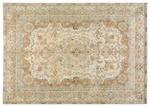
When most people think of an antique rug, they picture a dusty, faded floor covering hidden in a grandmother's attic. But in reality, antique rugs are among the most prized and valuable textile art forms in the world — rich in history, craftsmanship, and investment potential. Before you buy, sell, or inherit one, it's essential to understand what actually qualifies a rug as "antique."
The Age Rule: 100 Years or More
According to the U.S. Customs definition, a rug must be at least 100 years old to be classified as a true antique. This is the globally recognized benchmark used by dealers, auction houses, and collectors alike. Rugs that are between 20 and 99 years old are typically referred to as "vintage" — valuable in their own right, but a separate category entirely.
Rugs made before 1925 are now widely accepted as antiques. These include Persian, Turkish, Caucasian, Chinese, and Central Asian pieces woven during a time when natural dyes and hand-spinning techniques were the standard.
Natural Dyes vs. Synthetic Dyes
One of the most reliable markers of an antique rug is the use of natural dyes. Before the introduction of synthetic aniline dyes in the 1860s and chrome dyes in the early 1900s, weavers used plants, insects, and minerals to produce color. Natural indigo for blue, madder root for red, and pomegranate rinds for yellow were common. These dyes age beautifully, softening over time in a process known as "abrash" — subtle color variation across the pile.
Synthetic dyes, by contrast, often appear harsher and more uniform. A rug with vivid, unnatural-looking reds or blues that haven't faded at all is likely post-1900, if not modern.
Wool Quality and Pile Construction
Older rugs were typically made with hand-spun wool from sheep raised in harsh climates — this "highland wool" is lanolin-rich, lustrous, and incredibly durable. The hand-spinning process produces slight irregularities that give antique rugs their characteristic texture.
Machine-spun or commercially processed wool, introduced widely in the 20th century, produces a more uniform but less resilient fiber. Under magnification, hand-spun wool fibers appear twisted and irregular, while machine-spun fibers are perfectly round and consistent.
Knot Count and Weaving Techniques
While knot density (measured in knots per square inch) doesn't directly determine age, it's a useful quality indicator. Fine antique Persian city rugs from Tabriz or Isfahan can have hundreds of knots per square inch, enabling intricate curvilinear designs. Tribal rugs tend to have lower knot counts with bolder, geometric patterns.
The type of knot also helps with attribution: the asymmetrical Persian (Senneh) knot is used across Persia, Central Asia, and India, while the symmetrical Turkish (Ghiordes) knot is common in Anatolian and some Caucasian rugs.

 English
 Arabic
 French
 Spanish
 Portuguese
 Deutsch
 Turkish
 Dutch
Dutch
 Italiano
 Russian
 Portuguese (Brazil)
 Greek
Greek
