


Market Forecast: Cloud Data Warehouse
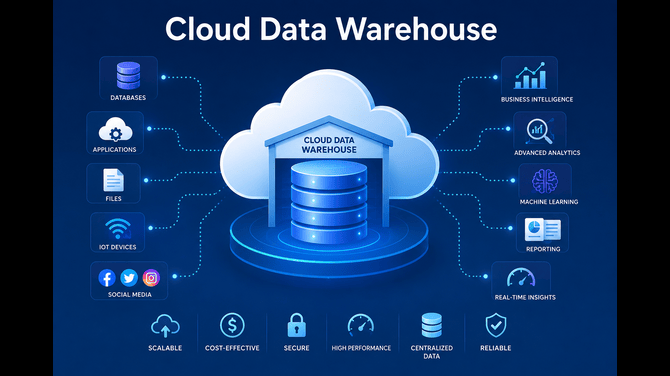
A Cloud Data Warehouse enables organizations to centralize structured, semi-structured, and unstructured data while supporting advanced analytics, artificial intelligence, and business intelligence applications. With virtually unlimited scalability and high-performance computing capabilities, cloud-based data warehousing has become a critical component of modern enterprise data strategies.
What is a Cloud Data Warehouse?
A Cloud Data Warehouse is a cloud-based platform designed for storing and managing large volumes of business data for reporting, analytics, and decision-making. Unlike traditional on-premises systems, cloud data warehouses leverage cloud infrastructure to provide elasticity, automation, and real-time data processing capabilities.
These platforms integrate data from multiple sources, including CRM systems, ERP software, databases, applications, and IoT devices, into a centralized repository. Businesses can then use analytics and visualization tools to generate insights and improve operational efficiency.
Key Features of Cloud Data Warehouse Platforms
Scalability and Flexibility
One of the biggest advantages of a Cloud Data Warehouse platform is its ability to scale resources dynamically. Businesses can increase or decrease storage and computing power based on workloads without investing in expensive hardware.
Cost Efficiency
Cloud-based platforms use pay-as-you-go pricing models, allowing organizations to pay only for the resources they consume. This reduces upfront capital expenditures and lowers operational costs compared to traditional infrastructure.
Centralized Data Management
A Cloud Data Warehouse consolidates data from multiple sources into a unified repository, enabling organizations to maintain data consistency, governance, and security while simplifying data management processes.
High-Speed Analytics
Modern cloud data warehouses are optimized for high-performance analytics and query processing. Businesses can analyze large datasets quickly, enabling faster reporting and data-driven decision-making.
Support for Multiple Data Types
Cloud data warehouse platforms can manage structured, semi-structured, and unstructured data formats, making them suitable for handling diverse enterprise data requirements.
Benefits of Cloud Data Warehousing
Improved Business Intelligence
By integrating with business intelligence and analytics tools, cloud data warehouses help organizations gain actionable insights from data. Decision-makers can access real-time dashboards, reports, and predictive analytics to improve strategic planning.
Faster Decision-Making
With real-time data access and high-speed processing, organizations can make informed decisions faster. This agility helps businesses respond quickly to market changes and customer demands.
Enhanced Collaboration
Cloud platforms enable teams across different locations to access shared data securely. This improves collaboration between departments and supports remote work environments.
Reduced IT Complexity
Cloud providers handle infrastructure maintenance, software updates, and system management, allowing IT teams to focus on innovation and business growth rather than hardware management.
Applications of Cloud Data Warehouses Across Industries
Retail and E-commerce
Retail companies use cloud data warehouses to analyze customer behavior, optimize inventory, personalize marketing campaigns, and improve supply chain management.
Healthcare
Healthcare organizations leverage cloud-based data warehouses to manage patient records, improve diagnostics, support medical research, and ensure regulatory compliance.
Banking and Financial Services
Financial institutions utilize cloud data warehousing solutions for fraud detection, risk analysis, customer analytics, and regulatory reporting.
Manufacturing
Manufacturers use cloud data warehouses to monitor production processes, analyze equipment performance, and optimize operational efficiency through predictive maintenance.
Future Trends in Cloud Data Warehousing
The future of Cloud Data Warehouse technology is driven by advancements in artificial intelligence, automation, and real-time analytics. Emerging trends include:
- Serverless data warehousing
- AI-powered analytics
- Multi-cloud and hybrid cloud deployments
As businesses continue to embrace digital transformation, cloud data warehouses will remain essential for managing and extracting value from rapidly growing data volumes.
Conclusion
The increasing complexity and scale of enterprise data have made Cloud Data Warehouse solutions a necessity for modern organizations. These platforms provide scalable, flexible, and cost-effective environments for centralized data management, advanced analytics, and real-time decision-making.
By adopting a robust Cloud Data Warehouse platform, businesses can improve operational efficiency, enhance customer experiences, support AI-driven innovation, and gain a competitive advantage in today’s data-driven economy.

 English
 French
 Spanish
 Portuguese
 Deutsch
 Turkish
 Dutch
Dutch
 Italiano
 Russian
 Romaian
 Portuguese (Brazil)
 Greek
Greek
