


Aircraft Fuel Systems Market Forecast to Reach US$ 10.4 Billion by 2034
Market Overview and Growth Outlook
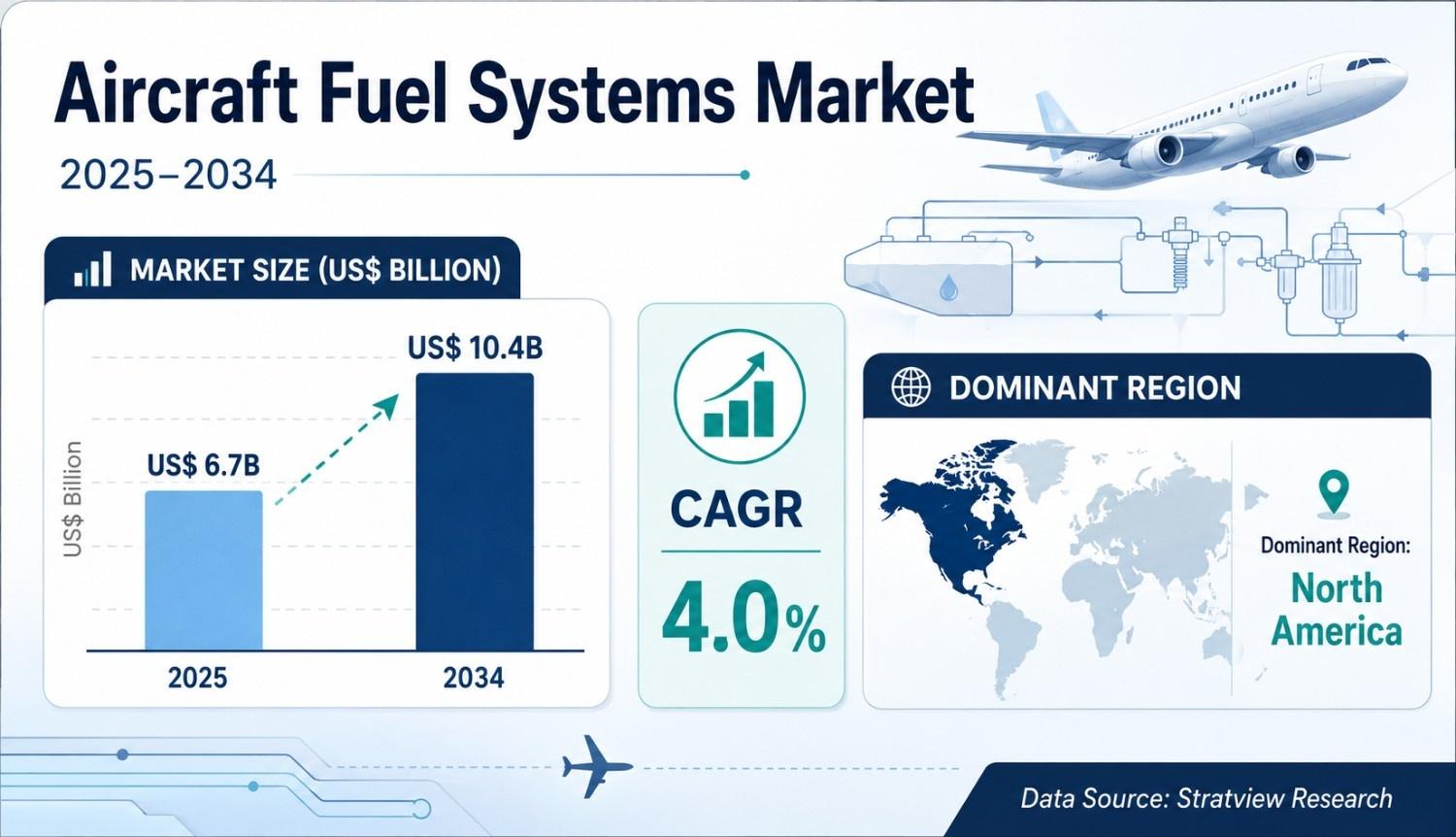
The Aircraft Fuel Systems Market forecast indicates expansion from US$ 6.7 billion in 2025 to US$ 10.4 billion by 2034. The Aircraft Fuel Systems Market is expected to grow at a CAGR of 4.0% during 2026–2034. Demand is increasing as aircraft platforms require greater fuel efficiency, safety, and automation.
Aircraft fuel systems manage fuel storage, control, delivery, transfer, monitoring, and redundancy. Their importance rises with complex aircraft architectures, modern propulsion systems, and stricter safety expectations. The Aircraft Fuel Systems Market forecast reflects the aviation industry’s need for smarter and more reliable fuel handling systems.
Request a free sample report:
https://www.stratviewresearch.com/Request-Sample/aircraft-fuel-systems-market#form
Market Segmentation Analysis
The Aircraft Fuel Systems Market is segmented by Aircraft Type into Commercial Aircraft, Regional Aircraft, Military Aircraft, Helicopter, General Aviation, and UAV. Commercial aircraft are expected to dominate demand and grow fastest during the forecast period due to production rates and the largest global fleet size.
By Component Type, the market is segmented into Pipe, Pump, Inerting System, Valve, Gauging & Management System, Filters, Tank, Metering, and Other Components. Gauging & Management System is expected to maintain its lead through 2034, while Inerting System is likely to remain the fastest-growing component type.
By Technology Type, the market is segmented into Fuel Injection, Pump Feed, and Gravity Feed. Pump Feed is likely to remain the most attractive technology type during the study period, supported by adoption in modern commercial and military aircraft platforms that require dependable fuel delivery.
By Engine Type, the market is segmented into Turbofan, Turboprop, and Other Engines. Turbofan is likely to maintain dominance by 2034, supported by its use in commercial aircraft, military aircraft, regional aircraft, and business jets. This reinforces demand for accurate fuel metering and control systems.
By Application Type, the market is segmented into Airframe and Engine. Airframe is likely to remain the widely used application, reflecting the broader fuel system scope across tanks, pumps, valves, inerting, and fuel distribution. Engine is expected to achieve higher growth during the forecast period.
By End-User Type, the market is segmented into OE and Aftermarket. OE is expected to remain dominant and faster-growing, driven by aircraft and aeroengine production, strong order backlogs, and demand for advanced fuel systems for next-generation engines.
Regional Market Insights
North America is expected to remain the largest region in the Aircraft Fuel Systems Market. The region’s lead is supported by Boeing, Gulfstream Aerospace, GE Aerospace, Pratt & Whitney, major Tier-1 players, MRO providers, airlines, and established aerospace manufacturing ecosystems.
Asia-Pacific is likely to grow at the fastest rate during 2026–2034. China and India are expected to impact regional demand, with China’s efforts toward indigenous production creating opportunity pools across the aircraft fuel systems value chain.
Emerging Trends Shaping the Aircraft Fuel Systems Market
The market is shaped by a shift toward advanced fuel monitoring, automation, and safety-focused architectures. Digital fuel quantity indication, automated fuel transfer, fuel balancing, and real-time diagnostics are becoming important because they improve accuracy and reduce pilot workload.
Manufacturers are also focusing on lightweight designs, advanced materials, composites, corrosion-resistant alloys, SAF-compatible systems, and more-electric aircraft configurations. These developments support fuel economy, durability, safety, and operational reliability across modern aviation platforms.
Key Growth Drivers of the Market
- Fleet modernization is raising demand for fuel-efficient aircraft and advanced fuel management systems.
- Aircraft production and aeroengine production are supporting OE demand across next-generation platforms.
- Regulatory pressure for fuel efficiency and emissions reduction is increasing the need for lighter and smarter systems.
- Digital monitoring and automated fuel balancing are improving safety, accuracy, and operational efficiency.
- Military aircraft upgrades and hybrid-electric propulsion trends are increasing the need for intelligent fuel management.
Competitive Landscape
Top Companies in the Market
Eaton Corporation Plc
Parker Hannifin Corporation
RTX Corporation
Safran S.A.
Woodward, Inc.
Honeywell International Inc.
Crane Company
Triumph Group, Inc.
PTI Technologies (ESCO Technologies)
Robertson Fuel Systems, LLC (Heico)
Conclusion and Strategic Outlook
The Aircraft Fuel Systems Market forecast shows steady long-term expansion, with value expected to reach US$ 10.4 billion by 2034 at a CAGR of 4.0%. Growth is anchored in aircraft production, safety requirements, automation, fuel efficiency, and advanced fuel management. The industry outlook favors suppliers aligned with smarter and lighter aircraft systems.
FAQs – Aircraft Fuel Systems Market
What is the Aircraft Fuel Systems Market forecast?
The Aircraft Fuel Systems Market is forecast to reach US$ 10.4 billion by 2034. It was valued at US$ 6.7 billion in 2025.
What CAGR will the Aircraft Fuel Systems Market record?
The Aircraft Fuel Systems Market is expected to grow at a CAGR of 4.0% during 2026–2034. This indicates a stable long-term growth path.
What are the main growth drivers?
The main drivers include fleet modernization, aircraft production, fuel efficiency requirements, safety regulations, and digital fuel management. OE demand is also increasing due to aircraft and aeroengine production.
Which region dominates the Aircraft Fuel Systems Market?
North America is expected to remain the largest market during the forecast period. The region is supported by major OEMs, Tier-1 players, MRO providers, airlines, and engine manufacturers.
What is the market outlook for investors and suppliers?
The outlook is favorable for suppliers focused on automation, monitoring accuracy, safety systems, lightweight designs, and SAF-compatible components. Competition depends on innovation, cost efficiency, precision, and safety compliance.

 English
 Arabic
 French
 Spanish
 Portuguese
 Deutsch
 Turkish
 Dutch
Dutch
 Italiano
 Romaian
 Portuguese (Brazil)
 Greek
Greek
