


Bake-Stable Chocolate Fillings Market Set to Reach USD 654.4 Million by 2036
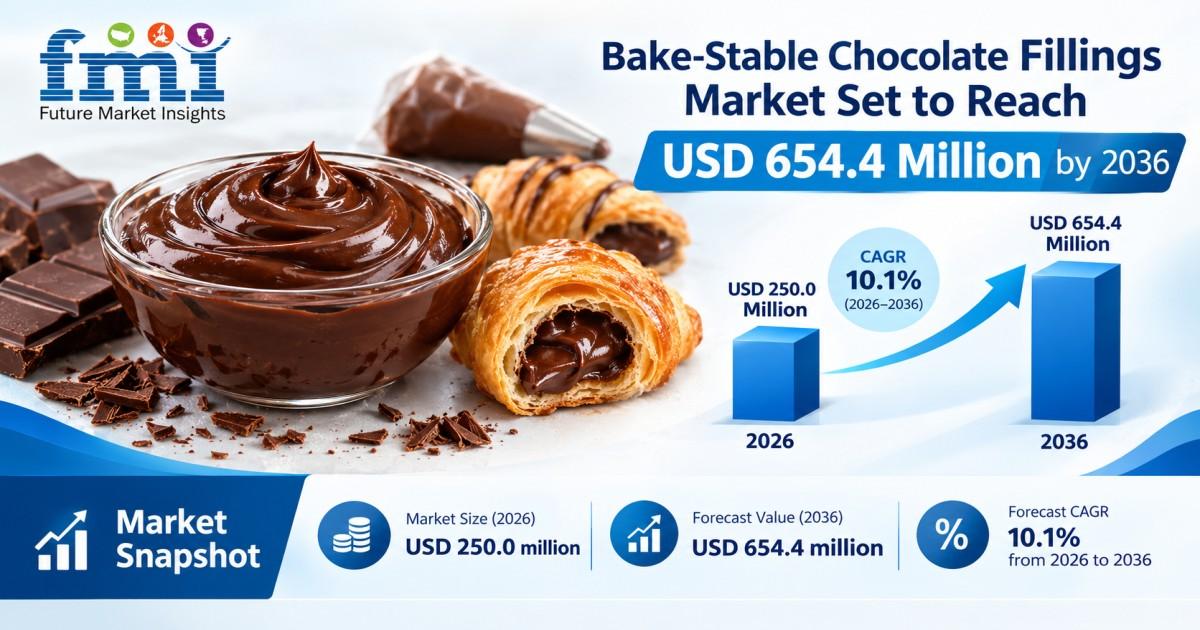
Dark chocolate varieties are projected to represent 39.0% of product type demand in 2026, as the global bake-stable chocolate fillings market expands from USD 250.0 million in 2026 to USD 654.4 million by 2036, according to the latest research report published by Future Market Insights.
The bake-stable chocolate fillings market is entering an expanded commercial phase as industrial wholesale bakeries, pastry manufacturers, and automated snack lines increasingly specify heat-resistant chocolate cremes, pastes, and powders that deposit cleanly, resist boiling or oil separation, and retain their rich cocoa-forward flavor profiles through high-temperature baking processes.
Input economics and manufacturing investments are actively shaping ingredient selection: with Barry Callebaut opening its third Canadian chocolate factory in Brantford, Ontario, and global processors expanding specialized lines, the industrial supply base is scaling up to meet rising demand. Concurrently, rising cocoa and confectionery input costs—highlighted by German federal statistical data showing wholesale prices for sugar, confectionery, and bakery products surging over 12% year-over-year—are prompting baking R&D teams to demand rigorous dosage efficiency and precise hydration control to protect finished product margins without sacrificing the consumer-facing indulgence of a filled bakery center.
Get Detailed Market Forecasts, Competitive Benchmarking, and Pricing Trends:
https://www.futuremarketinsights.com/reports/sample/rep-gb-35005
Future Market Insights estimates that the global bake-stable chocolate fillings market will advance at a robust 10.1% CAGR between 2026 and 2036, adding more than USD 404 million in incremental value over the ten-year forecast window.
The primary operational hurdle remains plant-specific qualification: while an ingredient supplier may offer a cost-effective chocolate filling, a lower unit price holds little value if the filling experiences viscosity drift, center migration, or leakage during oven expansion, requiring extensive, time-consuming factory line trials before a replacement can be approved.
How Are Different Companies Approaching the Bake-Stable Chocolate Opportunity?
The competitive landscape divides between global chocolate and pastry giants, specialized industrial bakery ingredient systems, and regional manufacturing networks. World-class chocolate platforms such as Barry Callebaut, Puratos, and IRCA Group combine deep cocoa sourcing with comprehensive technical support centers (such as Puratos’s 120 global innovation hubs and Barry Callebaut's Brantford facility), providing industrial clients with tailored fat systems and viscosity profiles.
Concurrently, specialized bakery-system providers like Dawn Foods, CSM Ingredients (launching its Creami range), and Royal Zeelandia Group integrate bake-stable chocolate solutions directly into broader premix, fat, and cream platforms. Meanwhile, regional networks like Bakels and AGRANA offer localized formulation adjustments for complex regulatory and allergen environments.
This market structure highlights distinct operating strategies: primary chocolate platforms focus on cocoa origin management, advanced fat-crystal stability, and high-volume molding, whereas industrial bakery ingredient systems emphasize depositor compatibility, dough-sealing performance, and direct plant-floor troubleshooting.
The shared commercial objective is thermal stability: a bake-stable filling achieves permanent plant adoption only when it maintains its designated center position and melt-resistant texture across high-speed industrial baking lines.
Why Do Powder - Dry Formats Lead Production Systems?
Powder - dry formats are projected to lead the form category with a 52.0% market share in 2026, driven by their superior storage efficiency, reduced transport weight, and precise, flexible hydration control at the bakery level.
Dry powder blends allow industrial baking plants to store shelf-stable concentrates and set the final moisture and viscosity right before depositing by adjusting water additions according to the specific dough recipe. This approach minimizes transport costs for liquid weight, simplifies allergen separation in dry ingredient rooms, and provides bakers with tight control over texture consistency across multi-plant manufacturing networks.
Standalone Market Stat: The global bake-stable chocolate fillings market is forecast to add more than USD 404.4 million in value between 2026 and 2036.
Analyst Perspective
“Industrial bakers qualify bake-stable fillings by depositability and oven retention then compare finished-product economics with unit price. A filling company earns repeat business by proving those conditions on the customer's line without forcing changes to dough handling or oven settings.” — Nandini Roy Choudhury, Principal Consultant, Future Market Insights
Market Snapshot
- Market Size (2026): USD 250.0 million
- Forecast Value (2036): USD 654.4 million
- Forecast CAGR:1% from 2026 to 2036
- Leading Product Type: Dark chocolate fillings, capturing a projected 39.0% share in 2026
- Leading Form: Powder - dry, estimated at 52.0% share in 2026
- Leading Application: Bread & rolls, holding 27.0% of market demand in 2026
- Leading Sales Channel: Direct to industrial bakeries, representing 48.0% in 2026
- Fastest-Growing Country: United Arab Emirates (UAE) at an 11.3% CAGR
What Is Driving Demand Across the Market?
Bread and roll applications anchor market demand at 27.0% share in 2026, as enclosed sweet-dough systems require precise pre-bake filling placement and robust sealing performance to prevent leakage during rapid oven expansion.
Dark chocolate variants lead product type demand at 39.0% share in 2026, prized for their ability to project intense cocoa flavor profiles that remain perceptible even after rigorous thermal exposure.
Direct to industrial bakeries captures the largest sales channel share at 48.0% in 2026, reflecting the collaborative plant trials and equipment calibration required to integrate new heat-stable fillings into high-speed industrial lines.
Geographically, the United Arab Emirates (UAE) leads country-level expansion at an 11.3% CAGR through 2036, supported by rapid domestic food-manufacturing investments and expanding industrial baking infrastructure. Saudi Arabia follows closely at an 11.0% CAGR, underpinned by large-scale commercial bakery consolidation, while South Korea (10.7%), the United States (10.4%), and Germany (10.0%) reflect mature industrial baking economies balancing strict cocoa cost management with uncompromising product quality.
Exclusive Discounts on Full Report: https://www.futuremarketinsights.com/reports/bake-stable-chocolate-fillings-market
About the Report
The Bake-Stable Chocolate Fillings Market report provides comprehensive commercial analysis of commercial chocolate-based fillings formulated to retain their texture, location, and sensory profile through industrial baking processes.
The research segments the market by product type (dark, milk, white & blond, sugar-free & specialty), form (powder - dry, liquid, paste / semi-solid, granules / pieces), application (bread & rolls, cakes & muffins, biscuits & cookies, viennoiserie & pastry, other bakery & snacks), claim (conventional, clean label, organic, non-GMO / identity preserved), sales channel (direct to industrial bakeries, ingredient distributors, foodservice & artisan supply, online B2B), and 20+ national markets.
The analysis synthesizes primary interviews with industrial pastry formulators, chocolate technologists, and bakery procurement directors, supported by desk research across governmental agricultural and economic databases (German Federal Statistical Office, UAE Ministry of Industry and Advanced Technology, U.S. FDA), and corporate financial disclosures.
About Future Market Insights (FMI)
Future Market Insights (FMI) delivers actionable, decision-focused market intelligence that goes beyond traditional research reports.
The company provides:
- In-depth pricing and cost benchmarking analysis
- Demand forecasting based on real industry inputs
- Procurement and buyer behavior insights
- Supply chain and trade flow intelligence
- Technology and application trend analysis across industries
FMI follows a robust bottom-up research methodology, combining insights from industry experts, procurement leaders, manufacturers, and technical professionals to ensure accurate and practical market intelligence.
For Press & Corporate Inquiries
Rahul Singh AVP - Marketing and Growth Strategy
Future Market Insights,
Inc. +91 8600020075
For Sales - sales@futuremarketinsights.com
For Media - Rahul.singh@futuremarketinsights.com
For Web - https://www.futuremarketinsights.com/

 English
 French
 Spanish
 Portuguese
 Deutsch
 Turkish
 Dutch
Dutch
 Italiano
 Russian
 Romaian
 Portuguese (Brazil)
 Greek
Greek
