


Photosensitive Semiconductor Device Market to Reach USD 7.7 Billion by 2035
Photosensitive Semiconductor Device Market to Reach USD 7.7 Billion by 2035
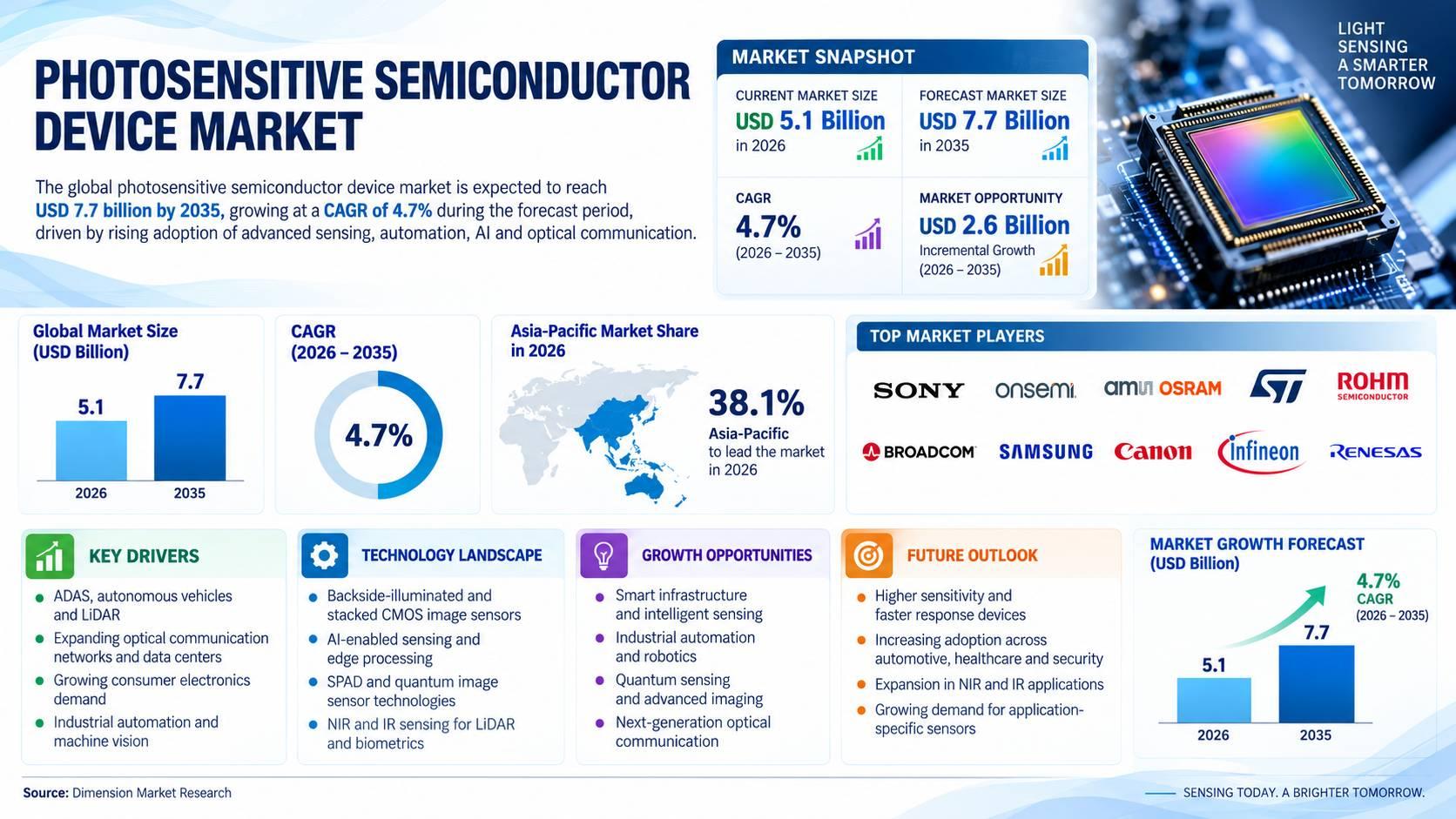
The Global Photosensitive Semiconductor Device Market is expected to reach USD 5.1 billion in 2026 and is projected to reach USD 7.7 billion by 2035, expanding at a CAGR of 4.7% during the forecast period. According to Dimension Market Research, rising adoption of advanced sensing, automation, artificial intelligence, LiDAR, optical communication and high-resolution imaging is supporting sustained market expansion.
Photosensitive semiconductor devices convert light into electrical signals and are increasingly essential across consumer electronics, automotive, healthcare, industrial automation, telecommunications and security applications. CMOS image sensors, photodiodes, phototransistors, avalanche photodiodes and SPAD/QIS technologies are helping manufacturers develop smarter and more responsive electronic systems.
Key Market Highlights
- Global market projected at USD 5.1 billion in 2026
- Market expected to reach USD 7.7 billion by 2035
- Global market CAGR estimated at 4.7%
- Asia-Pacific projected to lead with 38.1% share in 2026
- CMOS image sensors expected to remain the leading device type
- NIR and IR sensing are among the fastest-growing areas
- LiDAR and ADAS are major automotive growth drivers
- Edge AI is increasing demand for intelligent sensing
Get free sample data of the report - https://dimensionmarketresearch.com/request-sample/photosensitive-semiconductor-device-market/
What Is Driving the Photosensitive Semiconductor Device Market?
The growing deployment of ADAS, autonomous vehicles, machine vision, smart cameras and optical communication networks is creating strong demand for photosensitive semiconductor devices. Automotive manufacturers are integrating cameras, LiDAR receivers and in-cabin monitoring systems to improve safety and enable advanced mobility functions.
At the same time, expanding hyperscale data centers and fiber-optic networks require high-speed photodiodes capable of supporting increasing data transmission volumes. Consumer electronics also remain a major demand center as smartphones, wearables, smart home devices and AR/VR systems adopt sophisticated imaging and sensing capabilities.
Technology Trends Reshaping the Market
The development of backside-illuminated and stacked CMOS image sensors is improving light capture, image quality, processing speed and integration density. These technologies are particularly relevant to smartphones, automotive cameras and industrial vision systems.
Artificial intelligence is another major market trend. AI-enabled photosensitive semiconductor devices can process information closer to the point of capture, reducing latency and bandwidth requirements. In autonomous driving, AI can help interpret LiDAR point-cloud information, while industrial systems can use intelligent vision for inspection, sorting and robotic guidance.
Single-photon detection is also creating new opportunities. SPAD and quantum image sensor technologies are gaining attention for LiDAR, scientific instrumentation, biomedical applications and emerging quantum technologies.
Market Segmentation Analysis
- By device type, CMOS image sensors are expected to maintain market leadership because of their low power consumption, compact design, rapid readout and compatibility with advanced semiconductor manufacturing. Photodiodes, avalanche photodiodes, phototransistors, photo ICs and SPAD/QIS devices also serve specialized applications.
- By material, silicon remains the dominant choice because of its mature manufacturing infrastructure, affordability and compatibility with CMOS processing. GaAs, InGaAs and germanium support specialized applications requiring enhanced infrared or high-speed optical performance.
- By spectral response, visible-light devices account for a significant share due to their widespread use in imaging, cameras, surveillance and machine vision. However, near-infrared and infrared sensing are gaining momentum because of LiDAR, biometric recognition and optical communication applications.
- By application, consumer electronics is expected to remain a leading segment, while automotive and transportation, optical communication and datacom, healthcare, industrial automation, security and scientific instrumentation provide additional growth opportunities.
Regional Market Outlook
Asia-Pacific is projected to remain the leading regional market, accounting for an estimated 38.1% share in 2026. Strong consumer electronics manufacturing, semiconductor investments and expanding automotive production are supporting demand across China, Japan, South Korea and other regional markets.
The US Photosensitive Semiconductor Device Market is projected to reach USD 1.4 billion in 2026 and USD 2.0 billion by 2035. Autonomous vehicle development, hyperscale data centers, LiDAR and advanced research applications are key contributors.
The Europe market is estimated at USD 1.2 billion in 2026 and is projected to reach USD 1.8 billion by 2035. Automotive safety requirements, Industry 4.0 and machine vision are major growth factors.
The Japan market is projected at USD 431.1 million in 2026, supported by precision manufacturing, optical components, robotics, automotive electronics and InGaAs-based technologies.
Business Opportunities and Market Challenges
The market offers significant opportunities through smart infrastructure, industrial automation, autonomous mobility, quantum sensing and next-generation optical communication. Companies developing application-specific sensors and integrated sensing solutions can benefit from increasing demand for higher sensitivity, faster response and lower power consumption.
However, sophisticated manufacturing processes, high development costs, material constraints and global supply chain vulnerabilities can affect production economics. Manufacturers are increasingly focused on process optimization, supplier diversification and regional semiconductor capabilities.
Competitive Landscape
The competitive environment includes semiconductor manufacturers, integrated device manufacturers, fabless companies and specialized photonics suppliers. Competition is influenced by sensor architecture, manufacturing capabilities, device performance, reliability, customer relationships and application-specific design expertise.
Prominent companies include Hamamatsu Photonics, Sony Semiconductor Solutions, onsemi, ams-OSRAM, STMicroelectronics, ROHM, Vishay Intertechnology, Broadcom, TE Connectivity, OmniVision Technologies, Samsung Electronics, Canon, Toshiba Electronic Devices & Storage, Sharp, Excelitas Technologies, First Sensor, Infineon Technologies, Texas Instruments, Panasonic and Renesas Electronics.
Report Also Cover
What is the Photosensitive Semiconductor Device Market size?
The global Photosensitive Semiconductor Device Market is expected to reach USD 5.1 billion in 2026 and USD 7.7 billion by 2035, growing at a 4.7% CAGR.
What are the major Photosensitive Semiconductor Device Market trends?
Key trends include stacked CMOS sensors, backside illumination, edge AI, SPAD/QIS adoption, NIR sensing and advanced LiDAR technologies.
Which device type leads the market?
CMOS image sensors are expected to lead because they combine high integration, low power consumption, fast readout and broad application compatibility.
Which material dominates the market?
Silicon is expected to remain the leading material because of its mature manufacturing ecosystem, availability, cost advantages and CMOS compatibility.
Which spectral segment is growing fastest?
Near-infrared and infrared applications are expected to experience strong growth, particularly in LiDAR, biometrics and optical communication.
Which application dominates the market?
Consumer electronics is expected to remain a leading application due to extensive use of image sensors and optical sensing components.
Which region leads the Photosensitive Semiconductor Device Market?
Asia-Pacific is projected to lead the global market with an estimated 38.1% share in 2026.
How is AI changing photosensitive semiconductor devices?
AI is enabling edge-based processing, faster decision-making, lower latency and intelligent interpretation of visual and photonic sensor data.
What are the major growth drivers?
ADAS, autonomous vehicles, LiDAR, high-speed optical communication, industrial automation, machine vision and high-resolution imaging are key growth drivers.
What opportunities exist for market participants?
Major opportunities include quantum sensing, single-photon detection, smart infrastructure, industrial robotics, autonomous mobility and next-generation optical networks.
Outlook Through 2035
The Photosensitive Semiconductor Device Market is positioned for steady expansion as businesses increasingly integrate optical sensing into connected and intelligent systems. The convergence of semiconductor technology, photonics, artificial intelligence, automation and autonomous mobility is expected to create new demand for high-performance photosensitive devices.
For manufacturers, technology developers, investors and business decision-makers, understanding market size, competitive positioning, regional demand, device segmentation and emerging applications will be increasingly important. The Photosensitive Semiconductor Device Market Research Report provides detailed insights into these factors, helping stakeholders evaluate growth opportunities and make informed strategic decisions through 2035.
Similar reports:
- Semiconductor Device for Processing Application Market
- Semiconductor Devices for Electric Vehicle Market
About Us
Dimension Market Research (DMR) is a global market intelligence and consulting firm delivering data-driven insights that help organizations make informed strategic decisions. With expertise across 12+ industries and global markets, DMR provides syndicated reports, custom research, competitive analysis, white space analysis, and business strategy consulting.
Our research solutions combine analytical rigor, industry expertise, and forward-looking intelligence to identify opportunities, reduce risks, and support sustainable growth. Trusted by clients across diverse sectors, DMR is committed to delivering accurate, actionable insights that enable businesses to navigate evolving market landscapes with confidence.
Contact Us
Phone USA: +17323699777
Phone India: +919310023843
E-mail: enquiry@dimensionmarketresearch.com
Address USA: 957 Route 33, Suite 12 #308, Hamilton Square, NJ-08690
Address India: D44, Sector 6, Noida 201301, India

 English
 French
 Spanish
 Portuguese
 Deutsch
 Turkish
 Dutch
Dutch
 Italiano
 Russian
 Romaian
 Portuguese (Brazil)
 Greek
Greek
