


Commercial Alternators:How They Work, Failure Signs, and Selection Guide
Introduction
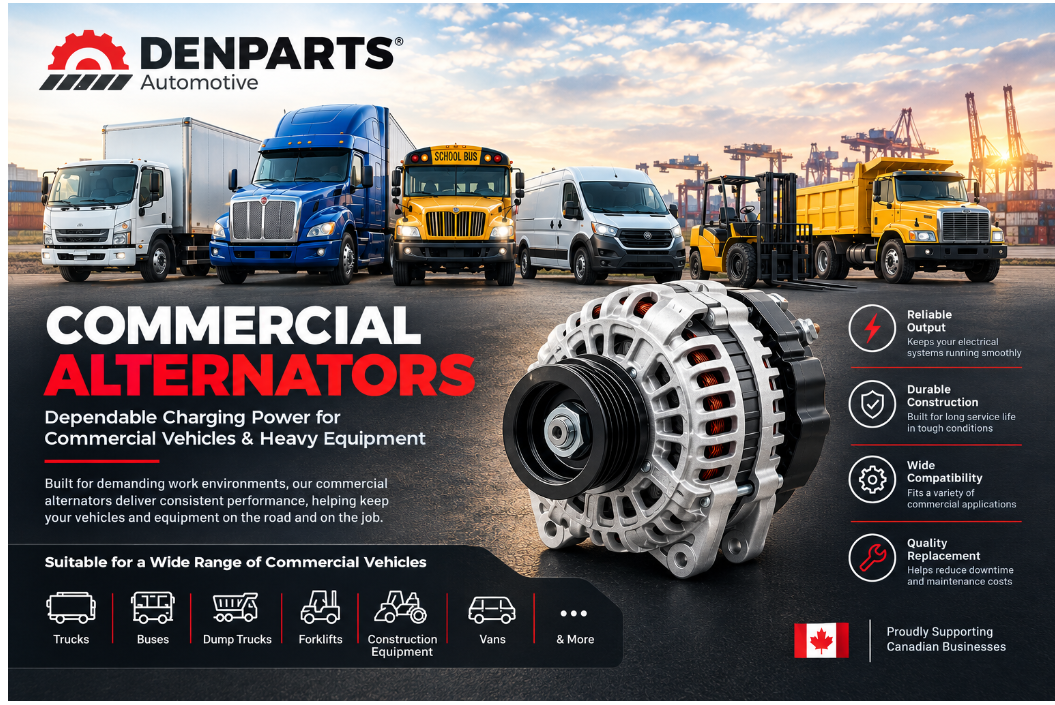
A reliable charging system keeps commercial vehicles running safely and efficiently. Commercial alternators generate electrical power while the engine is running, recharge the battery, and support systems such as lighting, HVAC, electronic controls, sensors, and other onboard equipment. For trucks, buses, forklifts, dump trucks, landscaping equipment, and other working vehicles, alternator performance can directly affect uptime.
What Does a Commercial Alternator Do?
A commercial alternator is an electrical generator driven by the vehicle's engine. Its job is to convert mechanical energy from the running engine into electrical energy that powers the vehicle's electrical systems and recharges the battery.
The process starts when the engine turns the alternator pulley through a belt. Inside the alternator, the rotor spins and creates a magnetic field, which interacts with the stator windings to produce alternating current (AC). A rectifier then converts that AC into direct current (DC), suitable for charging the battery and running electrical equipment. A voltage regulator controls the alternator's output to maintain the correct charging voltage.
This matters especially for commercial vehicles, which often run for long stretches and carry heavy electrical loads. Lighting, climate control, electronic modules, communication equipment, sensors, dashboards, and other accessories all depend on a stable electrical supply.
Common Signs of a Failing Commercial Alternator
Catching alternator trouble early can help prevent a vehicle from becoming unexpectedly disabled. Symptoms can overlap with battery, wiring, or other electrical issues, so several warning signs are worth watching for.
Dimming or flickering lights: Headlights or other lights growing noticeably dimmer while the engine runs is a common early sign.
Repeated battery discharge: A battery that keeps losing its charge may point to insufficient alternator output — though the battery itself, a bad connection, or wiring can also be the cause.
Electrical accessories acting up: HVAC, dashboard electronics, lighting, sensors, and other equipment can behave abnormally when the electrical supply is unstable.
Charging-system warning light: A dashboard warning light for the charging system should never be ignored.
Belt or bearing noise: Whining or grinding sounds, or a loose/misaligned mounting, can point to belt tension problems, bearing wear, or other mechanical issues affecting the alternator.
Frequent jump-starts or a dead battery: A charging system that's falling behind can eventually leave the vehicle running on battery power alone until it's depleted.
Alternator replacement isn't always the right diagnosis on its own — battery condition, cables, grounds, belt tension, connections, and voltage drop should all be checked before deciding the alternator itself is at fault.
Applications & Voltage Considerations
Commercial alternators are used across a wide range of working vehicles and equipment. Denparts' commercial category covers heavy-duty equipment, dump trucks, forklifts, on-road and off-road trucks, buses, landscaping equipment, and lift-gate/Tommy Gate applications, with alternators available for major brands including General Motors, Ford, Mercedes-Benz, BMW, Audi, Volvo, International, Honda, Toyota, Kenworth, and more.
Electrical requirements vary widely by application. A light-commercial or delivery vehicle typically runs a 12-volt system, while many heavy-duty trucks and equipment — including a number of Iveco applications — run on 24-volt systems. Because Denparts' commercial inventory spans both 12-volt and 24-volt alternators across different vehicle lines, voltage and vehicle-specific compatibility should always be confirmed before ordering, rather than assumed from the vehicle type alone.
Why Quality Matters
An alternator that's mismatched on voltage, output, or fitment can lead to undercharging, premature battery wear, or repeat failures — all of which cost more in downtime than the part itself. OEM-spec aftermarket alternators are engineered to match original performance and durability, which matters most on vehicles that run long hours with heavy accessory loads.
How to Choose the Right Commercial Alternator
Check the vehicle application: Confirm make, model, year, engine, and configuration — commercial vehicles often have multiple alternator options depending on how they were built.
Verify voltage: Confirm the replacement matches the vehicle's electrical system (12V or 24V) rather than assuming based on vehicle type.
Check amperage/output: The alternator needs to supply enough output for the vehicle's electrical demands; a unit with insufficient output can lead to charging problems.
Compare mounting configuration: Mounting points and dimensions should match the original unit for a secure installation.
Inspect the pulley: Pulley style, groove configuration, and diameter affect belt fit and operation.
Check electrical connections: Connector type, terminals, and regulator configuration should match the vehicle's charging system.
Use cross-reference numbers carefully: OEM and aftermarket reference numbers help narrow down a replacement, but application and specification should still be verified directly.
Maintenance Tips for Longer Alternator Life
Regular inspection helps catch charging-system problems before they turn into failures.
-
Check the alternator belt for wear, cracking, looseness, or improper tension — a slipping belt can prevent the alternator from reaching proper operating speed.
-
Inspect electrical connections for corrosion, looseness, or damaged wiring, since poor connections create resistance and can make a healthy alternator look like it's underperforming.
-
Test the battery, since alternator and battery performance are closely linked.
-
Keep grounds clean and secure, as poor grounding can interfere with charging.
-
Have a technician test charging voltage and alternator output under load if performance is in question, to help isolate whether the issue is the alternator, regulator, wiring, or battery.
Following the vehicle or equipment manufacturer's service procedures is recommended, since testing specifications vary by application.
Conclusion
A dependable alternator is essential to a commercial vehicle's charging system — recharging the battery and powering the systems that keep trucks, buses, forklifts, dump trucks, landscaping equipment, and other working vehicles running. When replacing one, weigh vehicle application, voltage, output, mounting, pulley design, and electrical connections rather than choosing on appearance alone. For More Details, Visit Denparts.ca

 Arabic
 French
 Spanish
 Portuguese
 Deutsch
 Turkish
 Dutch
Dutch
 Italiano
 Russian
 Romaian
 Portuguese (Brazil)
 Greek
Greek
