


Custom vs. Off-the-Shelf Software: 9 Factors to Choose the Right Solution with Buildera
Choosing the right software can have a major impact on how efficiently a business operates, serves customers, and scales. While off-the-shelf software may appear convenient because it is ready to deploy, custom software development can provide a solution designed specifically around a company's processes and long-term goals.
But which option is better for your business?
The answer depends on factors such as budget, functionality, scalability, security, integration requirements, and future growth. Working with the right custom software development company can help businesses evaluate these requirements before investing in a technology solution.
In this guide, Buildera explores nine important factors to help you compare custom software solutions with ready-made platforms and make a more informed commercial decision.
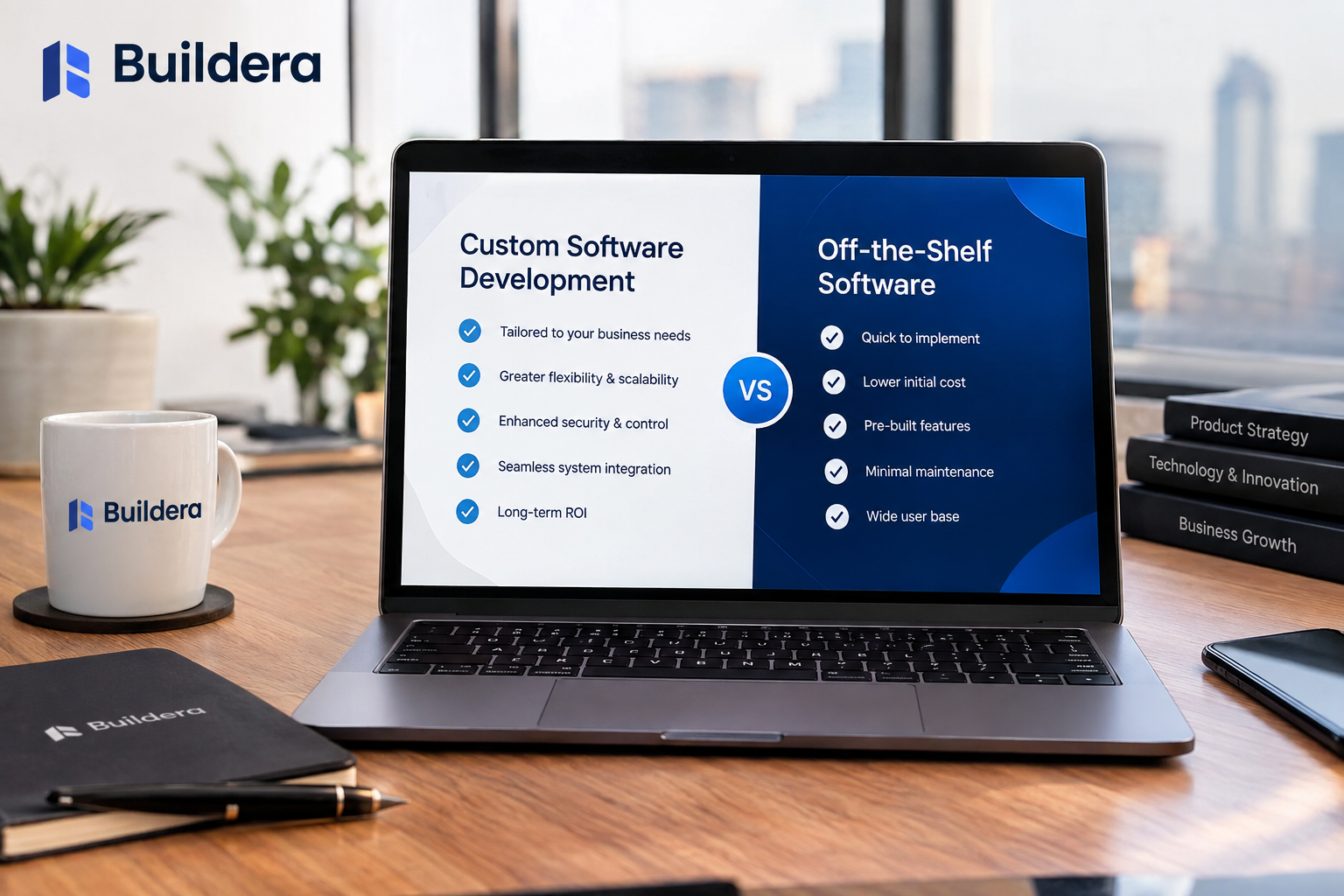
1. Business Requirements and Functionality
The first factor is how closely the software matches your business requirements.
Off-the-shelf software is developed for a broad audience. It typically includes standardized features that address common business needs. This makes it suitable for organizations that can adapt their workflows to existing functionality.
However, businesses with specialized processes may need custom software development services. Custom solutions are designed around specific workflows, user requirements, and operational challenges.
For example, a company may require a specialized business management system, automated approval workflows, industry-specific reporting, or a unique customer portal. If these capabilities are unavailable in standard software, customization may become necessary.
Buildera can help businesses determine whether existing software meets their operational requirements or whether a tailored solution would deliver greater value.
2. Initial Cost and Long-Term ROI
Budget is one of the most important considerations when selecting software.
Off-the-shelf software pricing is generally easier to understand initially. Businesses may pay a monthly subscription, annual license, or one-time purchase fee. Since the product has already been developed, the initial investment can be relatively low.
A custom software solution usually requires a larger upfront investment because the product must be researched, designed, developed, tested, and deployed.
However, businesses should look beyond the initial price and consider total cost of ownership.
Subscription fees, premium features, additional users, third-party integrations, customization charges, and ongoing licensing costs can increase the long-term expense of ready-made software.
A scalable software solution developed specifically for your organization may provide stronger long-term ROI by reducing manual work and eliminating unnecessary features or recurring costs.
3. Scalability and Future Growth
Businesses rarely remain the same size forever. As operations expand, software requirements can change significantly.
Many ready-made software platforms offer different plans based on users, transactions, storage, or features. While this can work for growing organizations, businesses may eventually encounter limitations.
Custom software can be developed with future expansion in mind. A professional software development company can create an architecture capable of supporting additional users, locations, workflows, modules, and integrations.
This makes software scalability a critical factor for startups, growing enterprises, and companies expecting rapid expansion.
Before choosing a solution, ask:
- Can the software support more users?
- Can new features be added?
- Can it accommodate additional locations?
- Can it integrate with future technologies?
- Will performance remain reliable as data increases?
The answers can reveal whether a standard platform or custom solution is more suitable.
4. Integration With Existing Systems
Modern businesses rarely depend on one application. They may use accounting platforms, CRM systems, payment gateways, ERP solutions, communication tools, analytics platforms, and other applications.
Therefore, software integration is another important consideration.
Off-the-shelf products may offer integrations with popular applications. However, these connections can sometimes be limited by available APIs, supported platforms, or subscription tiers.
A custom solution can be designed around your existing technology ecosystem. A custom software development company can build APIs and integration capabilities that allow different systems to communicate efficiently.
For businesses with complex technology environments, API integration, automated data synchronization, and centralized information management can significantly improve productivity.
5. Security and Data Protection
Security should never be treated as an afterthought.
Ready-made software providers typically implement security measures across their platforms. However, businesses may have specific security requirements that cannot always be addressed through standard configurations.
With custom application development, security requirements can be incorporated into the architecture from the beginning.
A tailored system can include role-based access control, authentication mechanisms, encryption, audit trails, secure APIs, and other security measures based on business requirements.
This can be particularly important for companies managing confidential customer information, financial records, intellectual property, or sensitive operational data.
When evaluating vendors, businesses should also examine their software security practices, development standards, testing procedures, and maintenance approach.
6. User Experience and Customization
User experience directly affects software adoption.
Off-the-shelf platforms generally have interfaces designed to accommodate a wide variety of customers. Although these interfaces can be polished and intuitive, they may include features your employees rarely use.
Custom software provides greater control over the user interface design and overall workflow.
A development partner can create dashboards, navigation, forms, reports, and workflows based on how your employees actually work.
This can lead to improved software usability, reduced training requirements, and better employee productivity.
Instead of forcing your team to change its processes to fit the software, a customized platform can be built around the processes that already make sense for your organization.
7. Maintenance, Support, and Updates
Every software solution requires ongoing maintenance.
With off-the-shelf software, the vendor generally handles updates, bug fixes, infrastructure, and product improvements. This can reduce the internal technical workload.
However, businesses have less control over when features are changed or discontinued.
With custom development, organizations can work with a software development partner for ongoing maintenance and technical support. Updates can be prioritized according to business needs.
A reliable provider should offer software maintenance and support, performance monitoring, security updates, troubleshooting, and future development.
When comparing vendors, don't simply ask about development costs. Ask about what happens after launch.
8. Time to Market
Time is another major consideration.
An off-the-shelf platform can often be implemented quickly because the core product already exists. Businesses can configure settings, import data, train employees, and begin using the system.
Custom development takes longer because the solution must be planned and built specifically for the organization.
The software development lifecycle may include discovery, requirements gathering, UI/UX design, development, testing, deployment, and post-launch support.
However, businesses should compare speed with suitability. Deploying an unsuitable platform quickly can create operational problems later.
For organizations with urgent requirements, a minimum viable product (MVP) approach can provide a practical middle ground. Essential functionality can be launched first, followed by additional features.
9. Competitive Advantage and Long-Term Control
The final factor is strategic value.
Standard software is available to many businesses. While it can improve productivity, competitors may have access to the same capabilities.
Custom software can provide a stronger competitive advantage when it solves a unique business challenge or enables a specialized process.
Organizations can also maintain greater control over functionality, development priorities, workflows, and future enhancements.
For companies that consider technology an important part of their business strategy, investing in bespoke software development can turn software from a basic operational tool into a strategic asset.
Custom vs. Off-the-Shelf Software: Which Should You Choose?
There is no universal answer.
Choose off-the-shelf software when:
- Your requirements are relatively standard.
- You need rapid implementation.
- Your budget is limited.
- Existing integrations meet your needs.
- You are comfortable adapting workflows to the platform.
Consider custom software development when:
- Your business has unique workflows.
- Existing platforms lack essential functionality.
- You need advanced integrations.
- Security requirements are highly specific.
- You expect significant future growth.
- Software can create a meaningful competitive advantage.
The right choice should ultimately be based on business objectives rather than simply comparing development prices.
Why Choose Buildera for Custom Software Development?
Choosing the right technology partner is just as important as choosing between custom and off-the-shelf software.
Buildera helps businesses turn specific requirements into practical digital solutions designed for usability, scalability, and long-term value. From understanding business workflows to developing, testing, deploying, and maintaining applications, the right development approach can help organizations maximize their technology investment.
If your current software creates unnecessary manual work, lacks important features, struggles with integrations, or cannot support your future plans, it may be time to evaluate a custom software development company.
Final Thoughts
The decision between custom and off-the-shelf software should not be based solely on upfront cost or implementation speed. Businesses need to evaluate functionality, scalability, integrations, security, user experience, maintenance, time to market, and long-term strategic value.
For simple and standardized requirements, an existing platform may be the most practical choice. For specialized operations and long-term growth, custom software development services can provide greater flexibility and control.
By carefully evaluating these nine factors, businesses can choose a solution that supports today's operations while preparing them for tomorrow's opportunities—with Buildera as a potential technology partner for building software around their unique needs.

 English
 Arabic
 French
 Spanish
 Portuguese
 Deutsch
 Dutch
Dutch
 Italiano
 Russian
 Romaian
 Portuguese (Brazil)
 Greek
Greek
