


The Ultimate Guide to Liquor Store Inventory Management Software | Barrel Books
Running a liquor store involves much more than stocking bottles on shelves and recording sales. Store owners must monitor hundreds or thousands of products, manage suppliers, track purchases, control stock movement, prevent losses, and ensure popular products are always available. Without an efficient system, even a profitable liquor business can lose money through inventory discrepancies, overstocking, stockouts, and inaccurate records.
This is where Liquor Shop Inventory Management software becomes essential.
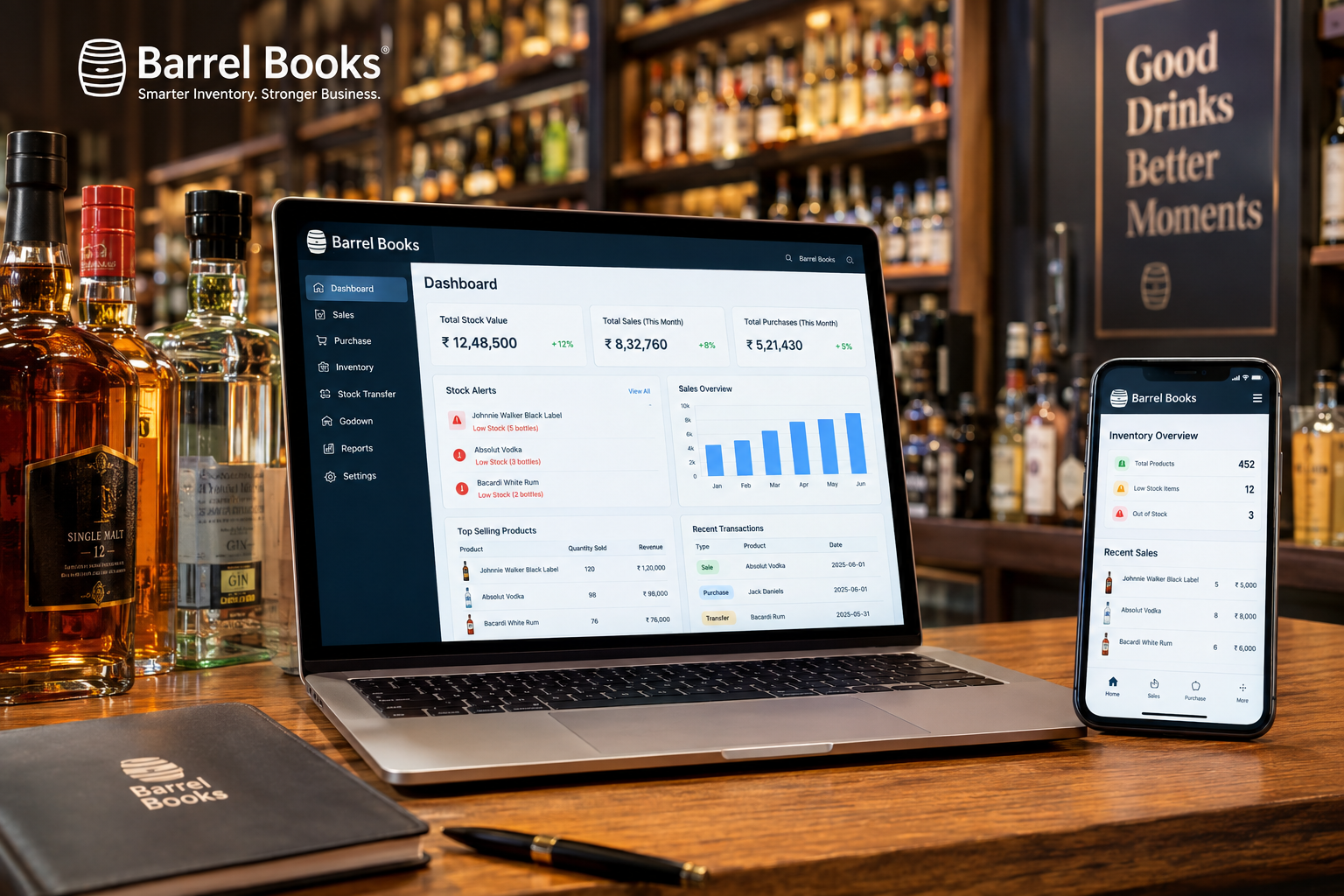
Modern liquor store inventory software helps retailers automate everyday inventory operations while providing real-time visibility into stock, purchases, sales, transfers, and warehouse quantities. For businesses looking to improve accuracy and operational efficiency, Barrel Books offers a practical approach to managing liquor retail operations from one centralized system.
What Is Liquor Shop Inventory Management?
Liquor Shop Inventory Management is the process of tracking, organizing, and controlling every product a liquor store purchases, stores, transfers, and sells.
Traditional inventory management often depends on spreadsheets, handwritten registers, or disconnected software. These methods can become difficult to manage as the product catalog and sales volume increase.
Dedicated liquor inventory management software centralizes important information, including:
- Product quantities
- Purchase orders
- Supplier details
- Sales transactions
- Stock transfers
- Shop and warehouse inventory
- Daily entries
- Stock alerts
- Purchase and sales history
With accurate information available in one place, retailers can make faster decisions and maintain better control over their inventory.
Why Liquor Stores Need Specialized Inventory Software
Liquor retailers have unique inventory requirements. A store may carry multiple brands, bottle sizes, product categories, and price points. Some products sell rapidly, while others remain on shelves for longer periods.
Using generic retail software may not provide the visibility required for these operations.
A dedicated liquor shop management system can help businesses monitor inventory across different locations and understand exactly where products are moving.
For example, when stock is transferred from a warehouse to a retail outlet, the system should record the movement accurately. Similarly, every purchase and sale should update inventory automatically.
This makes real-time inventory tracking one of the most valuable capabilities of modern liquor retail technology.
Key Features to Look for in Liquor Store Inventory Software
Choosing the right platform requires looking beyond basic stock counting. A powerful system should support the complete inventory lifecycle.
1. Real-Time Stock Tracking
One of the most important features is real-time stock management.
Instead of waiting until the end of the day to update inventory, retailers can see current quantities and product movements. This helps identify low-stock products quickly and reduces the risk of selling items that are no longer available.
Inventory tracking software also makes it easier to compare stock levels between shops and storage locations.
2. Purchase Order Management
Managing supplier purchases manually can result in incorrect quantities, duplicate entries, or missed orders.
With purchase order management, retailers can create and monitor purchase orders while maintaining a clear record of incoming stock.
A centralized liquor store inventory system makes purchasing more organized by keeping supplier and purchase information accessible in one place.
3. Godown and Warehouse Management
Many liquor businesses maintain additional storage facilities or godowns. Managing these quantities separately can become complicated without the right technology.
Warehouse inventory management allows retailers to understand what products are available in storage and what has already been moved to individual outlets.
This visibility is particularly useful for businesses operating multiple locations.
4. Shop-to-Shop Stock Transfers
Stock may need to move between outlets because of differences in demand.
For instance, one store may have excess inventory of a particular product while another location is running low. A good stock transfer management feature allows businesses to record these movements accurately.
This reduces manual paperwork and creates a reliable history of inventory transfers.
5. Stock Alerts
Running out of a popular product can mean losing potential sales.
Automated low stock alerts notify retailers when product quantities reach predefined levels. Store managers can then reorder products before inventory becomes critically low.
This supports better reorder management and helps maintain product availability.
6. Sales and Purchase Tracking
Inventory cannot be managed effectively without understanding sales and purchases.
Sales and purchase tracking connects outgoing products with incoming inventory, giving retailers a clearer picture of business activity.
By reviewing sales inventory reports, owners can identify fast-moving products, slow-moving stock, and purchasing patterns.
How Software Reduces Inventory Errors
Inventory errors can happen for many reasons: incorrect entries, misplaced products, unrecorded transfers, duplicate purchases, or inaccurate sales records.
Manual processes make it difficult to identify exactly where an error occurred.
A centralized inventory control system creates a consistent record of product movement. When purchases, transfers, and sales are recorded systematically, businesses can identify discrepancies faster.
Better stock accuracy can also help retailers reduce unnecessary purchases and make more informed decisions about their product assortment.
Prevent Overstocking and Stockouts
Two common inventory problems are having too much stock and having too little.
Overstocking ties up capital in products that may take months to sell. On the other hand, stockouts can cause customers to purchase their preferred products elsewhere.
Effective inventory optimization helps retailers balance availability with demand.
By analyzing historical sales and current quantities, store owners can determine which products deserve frequent replenishment and which should be purchased more cautiously.
This makes demand forecasting an important part of long-term liquor inventory planning.
Improve Liquor Store Profitability
Inventory has a direct impact on profitability.
Every bottle sitting unnecessarily on a shelf represents money tied up in stock. At the same time, every missed sale caused by an unavailable product represents potential revenue.
A reliable liquor retail management system helps businesses maintain better control over purchasing, sales, and inventory.
Retailers can use inventory reports to understand product performance and identify opportunities to improve purchasing decisions.
When managers know which products are selling consistently, they can focus resources on inventory that contributes more effectively to revenue.
Why Choose Barrel Books?
Barrel Books is designed to help liquor retailers simplify inventory and day-to-day store management.
Instead of relying on separate spreadsheets and manual registers, businesses can bring important operations together through a centralized liquor store management software solution.
Barrel Books supports essential processes such as stock alerts, godown management, shop transfers, purchase orders, daily entries, and sales and purchase tracking.
This approach gives liquor retailers greater visibility over their inventory while reducing the administrative burden associated with manual processes.
For growing businesses, having a centralized system can also make it easier to maintain consistent inventory practices across multiple locations.
How to Choose the Best Liquor Inventory Software
Before investing in a platform, liquor store owners should evaluate several factors.
First, consider whether the software supports your current inventory volume and business structure. A small independent store may have different requirements from a business managing several outlets.
Next, evaluate multi-store inventory management, reporting capabilities, purchasing tools, stock alerts, and transfer functionality.
Ease of use is equally important. Employees should be able to perform daily tasks without spending excessive time learning complicated systems.
Finally, consider scalability. The right inventory management solution should continue to support your business as product quantities, transactions, employees, and locations increase.
The Future of Liquor Shop Inventory Management
Technology is changing how liquor retailers manage their businesses. Automated reporting, centralized databases, real-time stock visibility, and smarter purchasing workflows are making inventory operations more efficient.
For retailers, the goal is not simply to count bottles. It is to understand inventory movement, minimize unnecessary costs, maintain availability, and make decisions using reliable information.
That is why investing in professional Liquor Shop Inventory Management can become an important step toward building a more organized and profitable retail operation.
Final Thoughts
Effective inventory management is the foundation of a well-run liquor store. From purchasing and warehouse control to shop transfers, sales tracking, and stock alerts, every inventory activity needs accuracy and visibility.
The right liquor inventory software can replace fragmented manual processes with a centralized approach that helps retailers save time, reduce errors, and maintain better control over stock.
For liquor businesses seeking a practical solution, Barrel Books provides tools designed around the everyday requirements of liquor retail operations.
If your store is still depending heavily on spreadsheets, handwritten records, or disconnected systems, now may be the right time to consider a dedicated Liquor Shop Inventory Management solution.

 English
 Arabic
 French
 Spanish
 Portuguese
 Turkish
 Dutch
Dutch
 Italiano
 Russian
 Romaian
 Portuguese (Brazil)
 Greek
Greek
