


Blockchain and AI for Autonomous Customer Service Knowledge Systems in 2026
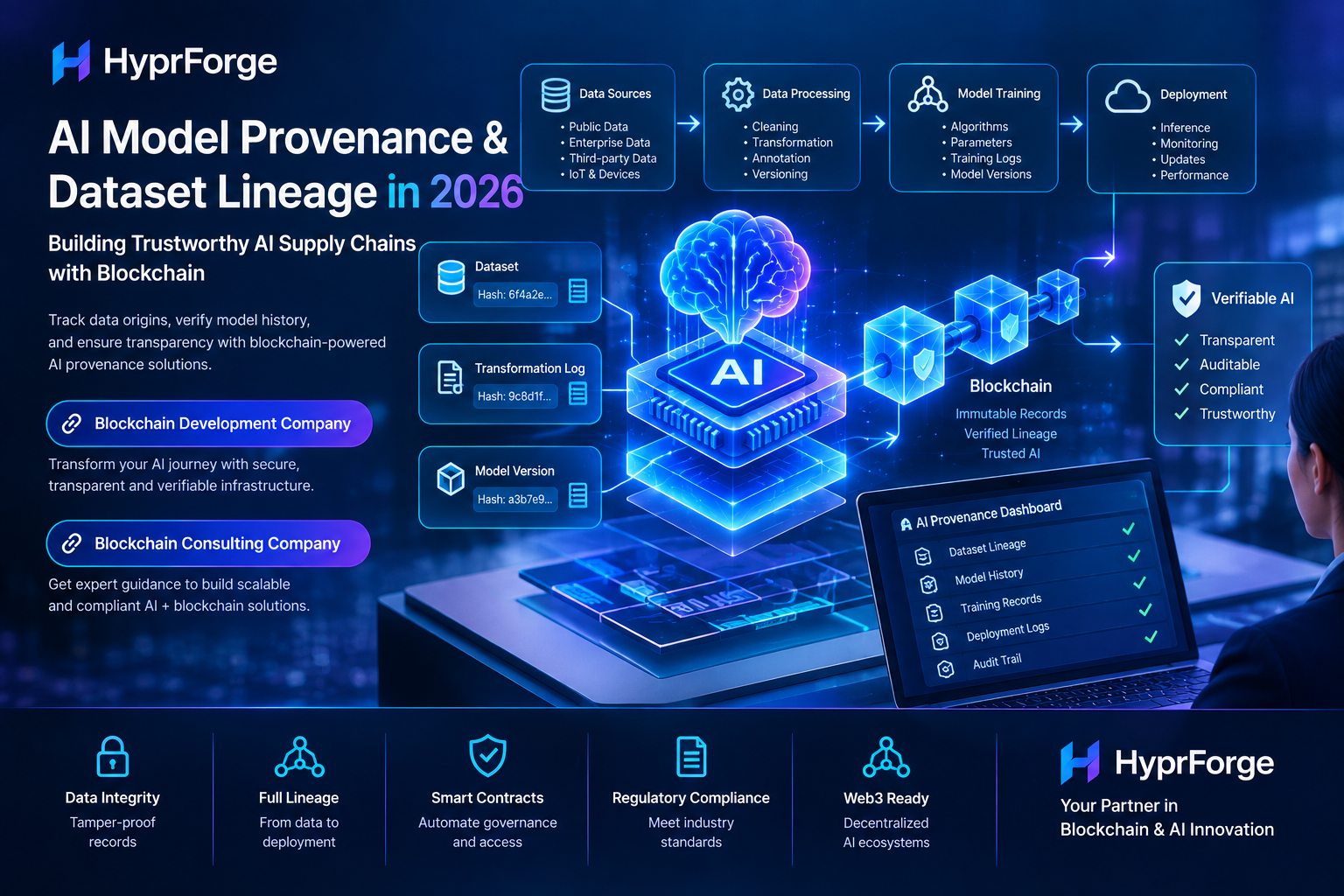
Customer service is entering a new phase in 2026. Businesses are moving from traditional chatbots toward AI-powered systems capable of understanding customer intent, retrieving enterprise knowledge, coordinating workflows, and continuously improving service operations.
But intelligent customer service introduces an important challenge: How can businesses ensure that AI agents are using accurate, authorized, and up-to-date information when communicating with customers?
The combination of blockchain, artificial intelligence, Retrieval-Augmented Generation (RAG), and enterprise knowledge management offers a promising architecture for solving this problem.
Rather than allowing AI systems to operate as isolated black boxes, organizations can build customer service platforms where knowledge sources, permissions, updates, and important AI actions are traceable.
What Are Autonomous Customer Service Knowledge Systems?
An autonomous customer service knowledge system is an AI-powered platform that can retrieve business information and use it to answer customer questions or support service workflows.
Instead of relying exclusively on a static knowledge base, the system can continuously connect with:
-
Product documentation
-
Customer policies
-
Support tickets
-
FAQs
-
Pricing information
-
Warranty records
-
Technical manuals
-
Service procedures
-
CRM data
-
Internal knowledge repositories
RAG enables the AI to retrieve relevant information at the time a customer asks a question.
Blockchain can provide an additional trust layer by recording important provenance and verification information about the knowledge being used.
Why Customer Service AI Needs Verifiable Knowledge
An AI customer service assistant can generate a convincing answer even when its underlying information is outdated.
Imagine a company changes its refund policy.
If an AI system continues retrieving the previous policy, customers could receive incorrect information.
This creates financial, operational, and reputational risks.
A blockchain-supported knowledge architecture can record important changes to approved information.
For example:
Policy Created → Policy Approved → Policy Version Hash → Blockchain Record → RAG Retrieval → AI Response
When the AI retrieves the policy, the system can verify whether the document corresponds to the approved version.
How RAG Improves AI Customer Service
RAG is particularly useful because enterprise information changes frequently.
A customer service AI can retrieve relevant information from controlled sources before generating a response.
For example, a customer asking about a product warranty could trigger retrieval of:
-
The customer's product information
-
The current warranty policy
-
Relevant service documentation
-
Previous support interactions
-
Approved troubleshooting procedures
The AI then generates a response using this retrieved context.
This reduces dependence on information permanently embedded inside the AI model.
Blockchain as a Knowledge Provenance Layer
Blockchain does not need to store the entire customer service knowledge base.
Instead, businesses can use blockchain to record selected metadata such as:
-
Content hashes
-
Document versions
-
Approval events
-
Timestamps
-
Authorized publishers
-
Knowledge identifiers
-
Verification status
The actual documents can remain inside secure enterprise infrastructure.
When a RAG system retrieves information, the platform can verify its fingerprint against the trusted record.
This creates an additional mechanism for determining whether the information is authentic and approved.
Key Benefits for Businesses
1. Improved Knowledge Accuracy
Verified document versions can help AI systems avoid relying on obsolete information.
2. Stronger Auditability
Organizations can maintain records of important knowledge changes and approval events.
3. Better Governance
Businesses can establish rules around which information AI systems are allowed to use.
4. Faster Knowledge Updates
When approved information changes, the RAG layer can update its retrieval index without retraining the entire AI model.
5. Greater Enterprise Trust
Customer service teams can have stronger evidence regarding which approved information influenced important responses.
Blockchain and AI Customer Service Architecture
A modern platform can be organized into several layers.
Knowledge Layer
Documents, policies, product information, customer records, and service information remain in enterprise databases and storage systems.
RAG Layer
The RAG architecture indexes knowledge and retrieves relevant information based on customer requests.
AI Layer
Large language models interpret customer intent and generate responses using retrieved context.
Blockchain Layer
Blockchain records selected provenance events, hashes, approvals, and verification information.
Identity Layer
Identity and access controls determine which users, applications, and AI agents can access particular knowledge.
Application Layer
Customers interact through websites, mobile applications, messaging platforms, voice systems, or other channels.
A specialized Blockchain Development Company can help organizations connect these layers into a customized enterprise architecture.
Smart Contracts for Knowledge Approval
Smart contracts can automate certain knowledge governance processes.
For example, a company could require that a new customer policy receive approval from designated departments before becoming an authorized AI knowledge source.
A workflow could be:
Draft → Review → Approval → Hash Registration → Knowledge Activation
A blockchain smart contract development agency can implement programmable rules that automatically record these events.
This can reduce ambiguity around who approved a knowledge item and when it became active.
AI Agents and Customer Service Automation
The next evolution is likely to involve AI agents rather than single-purpose chatbots.
An AI agent could potentially:
-
Understand customer intent
-
Retrieve relevant information
-
Verify knowledge sources
-
Check customer permissions
-
Create support tickets
-
Recommend actions
-
Escalate complex issues
-
Update CRM records
-
Request human approval
-
Track the outcome
Blockchain can provide a useful audit layer for selected high-value actions.
This is particularly relevant when AI agents begin interacting with business systems autonomously.
Use Cases Across Industries
E-Commerce
AI agents can answer questions about product availability, returns, warranties, delivery, and order policies using verified information.
Financial Services
Customer service systems can retrieve approved product policies and regulatory information while maintaining stronger audit trails.
Telecommunications
AI assistants can access verified service plans, technical documentation, and customer account information.
Manufacturing
Industrial customers can interact with AI systems that retrieve validated equipment manuals and service procedures.
SaaS Companies
AI support systems can combine product documentation, release notes, troubleshooting information, and customer-specific configuration data.
Privacy and Security Considerations
Customer service systems frequently process sensitive information.
Therefore, blockchain should not automatically become the storage layer for customer data.
A better architecture can keep sensitive information inside secure databases while using blockchain for limited verification metadata.
Organizations should also implement:
-
Strong identity management
-
Role-based permissions
-
Encryption
-
Data minimization
-
Secure API access
-
AI monitoring
-
Human escalation
-
Knowledge lifecycle controls
The blockchain layer should complement—not replace—enterprise security controls.
The Role of Blockchain Consulting
Businesses often assume blockchain must be used everywhere once they decide to adopt it.
That is rarely the best architecture.
A Blockchain Consulting Company can help determine where blockchain creates genuine value and where conventional databases, cloud systems, or enterprise security tools are more appropriate.
Consulting can cover:
-
Architecture strategy
-
Blockchain selection
-
Smart contract design
-
RAG integration
-
Data provenance
-
Identity management
-
API architecture
-
Security planning
-
Enterprise integration
Connecting Web3 With Customer Service
Web3 technologies can introduce additional possibilities for decentralized customer experiences.
A Web3 Development Agency can build decentralized applications that connect customer identities, digital assets, wallets, and blockchain-based service records.
A Web3 Development Company can also integrate smart contracts and decentralized identity into customer-facing platforms.
In blockchain-native businesses, cryptocurrency development may additionally connect customer support systems with transaction and wallet-related workflows.
A decentralized exchange ecosystem could use similar architectures for support documentation, transaction explanations, and verified platform policies.
Supporting Development Infrastructure
Building an intelligent customer service ecosystem may require several specialized development capabilities.
A blockchain developer company can implement blockchain integrations and smart contract infrastructure.
A Blockchain Development Agency can build customized enterprise applications.
A blockchain technology development company can help design the underlying distributed architecture.
Traditional application development remains important as well. A Web Development Agency or Web Development Company can build the customer-facing portals, dashboards, and service interfaces.
For decentralized financial platforms, a Decentralized Exchange Development Company can integrate AI-assisted support into trading applications.
A Decentralized Exchange Software Development Company can build intelligent customer service modules directly into exchange infrastructure, while a dex development company can connect support systems with on-chain transaction data.
Why HyprForge Can Help
HyprForge can help organizations explore the intersection of blockchain, AI, RAG, and intelligent enterprise applications.
The objective is not simply to add blockchain to a chatbot.
Instead, businesses can create an architecture where:
AI provides intelligence → RAG provides relevant knowledge → Enterprise systems provide operational data → Blockchain provides verification and provenance.
This approach can help create customer service systems that are more transparent, governable, and adaptable.
The Future of AI-Powered Customer Service
Customer service is increasingly becoming an intelligent operational layer rather than a separate support function.
AI agents may eventually handle increasingly complex workflows while humans focus on exceptions, strategic decisions, and sensitive customer interactions.
As autonomy increases, the importance of trusted knowledge will also increase.
Organizations will need to know:
What information did the AI use? Was it authorized? Was it current? Who approved it? Can the system prove which version influenced the response?
Blockchain-backed provenance combined with RAG provides one possible answer.
Conclusion
In 2026, the future of customer service is moving toward intelligent, autonomous, and knowledge-driven systems.
RAG enables AI to retrieve current enterprise information. Blockchain can provide a verification and provenance layer. Smart contracts can automate approval workflows, while identity systems control access to sensitive information.
Together, these technologies can transform traditional customer support into a more intelligent and verifiable digital service infrastructure.
For forward-looking businesses, blockchain and AI-powered customer service knowledge systems represent an emerging opportunity to combine automation with transparency, governance, and trusted enterprise knowledge.

 English
 Arabic
 French
 Spanish
 Portuguese
 Deutsch
 Turkish
 Dutch
Dutch
 Italiano
 Russian
 Romaian
 Greek
Greek
