


How Can a Battery Traceability Solution Prepare Businesses for Digital Battery Passport Requirements?
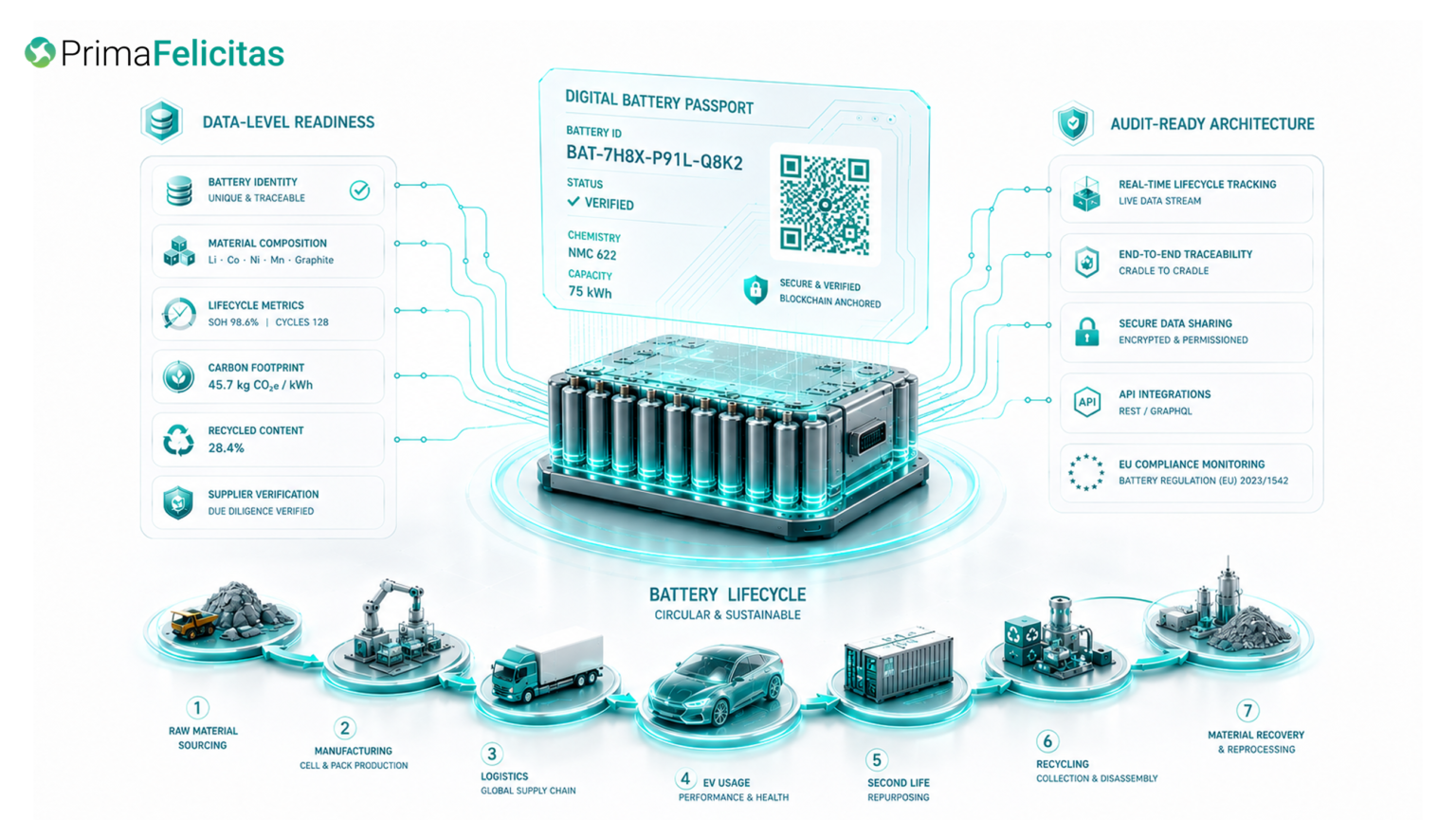
PrimaFelicitas helps battery manufacturers, EV companies, suppliers, recyclers, and other organizations build secure digital infrastructure for tracking battery information across the entire lifecycle. As battery supply chains become more complex and regulatory expectations increase, companies need reliable ways to collect, verify, manage, and share information from raw material sourcing through manufacturing, usage, repair, reuse, and recycling. A well-designed Battery Traceability Solution can connect these processes while improving visibility, data integrity, and compliance readiness.
The EU Battery Regulation 2023/1542 is accelerating the need for structured battery data. Article 77 states that from 18 February 2027, certain light means of transport batteries, industrial batteries above 2 kWh, and electric vehicle batteries placed on the EU market or put into service must have an electronic battery passport.
What Is a Battery Traceability Solution?
A Battery Traceability Solution is a digital system that enables organizations to track important battery information throughout its lifecycle. Instead of keeping critical data in disconnected spreadsheets, databases, or individual enterprise systems, a centralized traceability architecture can connect information from multiple participants and stages of the battery value chain.
A comprehensive solution can capture information related to raw materials, suppliers, manufacturing, battery identification, performance, usage, repairs, carbon footprint, recycling, and end-of-life activities.
PrimaFelicitas develops battery traceability platforms that support lifecycle tracking from raw material sourcing to recycling. Its solutions are designed to help organizations improve supply-chain transparency and manage battery information through scalable digital infrastructure.
Why Is Battery Traceability Becoming Important?
Battery manufacturing involves multiple organizations, geographic locations, suppliers, technologies, and lifecycle stages. Without an effective traceability framework, it can become difficult to determine where materials originated, how batteries were manufactured, how they performed during use, and what happened at the end of their useful life.
Traceability provides a structured approach to this challenge.
A reliable Battery Traceability System can help organizations:
-
Track battery information across the lifecycle
-
Improve supply-chain visibility
-
Organize supplier data
-
Support sustainability reporting
-
Monitor battery performance history
-
Manage recycling information
-
Improve data transparency
-
Prepare for regulatory requirements
-
Connect information from existing enterprise systems
PrimaFelicitas specifically highlights lifecycle tracking, verified sustainability data, regulatory readiness, and supply-chain transparency as key benefits of its battery passport and traceability solutions.
How Does a Battery Traceability System Work?
A Battery Traceability System typically connects data from different stages of the battery lifecycle. The exact architecture depends on the organization's operations, battery category, supply-chain structure, and technology environment.
The system can begin with information collected during raw material sourcing. Data can then be connected to manufacturing records, battery identification, performance information, distribution, usage, repair, and recycling.
For example, manufacturers can maintain records associated with battery production while downstream participants can contribute relevant information throughout the battery's operational life.
This creates a connected digital record rather than isolated information silos.
PrimaFelicitas supports integrations with ERP systems, IoT devices, manufacturing software, and existing enterprise infrastructure to help organizations build a connected traceability environment.
What Information Can a Battery Traceability Solution Track?
The information managed by a traceability platform depends on the battery type and business requirements. However, a comprehensive system can support several categories of lifecycle information.
These may include:
Material and Supply-Chain Data
Organizations can track information related to raw material sourcing, components, suppliers, and movement through the supply chain.
Manufacturing Information
Manufacturing records can provide visibility into how and where batteries were produced and help connect production information with individual battery identities.
Performance and Usage Data
Battery performance, usage information, and relevant operational records can help establish a history throughout the battery's useful life.
Repair and Maintenance Records
A traceability system can maintain information about repairs and other lifecycle events, helping organizations build a more complete battery history.
Sustainability Information
Carbon footprint, critical material usage, environmental risk, social risk, and human and labor rights information can form part of a broader battery data framework. PrimaFelicitas highlights these lifecycle measurement areas within its battery traceability offering.
Recycling and End-of-Life Data
Tracking recycling status and end-of-life information can improve visibility into how batteries and their materials move toward reuse, recovery, or recycling.
Read this guides : https://primafelicitas.com/traceability/digital-battery-passport-solution-for-audit-readiness/
How Does Blockchain Support Battery Traceability?
Blockchain can provide an additional layer of data integrity and transparency for battery traceability applications.
In a blockchain-powered architecture, relevant records can be maintained using tamper-resistant distributed ledger technology. This can help different supply-chain participants establish greater confidence in shared information.
PrimaFelicitas specifically offers blockchain-powered battery traceability solutions designed to create tamper-proof records and improve transparency across the battery supply chain.
Blockchain is not necessarily required for every traceability project. The appropriate technology architecture depends on factors such as data ownership, interoperability, privacy, scalability, governance, and business requirements.
What Role Do AI and IoT Play in Battery Traceability?
Modern battery ecosystems generate data from multiple sources. IoT devices can provide operational information, while AI can support data analysis, validation, monitoring, and other intelligent processes.
PrimaFelicitas combines blockchain, AI, and IoT integrations within its battery traceability approach. These technologies can help organizations build more connected platforms for managing complex battery lifecycle information.
For example, IoT-connected systems may provide data from battery-related equipment, while AI-based processes can help identify patterns or potential data inconsistencies. Integrating these technologies with enterprise systems can create a more comprehensive traceability architecture.
How Does Battery Traceability Support the Digital Battery Passport?
The Digital Battery Passport is closely connected to battery traceability because the passport depends on reliable lifecycle information.
Under Article 77 of the EU Battery Regulation, the battery passport contains information relating to the battery model and information specific to the individual battery.
This means organizations need more than a simple digital document. They need an underlying data infrastructure capable of collecting, managing, updating, and providing appropriate access to battery information.
A Battery Traceability Solution can provide this technological foundation by connecting data sources and lifecycle events with the battery's digital identity.
What Are the Main Benefits of a Battery Traceability Solution?
Implementing a structured traceability platform can provide several business and operational benefits.
Better Supply-Chain Visibility
Organizations can gain greater insight into the movement of materials, components, and batteries across different supply-chain stages.
Improved Data Management
Centralized and connected data structures can reduce dependence on disconnected records and make important information easier to manage.
Regulatory Readiness
A traceability infrastructure can help organizations prepare for Digital Battery Passport requirements and other regulatory data expectations.
Greater Sustainability Transparency
Organizations can better organize information related to carbon footprint, material sourcing, recycling, and other sustainability indicators.
Lifecycle Visibility
A connected system can provide a broader view of a battery from sourcing and manufacturing through usage and recycling.
Enterprise Integration
Integrating traceability platforms with ERP systems, IoT devices, manufacturing software, and other enterprise infrastructure can reduce data silos.
Who Needs a Battery Traceability System?
Battery traceability is relevant to multiple participants in the battery ecosystem.
PrimaFelicitas supports:
-
EV manufacturers
-
Battery manufacturers
-
Energy storage companies
-
Battery recycling companies
-
Raw material suppliers
-
Supply-chain and logistics platforms
Each organization can have different data requirements, but all can benefit from greater visibility into the battery lifecycle.
How Can Businesses Prepare for Battery Passport Requirements?
Preparation should begin with understanding what battery information an organization currently collects, where that information is stored, who owns it, and which data gaps exist.
Businesses can start by assessing:
-
Current battery data sources
-
Supplier information availability
-
Battery identification processes
-
Lifecycle data collection
-
Existing enterprise integrations
-
Data quality and governance
-
Security and access requirements
-
Digital Battery Passport architecture
-
Recycling and end-of-life information
-
Compliance readiness
A structured assessment can help organizations identify gaps before they become operational or regulatory challenges.
Why Choose PrimaFelicitas for Battery Traceability?
PrimaFelicitas provides technology solutions covering several components of a modern battery traceability ecosystem. Its services include Battery Passport Platform Development, blockchain-powered traceability, battery lifecycle data management, supply-chain traceability, compliance-ready data infrastructure, and integration with existing systems.
The company also offers a Digital Battery Passport strategy session covering architecture recommendations, compliance readiness assessment, technology-stack suggestions, and an estimated development roadmap.
This approach allows organizations to consider traceability as part of a broader digital infrastructure strategy rather than treating the Battery Passport as an isolated compliance project.
Final Thoughts
Battery supply chains are becoming increasingly data-driven, and reliable lifecycle information is becoming essential for transparency, sustainability, and regulatory readiness. A well-designed Battery Traceability Solution can connect information across sourcing, manufacturing, distribution, usage, maintenance, and recycling.
A scalable Battery Traceability System can also provide the technological foundation needed to support Digital Battery Passport initiatives and integrate battery information with existing enterprise infrastructure.
As the EU Battery Regulation moves toward the 18 February 2027 battery passport requirement for covered battery categories, organizations have an opportunity to assess their data architecture and address traceability gaps early.
PrimaFelicitas helps organizations build secure, scalable, and connected battery traceability platforms using technologies such as blockchain, AI, and IoT. For businesses operating across the EV, battery manufacturing, energy storage, raw material, and recycling ecosystems, investing in structured traceability infrastructure can support both immediate data needs and future battery lifecycle requirements.

 English
 Arabic
 French
 Spanish
 Portuguese
 Deutsch
 Turkish
 Dutch
Dutch
 Italiano
 Russian
 Romaian
 Greek
Greek
