


Mass Communication Courses After Graduation: Careers Beyond Journalism
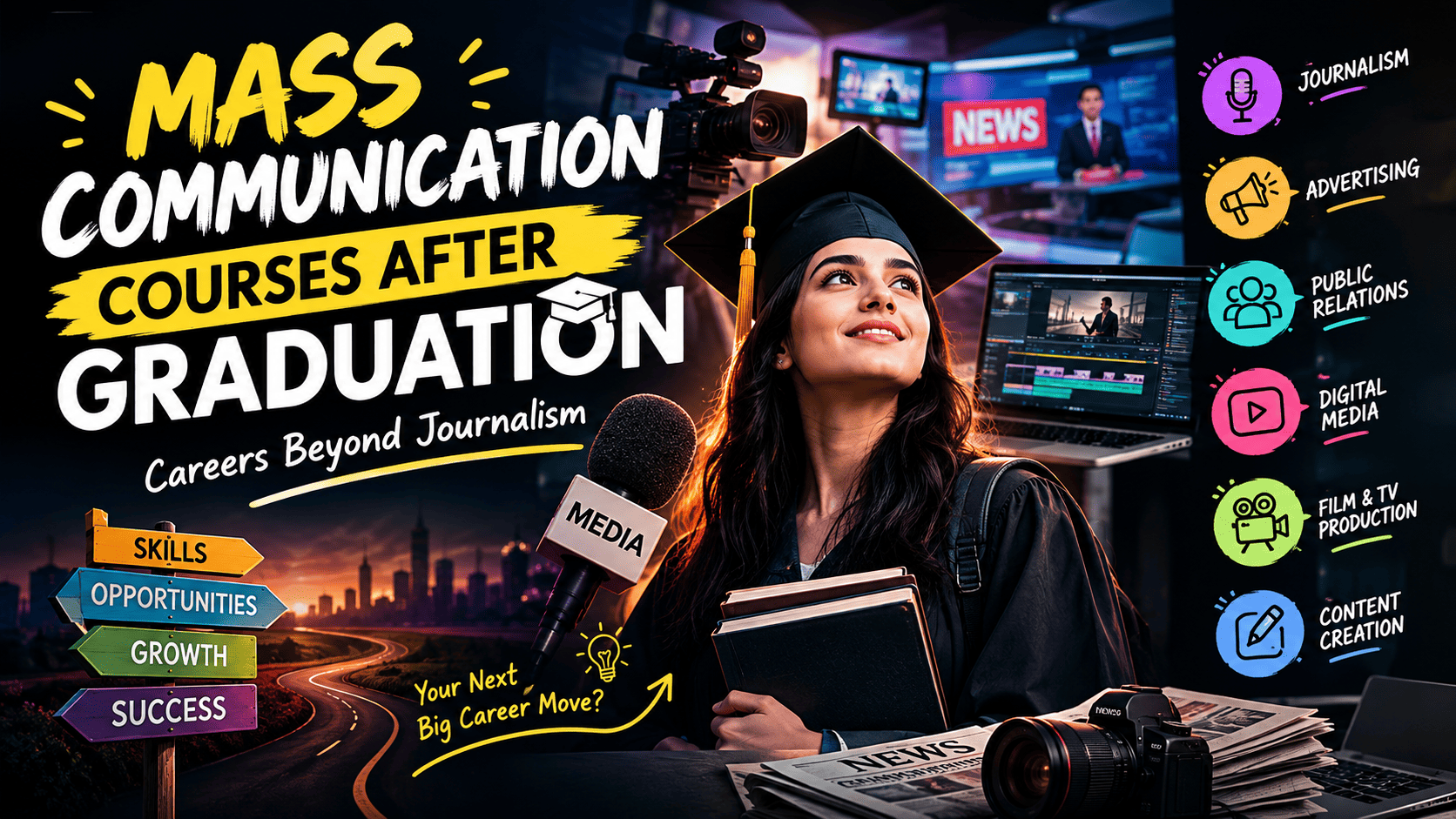
It might be graduation, which is an essential stage of a student’s career, but it does not have to mean that learning has to come to a halt. Most graduates prefer to develop their skills in a specialised subject field through professional or postgraduate courses. The mass communication courses after graduation turn out to be helpful in shaping the careers of interested students who wish to pursue a career in media, journalism, advertising & public relations, digital content, and communication.
Mass communication is a vast field that requires not only skills in communication, creativity, technology, and current affairs. Television, digital media, social media, podcasts, online news platforms, and streaming services have expanded the opportunities for communicators. In this article, you will get to know about course options after graduation, including eligibility criteria, skills gained, and career opportunities/prospects/future scope.
What Is Mass Communication?
The process of mass communication can involve relaying information, ideas, news, and products to large numbers of people through media at once. While traditional forms consist of newspapers, magazines, radio, and television, modern communication also includes websites, social media networks, podcasts, constantly updated blogs, and videos.
A mass communication course teaches you how media works and how information is made, presented, and distributed. Students can study, depending on the course:
-
Journalism
-
Advertising
-
Public Relations
-
Digital media
-
Film
-
Television production
-
Communication theory
-
Media management
Why Should You Pursue Mass Communication After Completion of Graduation?
Mass communication can be taken up by graduates from all backgrounds, as the field is not wholly dependent on one specific undergraduate subject. If a student has an inclination towards communication and creative work, then he or she can go for media-related education with any degree in commerce, arts, science, management, or another discipline.
The biggest advantage of studying mass communication after graduation is to gain practical experience. Teach students to write articles, create public engagements, interview people, use social media for content and directness, and communicate with audiences, as well as understand other media forms. Students can explore affordable mass communication courses after graduation to build practical skills and prepare for careers in journalism, digital media, advertising, and public relations.
The field, too, is rapidly finding its footing. Digital platforms like social media have become more easily accessible and opened new doors not seen in conventional newspapers or television channels.
Mass Communication Courses After Graduation
Graduate entrants into the media and communication sector have a number of choices to make. Choosing between the two depends on career aspirations, education profile, budget, and time available.
Postgraduate Degree in Mass Communication
A comparable postgraduate degree in mass communication or journalism and mass communication gives a better understanding of media and communications. For example, the curriculum for these degrees may contain journalism topics like media research, advertising and public relations, digital media, television and radio, as well as media management.
This is quite simply for aspirant media students who wish to have an organized academic degree as well as perform a job in the long run.
Postgraduate Diploma in Mass Communication
Post Graduate diploma for a shorter version of complete Post Graduate. These programs are often more focused on hands-on experiences and specific sections of media.
Students at some institutions will study reporting, writing, editing, broadcasting, digital journalism, and public relations, while others may focus on media production or similar topics. Great for recent graduates who wish to accumulate more knowledge and expertise in a specific area of interest — without another couple more years on their degree.
Journalism Courses
Journalism is one of the most preferred fields in mass communication. It teaches students how to research information, find reliable sources of news, interview people, write news reports,ts and communicate information in a clear manner.
Students may also learn digital reporting, multimedia storytelling, video journalism,ism and content publishing as online journalism begins to grow.
Digital Media Courses
Digital media has established a prominent space in contemporary communication. In this field, courses can include:
-
Social media
-
Content creation
-
Digital journalism
-
Online marketing
-
Video production
-
Audience reviews
This is for anyone with a desire to specialize in websites, social platforms, blogs, and podcasts, and online video should be of interest too.
Advertising and Public Relations Courses
Everything we need to talk about above: advertising, branding, sales funnel management, individual products, and services to targeted segments. Public relations (PR): PR is the capacity to manage how data about an individual or organization is disseminated to the public.
It being that part of communication strategy, campaign planning and execution, media relations, copywriting, and brand communication, students can look into those specializations.
Film and Television Production Courses
Development and production of film and television for students interested in visual storytelling. Such as does the course maybe throw the students to writing rudimentary scripts, or learning about camera work, and editing, production planning, direction etc.
Ideal for those who love to tell stories through video and visual media.
Mass Communication Courses After Graduation: Age Limit
There will be various eligibility requirements of the colleges and their institutions. A majority of Postgraduate programs demand that candidates have an undergraduate degree from a recognized university. Few other institutions may have a minimum percentage.
Some programs may have entrance examinations, selected interview requirements, or even portfolio assessments, while a few might offer admissions on graduation marks.
As requirements may vary, students need to confirm current admission policies of the institution.
Top 9 Skills to Pursue a Career in Mass Communication
You can have qualifications, but you also need to be able to do something practical with that degree/qualification in the near future, especially if getting into a profession based on communication. Some useful skills include:
-
Strong written and verbal communication
-
Research and information-gathering skills
-
Creativity and storytelling
-
Basic video and photo editing
-
Interviewing and presentation skills
-
Social media knowledge
-
Critical thinking
-
Time management
-
Adaptability to new technology
-
Audience and media trend awareness
All 4 skills do not have to be mastered at the onset of their study. Projects, internships, practice, and constant exposure to various types of media can sharpen these skills.
Career Opportunities After Mass Communication
There are quite a few career paths in mass communication. The specific opportunities will primarily rely on someone's education, specialization, experience, and portfolio.
Some common career options include:
-
Journalist
-
Content Writer
-
Copywriter
-
News Reporter
-
Editor
-
Social Media Executive
-
Public Relations Executive
-
Digital Content Creator
-
Advertising Professional
-
Media Planner
-
Video Producer
-
Script Writer
-
Communication Executive
-
Radio Professional
-
Television Production Professional
A graduate can make a career in: -
Newspaper
-
TV Channel
-
Digital Publication House
-
Advertising Agency
-
Public Relations Firm
-
Production House
-
Corporate Communication Department
-
Online News Media Organizations
Importance of Digital Media in Mass Communication
Digital media has transformed the way we gather and disseminate information. Previously, audiences relied mostly on newspapers, radio, and television. Today, news and entertainment are consumable through any platform, including websites, mobile applications, social media, podcasts &video platforms.
This shift has also changed the skill sets that are expected of media professionals. You might need to know video, social media, search-friendly writing, and digital publishing as a journalist now. A content professional may do short pieces of writing, short-form videos, podcasts, and social media posts in a similar way.
Thus, students seeking information regarding Mass Communication Courses after Graduation can get the best of both worlds for themselves: the knowledge of traditional communication concepts along with that of modern-day digital skills.
Selecting the Proper Mass Comm Course
A course should be more than its name. I recommend the best type of media work that students will decide to pursue. As for a news junkie — probably journalism; as for a creative person — advertising, digital content and production.
Apart from fee structure, certain other factors are important for students to think of, like course duration, syllabus, practical-based training opportunities, professional faculty experience, internships and projects included in the respective curriculum, assessment, and admission process, along with the total cost involved.
You can also check if the course teaches up-to-date tools and technologies. Because the media is constantly changing, some hands-on experience can help make for a more effective learning process.
Future Scope of Mass Communication
Mass communication is intrinsically linked to the rise of digital platforms. Communication is vital for businesses, governments, media organisations, educational institutions, anything and anyone.
The growth of social media, online publications, video content, podcasts, streaming platforms and digital advertising is probably going to continue to create new communication roles. Concurrently, traditional forms of media still prove their relevance.
For students, mass communication is not one track. By developing versatile communication approaches, digital awareness, creativity, and experience, graduates can adapt to evolving opportunities.
Final Thoughts
Mass Communication Courses after Graduation can be one of the best options for all those graduates who have an interest in writing, storytelling, media, communication and creative work. As one of the most dynamic and multifunctional areas, journalism provides quite a few opportunities for specialization too – such as digital media, advertising, public relations and production.
Graduates can also consider professional certificate programmes for media careers to develop specialized skills in digital media, content creation, advertising, and communication.
Students must compare the curriculum, eligibility criteria, practical exposure, duration, and career path before selecting any course. Most importantly, keep up with lessons and continue educating yourself with practical skills. As the media landscape is constantly changing and we are always trying to adapt to new platforms, being able to articulate your thoughts clearly may become just as valuable a qualification!

 English
 Arabic
 French
 Portuguese
 Deutsch
 Turkish
 Dutch
Dutch
 Italiano
 Russian
 Romaian
 Portuguese (Brazil)
 Greek
Greek
