


Financial Close Management: AI, Automation, and Finance Transformation
The Financial Close Management market is undergoing significant transformation as organizations look to modernize complex financial close processes, improve reporting accuracy, strengthen compliance, and accelerate decision-making. As finance teams manage increasing data volumes, regulatory requirements, and business complexity, organizations are adopting cloud-native and AI-driven Financial Close Management solutions to streamline period-end activities and improve financial visibility.
What Is Financial Close Management?
Financial Close Management refers to the technologies, processes, and workflows organizations use to manage and automate activities involved in closing their financial books. These solutions support critical processes such as account reconciliation, journal management, financial consolidation, close task management, reporting, compliance, and audit preparation.
Modern Financial Close Management platforms help finance teams replace manual spreadsheets and disconnected workflows with centralized, automated processes. By integrating financial data across enterprise systems, organizations can improve accuracy, reduce close-cycle times, and provide finance leaders with timely insights.
Key Trends Shaping the Financial Close Management Market
AI-Driven Financial Close Automation
Artificial intelligence is becoming a major driver of innovation in Financial Close Management. AI-enabled platforms can automate repetitive activities, identify anomalies, support account reconciliation, and provide finance teams with intelligent recommendations.
AI can also help organizations identify potential issues before they affect financial reporting, allowing finance professionals to focus on higher-value analysis and strategic activities.
Cloud-Native Financial Management
Cloud adoption is accelerating the modernization of financial close processes. Cloud-based Financial Close Management solutions provide scalability, centralized data access, easier collaboration, and faster deployment compared with traditional on-premises systems.
Finance teams can access financial information and workflows across locations while maintaining greater visibility into the progress of close activities.
Deep ERP Integration
Integration with ERP platforms is increasingly important for organizations seeking a connected financial ecosystem. Modern Financial Close Management solutions integrate financial data and workflows across enterprise applications to reduce data silos and manual reconciliation.
This enables finance teams to create more consistent processes and improve the accuracy and timeliness of financial reporting.
Intelligent Analytics and Predictive Insights
Advanced analytics are helping organizations move beyond historical reporting toward proactive financial management. Financial close platforms can provide dashboards, performance indicators, exception monitoring, and predictive insights that help finance leaders identify risks and opportunities.
These capabilities strengthen the role of finance as a strategic business function rather than simply a reporting function.
Why Organizations Are Adopting Financial Close Management Solutions
Organizations are increasingly investing in Financial Close Management to address several challenges associated with traditional financial processes. Manual data entry, spreadsheet dependency, disconnected systems, lengthy reconciliation cycles, and limited visibility can increase operational costs and create risks.
Automated Financial Close Management solutions can help organizations:
- Accelerate financial close cycles
- Reduce manual and repetitive tasks
- Improve financial data accuracy
- Strengthen compliance and internal controls
- Increase transparency across close activities
- Improve collaboration between finance teams
- Reduce reconciliation and reporting errors
- Provide faster access to financial insights
- Support more informed business decisions
Competitive Landscape and Vendor Evaluation
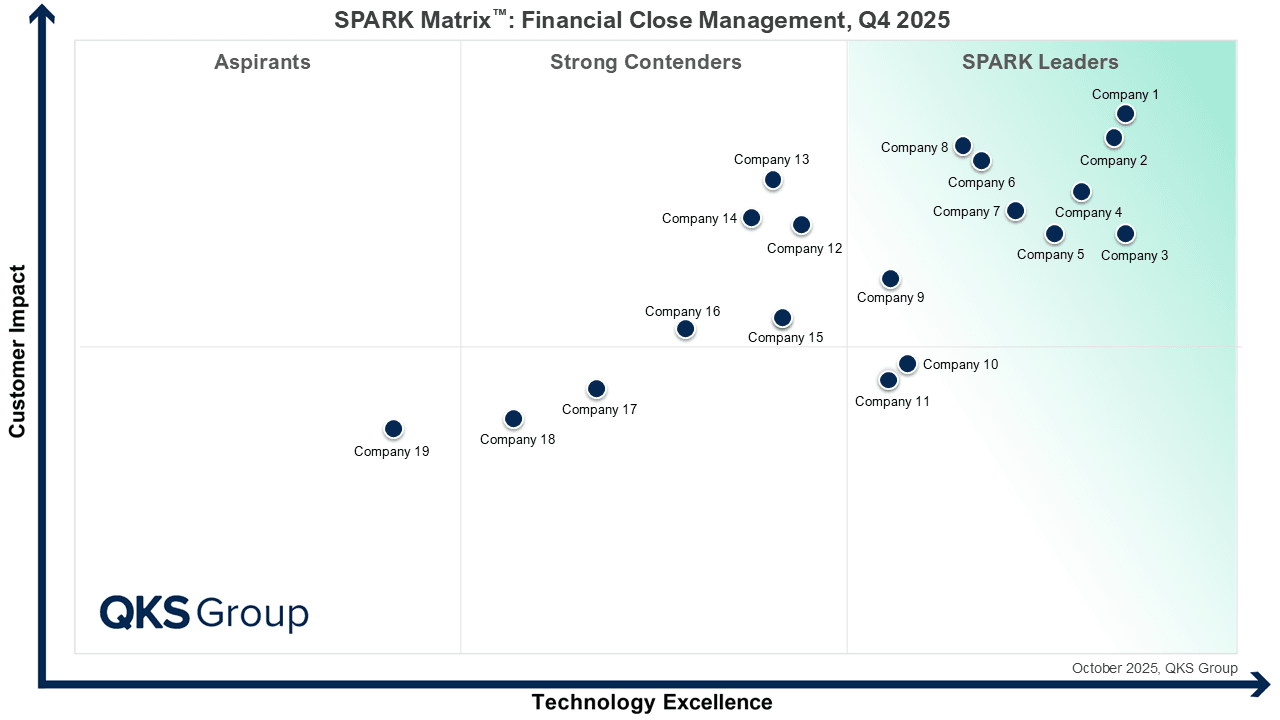
The Financial Close Management market includes established enterprise technology providers and specialized financial management vendors. QKS Group's research provides a comprehensive evaluation of leading vendors through its proprietary SPARK Matrix™ analysis.
The SPARK Matrix evaluates vendors based on their technology capabilities, competitive differentiation, and market positioning. The research includes Anaplan, BlackLine, Board, Cube, Datarails, SAP, FloQast, Trintech, IBM, insightsoftware, Jedox, OneStream Software, Oracle, Planful, Prophix, Redwood Software, Vena Solutions, Wolters Kluwer, and Workday.
This competitive assessment enables technology buyers to compare vendor capabilities and identify solutions aligned with their financial transformation priorities.
QKS Group Perspective on Financial Close Management
The evolution of Financial Close Management is enabling organizations to achieve faster closes with greater accuracy and transparency. Deep ERP integration, intelligent analytics, and compliance capabilities are helping finance teams streamline period-end processes while gaining predictive insights.
As finance becomes increasingly data-driven and strategic, modern Financial Close Management platforms can help organizations improve collaboration, increase agility, and support better business decisions.
Future Outlook for Financial Close Management
The future of Financial Close Management will increasingly be shaped by AI, automation, cloud technologies, integrated financial ecosystems, and intelligent analytics. Vendors are expected to focus on delivering more autonomous workflows that can identify exceptions, recommend actions, and reduce manual intervention.
AI-powered capabilities will also strengthen predictive financial analysis, while deeper integration with ERP, enterprise performance management, and other business applications will create more connected financial operations.
Organizations evaluating Financial Close Management platforms should therefore consider not only current automation capabilities but also AI readiness, integration architecture, scalability, compliance, analytics, and the ability to support evolving finance requirements.
Conclusion
The Financial Close Management market is moving from traditional, manual financial processes toward intelligent, automated, and connected finance operations. Cloud-native platforms, AI-driven automation, ERP integration, analytics, and compliance capabilities are redefining how organizations manage financial close activities.
QKS Group's Financial Close Management market research and SPARK Matrix™ provide strategic insights into emerging technologies, market trends, vendor capabilities, competitive differentiation, and future opportunities. For technology buyers, these insights can support informed vendor selection, while technology providers can use the research to understand market dynamics and strengthen their growth strategies.
#FinancialCloseManagement #FinancialClose #FinancialCloseAutomation #FinancialCloseSoftware #FinanceAutomation #FinancialManagement #DigitalFinance #AIinFinance #FinanceTransformation #FinancialReporting #CloudFinance #FinanceTechnology #SPARKMatrix #QKSGroup

 English
 Arabic
 French
 Spanish
 Portuguese
 Deutsch
 Turkish
 Dutch
Dutch
 Italiano
 Romaian
 Portuguese (Brazil)
 Greek
Greek
