


AI Server Market: The Infrastructure Boom Behind the Global AI Revolution
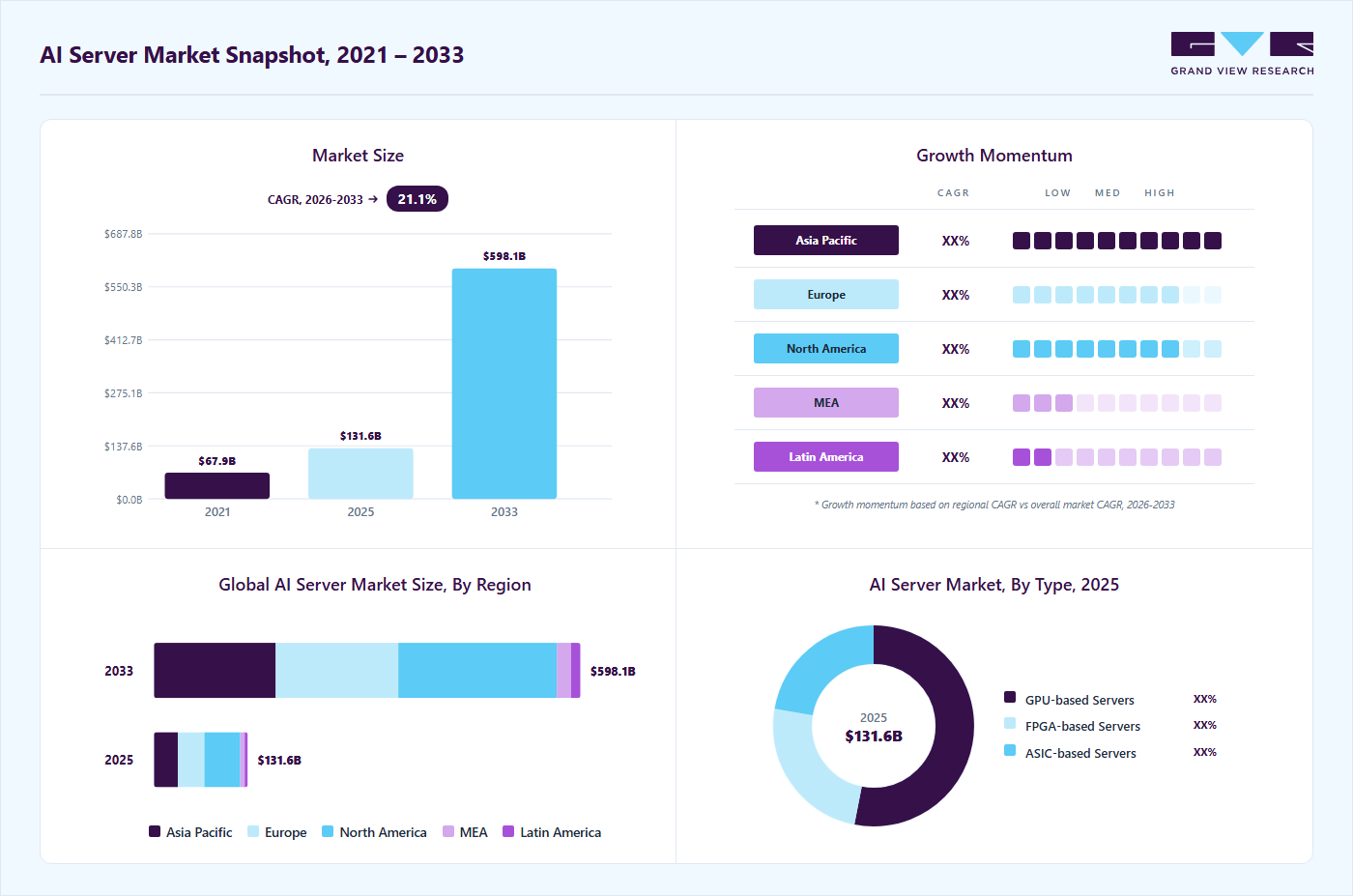
The AI Server Market is moving into a much larger phase of expansion as generative AI, cloud computing, and hyperscale data centers push demand for specialized computing infrastructure. The global AI server market was valued at USD 131.7 billion in 2025 and is estimated to reach USD 157.0 billion in 2026, before climbing to USD 598.1 billion by 2033, representing a 21.1% CAGR from 2026 to 2033. North America remains the largest regional contributor, while Asia Pacific is expected to record the fastest growth during the forecast period.
The headline numbers are impressive, but the more important story is what is changing inside the server itself. AI workloads are creating requirements that conventional computing infrastructure was not designed to handle, from massive parallel processing and high-speed data movement to tighter power and thermal constraints. As enterprises move beyond experimentation and begin deploying AI across production environments, server architecture is becoming an increasingly important part of their technology strategy.
Why AI Servers Are Evolving Alongside Generative AI
The rise of generative AI has fundamentally changed the type of computing infrastructure organizations need. Training and deploying large language models, image-generation systems, recommendation engines, and other machine-learning applications requires high throughput, low latency, and the ability to process enormous datasets simultaneously.
That explains the continued dominance of GPU-based systems. According to Grand View Research, GPU-based servers accounted for more than 53.0% of global revenue in 2025, making them the leading processor category. GPUs are particularly well suited to the parallel calculations required by AI and machine learning workloads, with architectures such as NVIDIA's A100 and H100 supporting demanding training and inference applications.
However, GPUs are not the only technology gaining attention. ASIC-based servers are expected to record the fastest CAGR during the forecast period. Their appeal comes from their ability to deliver specialized processing with greater energy efficiency for specific AI workloads. As data center operators face increasing pressure to improve performance per watt and control operating costs, purpose-built accelerators can become attractive alternatives for large-scale deployments.
The result is a more diverse processor environment. Instead of every organization purchasing the same type of AI infrastructure, server configurations are increasingly being matched to the workload—whether that means model training, inference, recommendation engines, analytics, or real-time decision-making.
Download a free sample report or claim your copy of this full market intelligence report
The Real Infrastructure Challenge Is Becoming Thermal Management
AI computing is not simply a processor problem. As accelerators become more powerful and server configurations become denser, managing the heat generated by these systems is becoming an equally important consideration.
Air cooling remained the leading cooling technology in 2025, supported by its established infrastructure and suitability for many edge and distributed deployments. Edge AI installations, modular data centers, smart-city systems, and industrial environments often cannot justify the complexity of installing extensive liquid-cooling infrastructure. Air-cooled systems therefore continue to provide a practical option where deployment flexibility and simpler maintenance are priorities.
At the high-density end, however, the requirements are changing. Grand View Research expects hybrid cooling to register significant growth from 2026 to 2033. These systems combine liquid cooling with conventional air handling to manage the concentrated heat generated by advanced GPUs and custom AI accelerators. The objective is not simply to keep equipment within a safe temperature range; effective thermal management helps prevent throttling and allows processors to maintain their intended performance.
Recent industry activity illustrates how important this issue has become. In April 2025, Fujitsu partnered with Supermicro and Nidec to develop AI server systems optimized for liquid cooling. The collaboration combines Fujitsu's liquid-cooling software, Supermicro's GPU server technology, and Nidec's cooling systems to reduce fan requirements, server power consumption, noise, and operating temperatures.
For buyers, this changes the evaluation process. Processor specifications remain important, but cooling architecture, power consumption, rack density, and sustained performance increasingly need to be considered together.
Form Factor Is Becoming a Strategic Data Center Decision
Physical server design is another area being reshaped by AI workloads. Rack-mounted servers held the largest revenue share in 2025, supported by their modular architecture, efficient use of data center space, and compatibility with high-density computing environments. Their ability to be stacked efficiently while supporting airflow, cabling, and power management makes them a natural fit for organizations expanding AI capacity within existing facilities.
Yet the next stage of growth is not necessarily going to favor the same configuration. Blade servers are projected to achieve the fastest CAGR from 2026 to 2033. Their compact architecture and centralized power, cooling, and connectivity can be particularly valuable for organizations adopting converged or hyper-converged infrastructure.
This shift is particularly relevant to manufacturing and telecommunications environments, where organizations increasingly want compute, storage, and networking resources managed through a more integrated infrastructure. For data center planners, the question is therefore moving beyond how much computing power can fit into a rack. Space, power availability, cooling capacity, and infrastructure consolidation are becoming equally important.
Where AI Server Demand Is Concentrating
The geographic picture reveals another important dimension of the AI Server Market. North America accounted for 38.2% of global revenue in 2025, giving it the largest regional share. The region benefits from a mature cloud ecosystem, substantial data center investment, and a strong base of semiconductor and server technology companies. The expansion of AI-as-a-service offerings is also encouraging cloud providers to deploy increasingly powerful AI infrastructure.
The U.S. plays a particularly important role because of its concentration of AI hardware and semiconductor companies. NVIDIA, AMD, Intel, and emerging AI processor developers such as Cerebras and Groq are contributing to an ecosystem that supports experimentation, customization, and large-scale deployment.
Asia Pacific is expected to be the fastest-growing regional market from 2026 to 2033. Its expansion is being supported by rapidly growing e-commerce, digital entertainment, fintech, and online services. Companies in the region are using AI for recommendation engines, fraud detection, inventory management, demand forecasting, content personalization, translation, and other high-volume applications.
China is an important contributor to this growth. Platforms such as Alibaba and JD.com use AI infrastructure for applications including logistics optimization, dynamic pricing, and personalization, while financial technology companies rely on AI for fraud detection, credit scoring, and customer support.
Europe is following a different path. Automotive applications, autonomous driving, smart mobility, and data-sovereignty requirements are supporting demand. Germany, in particular, is seeing increased interest in locally hosted AI infrastructure as organizations seek to process sensitive information within national borders while maintaining compliance with GDPR requirements.
The regional takeaway is significant: AI server demand is no longer concentrated solely around companies training the world's largest models. Increasingly, demand is coming from practical AI applications embedded in commerce, telecommunications, finance, entertainment, automotive systems, and enterprise operations.
Looking for more in-depth data focusing on specific segments or regions? Get this report customized with inclusion of custom data sets to suit your exact business needs
What This Means for Buyers and Vendors
End-use adoption reinforces this diversification. IT and telecommunications represented the largest end-use segment in 2025, supported by the expansion of edge computing, IoT, next-generation networks, augmented reality, virtual reality, and other latency-sensitive applications. AI servers positioned closer to users can process information faster while reducing the amount of data that must be sent back to centralized infrastructure.
At the same time, retail and e-commerce is expected to experience substantial growth during the forecast period. Real-time fraud detection and cybersecurity are among the applications increasing demand for high-performance AI infrastructure. Retail platforms also use AI for customer personalization, inventory planning, forecasting, and other data-intensive functions.
This means an AI server is no longer a single, standardized purchasing category. A hyperscaler training a large language model has very different requirements from an online retailer performing real-time fraud detection or a telecommunications operator running AI applications at the network edge.
The processor, cooling architecture, form factor, networking requirements, power envelope, and deployment environment all influence the appropriate configuration. Buyers therefore increasingly need to evaluate infrastructure according to workload rather than simply comparing headline processor specifications.
Key Players in the AI Server Market
Competition is also broadening beyond chip manufacturers. The current Grand View Research report identifies Dell Inc., Cisco Systems, IBM Corporation, HP Development Company, Huawei Technologies, NVIDIA, Fujitsu, ADLINK Technology, Lenovo, and Super Micro Computer among the key companies profiled in the global AI server market.
Dell Technologies is expanding its AI server portfolio across air- and liquid-cooled configurations. In May 2025, Dell introduced servers powered by NVIDIA Blackwell Ultra chips, with configurations supporting up to 192 chips as standard and customization up to 256 chips.
The Next Phase of AI Server Growth
The next phase of the AI Server Market will be defined less by simply adding more compute and more by making that compute sustainable, scalable, and workload-specific. The market is projected to expand from USD 157.0 billion in 2026 to USD 598.1 billion by 2033, but that growth will involve a broader range of architectures rather than one universal server design.
GPUs will remain central to demanding AI workloads, while ASICs are gaining ground where efficiency and performance per watt matter most. Air cooling continues to dominate current deployments, but hybrid approaches are becoming increasingly relevant as chip and rack densities rise. Rack-mounted systems remain the leading form factor, while blade architectures are positioned for faster growth.
For vendors, the opportunity is therefore not simply to sell faster servers. It is to provide complete infrastructure optimized around specific AI workloads. For buyers, the lesson is equally straightforward: the best AI server is not necessarily the one with the highest theoretical compute figure, but the one that can deliver the required performance reliably within the available power, cooling, space, security, and deployment constraints.

 English
 Arabic
 French
 Spanish
 Deutsch
 Turkish
 Dutch
Dutch
 Italiano
 Russian
 Romaian
 Portuguese (Brazil)
 Greek
Greek
