


Mini Piling and Underpinning in Hertfordshire Explained
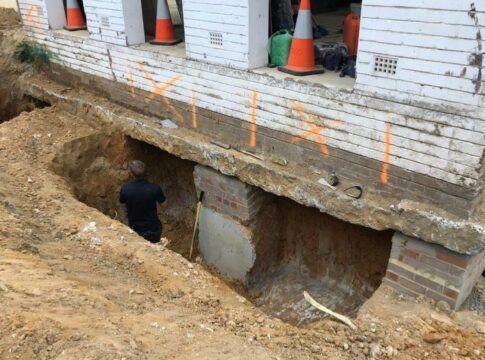
Homeowners looking for underpinning in hertfordshire are often respond to visible warning signs, such as diagonal cracks appearing above door frames, gaps forming between walls and ceilings, or internal doors that have begun sticking or binding in their frames.
The geology across Hertfordshire includes chalk in the north and east, London clay in the southern areas, and glacial deposits in several other zones. These different soil types behave very differently under changes in moisture and applied load. Clay in particular is highly susceptible to shrink and swell cycles driven by seasonal rainfall and drought, which creates cyclical movement beneath foundations. Understanding the specific ground conditions on a given site is therefore the essential starting point before any remedial foundation work is designed or carried out.
Structural Assessment Before Any Works
The Role of a Structural Engineer
A qualified structural engineer must assess the property before any underpinning is specified or carried out. This assessment typically involves reviewing the building history, examining all visible signs of movement and distress, and commissioning a ground investigation to understand what is happening at foundation level and below. The engineer then produces a detailed specification for the proposed works, which serves as the technical basis for contractor quotations and Building Regulations submissions.
Crack Monitoring and Movement Surveys
In some cases, the engineer will recommend monitoring the property before recommending any intervention. Crack monitors or settlement gauges are installed at strategic locations and readings are recorded over a period of months. This process distinguishes between active, progressive movement that requires structural intervention and historic cracking that has since stabilised. Only active movement justifies underpinning. Stable, historic cracking may need only cosmetic repair and should not trigger unnecessary structural work.
Underpinning Methods for Soils
Traditional Mass Concrete Underpinning
For properties with relatively shallow foundations and straightforward ground conditions, traditional mass concrete underpinning remains a reliable and cost-effective method. The process involves dividing the existing foundation into manageable sections, excavating beneath each section in a carefully planned sequence, and pouring concrete to fill the void. Each section is cured before the adjacent one is excavated, ensuring that no part of the structure is left unsupported at any stage. This sequential approach is labour-intensive but well understood and widely used across the county.
Beam and Base Underpinning
Where the foundation load needs to be redistributed across a wider area, or where the existing foundation has deteriorated significantly, beam and base underpinning offers greater flexibility. A reinforced concrete beam is constructed beneath or alongside the existing foundation, transferring the structural load to a series of discrete concrete bases positioned at calculated intervals. This method suits situations where the ground conditions are variable or where the geometry of the foundation makes sequential mass concrete impractical.
Mini Piling
When Mini Piles Are the Right Choice
Mini piling is the preferred solution when the competent bearing layer is too deep for conventional mass concrete underpinning to reach economically, or when site access prevents the use of conventional excavation equipment. Those seeking mini piling in hertfordshire are often dealing with properties adjacent to boundaries, in areas with restricted overhead clearance such as below existing floor slabs, or where the ground investigation has identified unstable or compressible soils at shallow depth that cannot carry the foundation loads.
The Mini Piling Installation Process
Mini piles typically range from 100mm to 300mm in diameter and are installed using compact drilling rigs that can be manoeuvred through standard doorways when internal access is required. Once the piles are drilled and grouted or cast in place, a reinforced concrete pile cap or ring beam is constructed to connect the tops of the piles and transfer the building load evenly across them. The process involves significantly less excavation than traditional underpinning and generally causes less disruption to the surrounding ground and adjacent structures.
Regulatory Requirements
All underpinning and mini piling works require compliance with Building Regulations. A structural engineer must design the works and submit details for Building Control approval. A Building Control officer will inspect the works at key stages before completion. These inspections are not optional and cannot be skipped. Failure to obtain the appropriate approvals creates complications at the point of future property sale and may affect insurance coverage for the building.
Conclusion
Whether your property requires traditional underpinning or a specialist mini piling solution, the process must begin with a thorough structural and geotechnical assessment by a qualified engineer. Selecting a contractor with relevant experience, proper insurance, and a clear approach to regulatory compliance is the most reliable route to a safe and lasting result.

 Arabic
 French
 Spanish
 Portuguese
 Deutsch
 Turkish
 Dutch
Dutch
 Italiano
 Russian
 Romaian
 Portuguese (Brazil)
 Greek
Greek
