


Fitness Focused Indian Kitchen High Protein Khapli Atta Guide
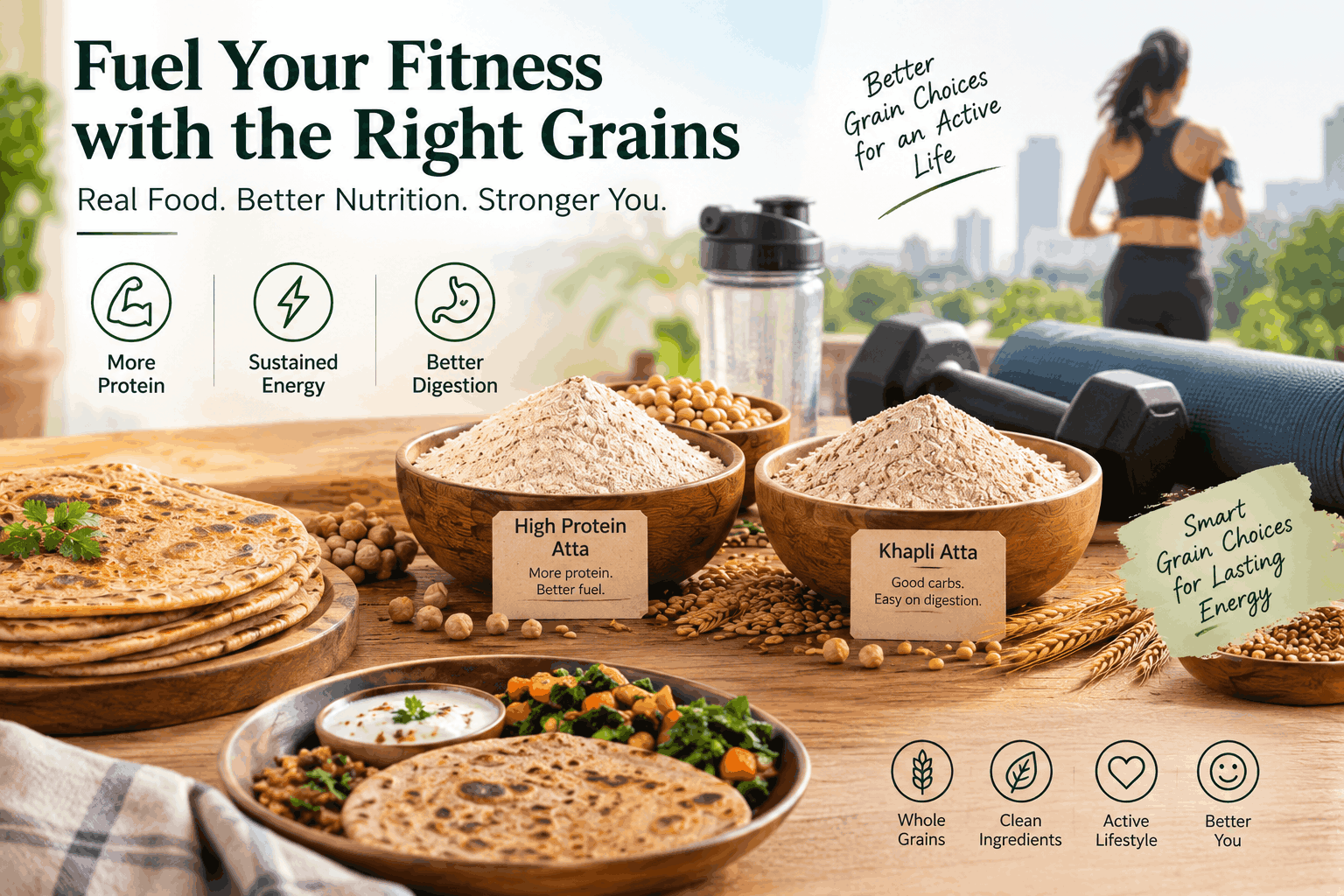
The Fitness-Focused Indian Kitchen — Supporting Active Lifestyles Through Grain Choices, Not Supplements
India's fitness culture has matured considerably over the last decade. The gym, once a niche environment for bodybuilders and athletes, has become a mainstream part of urban professional life. Morning runs, yoga practices, strength training routines, and team sports participation have moved from occasional aspirations into the daily schedules of a genuinely large segment of the working population.
What hasn't kept pace with this physical activity expansion is the nutritional knowledge that supports it. The dominant nutritional message reaching India's fitness community continues to be supplement-led — protein powders, pre-workout supplements, BCAA blends, and the full ecosystem of sports nutrition products marketed as necessary for anyone who exercises seriously. This message benefits the supplement industry considerably. Its alignment with the actual nutritional needs of most active Indians is less convincing on examination.
The nutritionally informed approach to supporting an active lifestyle through food rather than supplements starts with the daily grain choices that constitute the largest volume of carbohydrate and protein intake for most Indians. Getting those choices right — specifically, choosing flour products that deliver both the protein and the digestive qualities that active lifestyles require — produces measurably better outcomes than adding supplement layers on top of nutritionally inadequate daily food.
What Active Bodies Actually Need From Daily Food
The nutritional requirements of physically active people differ from those of sedentary individuals in two primary dimensions — higher protein needs for muscle repair and adaptation, and higher carbohydrate needs for glycogen replenishment and sustained energy. Both of these requirements interact with the grain choices in the daily kitchen.
Higher protein needs — the requirement to consume adequate protein to support muscle protein synthesis after training — is the dimension that the supplement industry has most successfully colonised. The message that active people need protein powders to meet their requirements has been effectively communicated, but it significantly overstates the gap between what active bodies need and what thoughtfully chosen whole foods can provide.
An active adult requires approximately 1.4 to 2.0 grams of protein per kilogram of body weight daily — a range that is achievable through food for most Indians who are eating adequate total calories and choosing protein-supporting food options. The flour used for daily rotis, if chosen with protein content in mind, contributes meaningfully to this total — reducing the gap that supplements are marketed to fill rather than eliminating it entirely.
Better glycaemic quality for sustained energy — the requirement that training nutrition fuel performance during sessions and support recovery afterward without the blood sugar dysregulation that refined carbohydrate diets create — is the dimension that the supplement industry addresses less well and that grain choices affect most directly.
How High Protein Atta Addresses the Protein Gap Through Daily Rotis
The protein contribution of daily rotis — eaten three to four times per person per daily meal cycle in most Indian households — is one of the most consistent and high-volume dietary inputs available for meeting the elevated protein needs of active individuals. Standard refined wheat atta contributes modestly to this total — approximately 10-12 grams of protein per 100 grams of flour. High Protein Atta raises this meaningfully by incorporating legume-based additions that boost protein content and improve the amino acid profile.
A quality high protein atta — formulated with soybean, chickpea, or other protein-dense legume additions — provides 18-20 grams or more of protein per 100 grams of flour. Across the four to six rotis that an active adult might eat daily, this difference accumulates into a protein contribution that genuinely reduces the gap between dietary protein intake and training requirements.
The amino acid profile improvement is nutritionally as significant as the protein quantity increase. The legume additions in a high protein atta blend complement wheat's amino acid profile — wheat is relatively low in lysine, while legumes are high in it — producing a flour whose usable protein is more complete than wheat alone provides. For vegetarian and vegan active individuals for whom plant-based protein completeness is the central nutritional challenge, this complementarity is genuinely valuable.
How Khapli Atta Addresses the Digestive Quality Requirement
The glycaemic quality of the carbohydrate sources in an active person's diet is a dimension that most sports nutrition conversations in India underweight relative to the protein conversation. The blood sugar management implications of consuming refined versus whole grain carbohydrates affect energy availability during training, recovery quality after sessions, and the hormonal environment that makes muscle adaptation possible.
Refined commercial wheat atta's high glycaemic index produces the blood sugar patterns — rapid rise, rapid fall — that challenge sustained training performance and recovery. The insulin spike that follows a refined wheat roti meal triggers fat storage mechanisms and can impair the fat oxidation that aerobic training is partly designed to develop.
Khapli atta's lower glycaemic index — a consequence of emmer wheat's ancient grain structure and lower modern gluten content — produces a more sustained, flatter glucose response that supports training energy more effectively than refined wheat. For active individuals who eat roti before training sessions or as a recovery meal, the glycaemic profile of the flour choice directly affects how those sessions feel and how well recovery progresses.
The digestive comfort dimension of khapli atta is additionally relevant for active individuals whose training creates systemic physiological stress that can reduce gut function. The lower modern gluten content of khapli flour and its different starch structure tend to produce better digestive comfort during and after training than refined commercial wheat — reducing the gastrointestinal issues that some athletes experience with high wheat intake during heavy training periods.
The Combined Approach for Active Indian Households
The most effective grain strategy for fitness-focused Indian households uses both products in a way that addresses both nutritional dimensions — high protein atta for the protein contribution through daily rotis, khapli atta for the glycaemic quality and digestive comfort that training nutrition requires.
The practical implementation is straightforward. High protein atta handles the household's primary daily roti production — contributing to the elevated protein requirements of active household members while serving the rest of the family's nutritional needs simultaneously. Khapli atta is used specifically for the rotis that are eaten closest to training sessions — the pre-training meal and the post-training recovery meal — where glycaemic quality has the most direct performance impact.
For fitness-focused households building this two-flour approach, 10on10 foods provides both products formulated to the whole grain and clean ingredient standard that makes the nutritional claims meaningful — high protein atta with genuine legume-based protein elevation rather than protein powder fortification, and khapli atta from whole grain emmer wheat that retains the ancient grain's glycaemic and digestive advantages.
Food-First Fitness Nutrition That Actually Works
The supplement industry's dominance of Indian fitness nutrition conversations has created a framework where active individuals reach for powders and pills to address gaps that better food choices would fill more effectively, more sustainably, and at lower cost. The two-flour approach isn't anti-supplement — it's pro-food-first, recognising that the nutritional foundation built through daily eating decisions is more powerful and more durable than any supplement protocol layered on top of an inadequate dietary base.
Active Indian bodies deserve active Indian food intelligence — grain choices that reflect both the elevated protein needs and the glycaemic quality requirements that training creates, delivered through the daily kitchen rather than through supplement schedules that the busiest training weeks are most likely to interrupt.

 English
 Arabic
 French
 Spanish
 Portuguese
 Deutsch
 Turkish
 Dutch
Dutch
 Russian
 Romaian
 Portuguese (Brazil)
 Greek
Greek
