


What Employers Should Know About JHSC Training in Burnaby
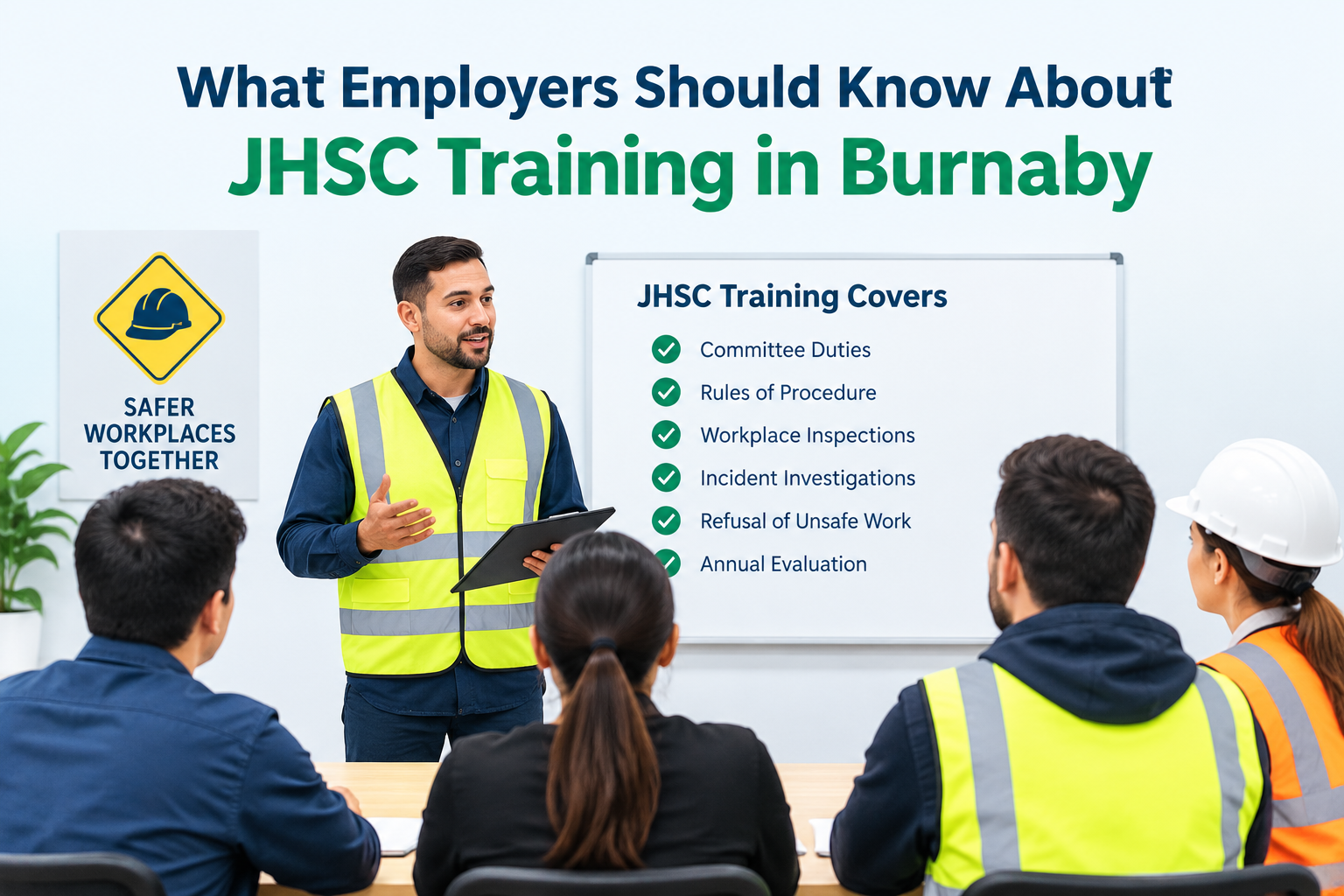
Workplace safety is not something employers can treat as a once-a-year checklist. In Burnaby, businesses operate across many different environments, from offices and retail locations to warehouses, construction sites, manufacturing facilities, schools, and service businesses. Each workplace can have its own hazards, procedures, and safety concerns.
A well-functioning Joint Health and Safety Committee (JHSC) gives employers and workers a structured way to identify concerns, discuss workplace conditions, participate in inspections and investigations, and recommend improvements.
For employers, understanding JHSC training in Burnaby is an important part of supporting committee members and meeting British Columbia's occupational health and safety requirements. WorkSafeBC states that workplaces with 20 or more workers generally require a joint health and safety committee, while workplaces with more than 9 but fewer than 20 workers generally require a worker health and safety representative.
But compliance is only one part of the picture. The real value of training comes from helping committee members understand how to perform their responsibilities effectively.
Why JHSC Training Matters to Burnaby Employers
A committee can only be effective when its members understand what their role involves. Without appropriate training, committee meetings can become focused on general discussions without producing clear actions or recommendations.
Training gives members a foundation for participating in workplace safety activities. It helps them understand the purpose of the committee, the responsibilities of its members, and the processes used to address health and safety issues.
For employers, this can lead to several practical benefits:
-
Better understanding of workplace safety responsibilities
-
More productive committee meetings
-
More organized workplace inspections
-
Stronger participation in incident investigations
-
Better communication between workers and management
-
More informed safety recommendations
-
Greater awareness of the regulatory requirements affecting the committee
WorkSafeBC describes joint committees as a way for employer and worker representatives to work together to identify and help resolve health and safety issues.
Does Every Burnaby Workplace Need a Joint Committee?
One of the first questions employers should answer is whether their workplace requires a joint committee or a worker health and safety representative.
According to WorkSafeBC:
-
9 or fewer workers: No committee or representative is generally required under the size-based table.
-
More than 9 but fewer than 20 workers: A worker health and safety representative is generally required.
-
20 or more workers: A joint health and safety committee is generally required.
The requirement is based on workers regularly employed at the workplace, and WorkSafeBC notes that a committee is required at workplaces with 20 or more workers.
Employers should also remember that workplace circumstances can affect their obligations. WorkSafeBC may require a joint committee in other situations as well.
Why Workplace Size Matters
Understanding the workforce threshold is particularly important for growing businesses. An employer may begin with a smaller operation and eventually reach the point where a formal joint committee becomes necessary.
Rather than waiting until an issue arises, employers can prepare by understanding their obligations, identifying suitable representatives, and making sure those representatives receive the required instruction and training.
What Training Is Required for New JHSC Members?
For new joint committee members selected on or after April 3, 2017, the employer must ensure that each member receives at least eight hours of instruction and training as soon as practicable and no more than six months after becoming a member.
This is an important point for employers. The six-month period is an outer limit rather than a reason to delay training unnecessarily. WorkSafeBC explains that training should be provided as soon as it is reasonably capable of being completed.
Training requirements are different for worker health and safety representatives. New representatives selected on or after April 3, 2017 require at least four hours of instruction and training.
What Does JHSC Training Cover?
A quality JHSC training in Burnaby program should address the core subjects established under the applicable British Columbia requirements.
WorkSafeBC identifies several required areas for joint committee member training.
1. Committee Duties and Functions
Members need to understand why the committee exists and what it is expected to accomplish.
This includes understanding the committee's role in identifying workplace health and safety concerns and working with the employer and workers to address them.
Training should move beyond simply explaining the committee's existence. Members should understand how their responsibilities apply during regular workplace activities.
2. Rules of Procedure
Every effective committee needs an organized way to operate.
Training covers the rules of procedure and how the committee uses them. This can include understanding meeting processes, responsibilities of members and co-chairs, and how issues are brought forward and followed up.
Clear procedures help prevent meetings from becoming unstructured conversations.
3. Incident Investigations
When an incident occurs, committee members need to understand their role in the investigation process.
Training introduces the requirements surrounding investigations and helps members understand the importance of examining what happened rather than simply assigning blame.
A useful investigation may consider:
-
What happened?
-
Where and when did it happen?
-
What conditions contributed to the incident?
-
Were procedures followed?
-
Were hazards previously identified?
-
What corrective actions may be appropriate?
The objective should be to learn from incidents and reduce the likelihood of similar events occurring again.
4. Workplace Inspections
Regular inspections are another important part of committee work.
Committee members should understand how inspections are conducted, what to look for, and how findings can be documented and communicated.
In a Burnaby workplace, inspection priorities may differ significantly depending on the industry. A warehouse could have concerns involving material handling and mobile equipment, while an office may have greater emphasis on ergonomics, emergency procedures, and workstation conditions.
Training gives committee members a framework they can apply to their own workplace.
5. Refusal of Unsafe Work
Workers have specific rights and responsibilities when they believe work would create an undue hazard.
JHSC training introduces the requirements surrounding refusal of unsafe work and helps committee members understand the process that applies when a concern is raised.
This is an area where employers benefit from having properly informed committee members because the issue can involve communication, investigation, and appropriate follow-up.
6. Annual Committee Evaluation
Training also addresses the evaluation of the joint committee.
WorkSafeBC states that section 3.26 requires a written evaluation to be conducted annually to determine the effectiveness of the joint committee. The evaluation is intended to assess compliance and effectiveness and identify areas for improvement.
This means employers should not view training as the end of their responsibility. The committee's performance should continue to be reviewed and improved.
How Employers Can Make Training More Effective
Simply registering committee members for a course is not the only step employers should consider.
The workplace should give trained members opportunities to apply what they learn.
For example, after completing training, committee members can participate actively in:
-
Monthly committee meetings
-
Workplace inspections
-
Incident investigations
-
Safety discussions
-
Hazard identification
-
Recommendations to management
-
Committee evaluations
-
Follow-up on previous safety concerns
When training is connected to real workplace activities, members are more likely to understand how their knowledge applies in practice.
Choosing a JHSC Course in Burnaby
Employers have options when arranging required training. WorkSafeBC indicates that mandatory training can be delivered by the employer or by external training providers, provided the training meets the applicable requirements.
When comparing a training provider, employers should consider whether the program clearly addresses the required subjects.
Look for training that provides practical explanations of:
-
Joint committee duties
-
Rules of procedure
-
Incident investigations
-
Workplace inspections
-
Unsafe work refusals
-
Annual committee evaluation
-
Applicable occupational health and safety responsibilities
Employers may also want to consider the delivery format. WorkSafeBC notes that training can be delivered in different formats and does not have to occur in one single session.
A format that combines independent learning with instructor-led training may be useful for organizations trying to balance training requirements with operational schedules.
What Employers Should Do Before Training
Preparation can make the training experience more useful.
Before enrolling committee members, employers can review their current workplace safety practices and identify areas where committee members may need additional understanding.
Consider asking:
-
Does our workplace have the correct committee or representative?
-
Are new members receiving training within the required timeframe?
-
Are committee meetings being conducted effectively?
-
Are workplace inspections documented?
-
Are incident investigations receiving appropriate participation?
-
Are worker safety concerns being followed up?
-
Are committee recommendations being communicated and tracked?
-
Are we completing the required annual committee evaluation?
These questions can help identify gaps that training may help address.
Training Records and Employer Responsibilities
Employers should also pay attention to documentation.
Under section 3.27, employers must ensure that a person receiving the required training receives a copy of their training record as soon as practicable after completing the training. Employers must retain the training record for two years after the person ceases to be a joint committee member or worker health and safety representative.
Keeping organized records can make it easier to demonstrate that training requirements have been addressed.
It also helps employers monitor when new committee members have joined and whether their required training has been completed.
Annual Education Leave Is Separate
Another point employers should understand is that mandatory initial training is different from annual educational leave.
WorkSafeBC states that joint committee members and worker health and safety representatives are entitled to eight hours of annual educational leave for occupational health and safety training. This entitlement is separate from the mandatory minimum training required for new members and representatives.
That distinction is important because completing the initial training does not eliminate the ongoing value of safety education.
Regular learning can help committee members stay engaged and develop knowledge that is relevant to changing workplace conditions.
Common Mistakes Employers Should Avoid
Several simple mistakes can reduce the effectiveness of a workplace committee.
Waiting Too Long to Train New Members
The regulations establish a maximum six-month timeframe for required training of new joint committee members. Employers should plan training early rather than waiting until the deadline approaches.
Treating the Committee as a Formality
A committee should not exist only to satisfy a requirement. Its value comes from active participation, meaningful discussions, inspections, investigations, recommendations, and follow-up.
Ignoring Workplace-Specific Hazards
Generic safety knowledge is useful, but committee members also need to understand the hazards relevant to their particular workplace.
Failing to Follow Up
Identifying a hazard is only part of the process. Concerns should be documented, communicated, assigned where appropriate, and followed through.
Forgetting the Annual Evaluation
The annual evaluation provides an opportunity to determine whether the committee is actually fulfilling its role and where improvements may be needed.
FAQs About JHSC Training in Burnaby
How many workers require a joint health and safety committee?
Generally, a workplace with 20 or more workers requires a joint health and safety committee. Workplaces with more than 9 but fewer than 20 workers generally require a worker health and safety representative.
How many hours of training do new JHSC members need?
New joint committee members selected on or after April 3, 2017 must receive at least eight hours of instruction and training, as soon as practicable and no more than six months after becoming a member.
Is JHSC training only about workplace inspections?
No. Required training covers several areas, including committee duties, rules of procedure, incident investigations, workplace inspections, refusal of unsafe work, and annual committee evaluation.
Can employers use an external training provider?
Yes. WorkSafeBC states that mandatory training may be delivered by an employer or an external provider, provided the training meets the applicable requirements.
Is annual safety education different from mandatory JHSC training?
Yes. The required initial training for new members is separate from the eight hours of annual educational leave available to joint committee members and worker representatives.
Why is practical training important?
Practical training helps committee members connect regulatory requirements with everyday workplace activities such as inspections, investigations, meetings, hazard identification, and recommendations.
Conclusion
For Burnaby employers, effective joint health and safety committee training is about more than completing a required course. It is an opportunity to give committee members the knowledge and confidence needed to participate meaningfully in workplace safety.
The right JHSC training in Burnaby should help members understand their responsibilities, workplace inspection practices, incident investigations, unsafe work procedures, committee operations, and evaluation requirements.
Employers can strengthen the process by selecting appropriate training, keeping accurate records, supporting committee participation, and giving members opportunities to apply their knowledge at the workplace.
Ultimately, a strong joint committee depends on active cooperation between employers and workers. When members are properly trained and supported, the committee can become a practical part of the workplace safety system rather than simply another administrative requirement.

 English
 Arabic
 French
 Spanish
 Portuguese
 Deutsch
 Turkish
 Dutch
Dutch
 Italiano
 Russian
 Romaian
 Portuguese (Brazil)
