


SAP Courses: Best SAP Modules, Training and Certification Guide for 2026
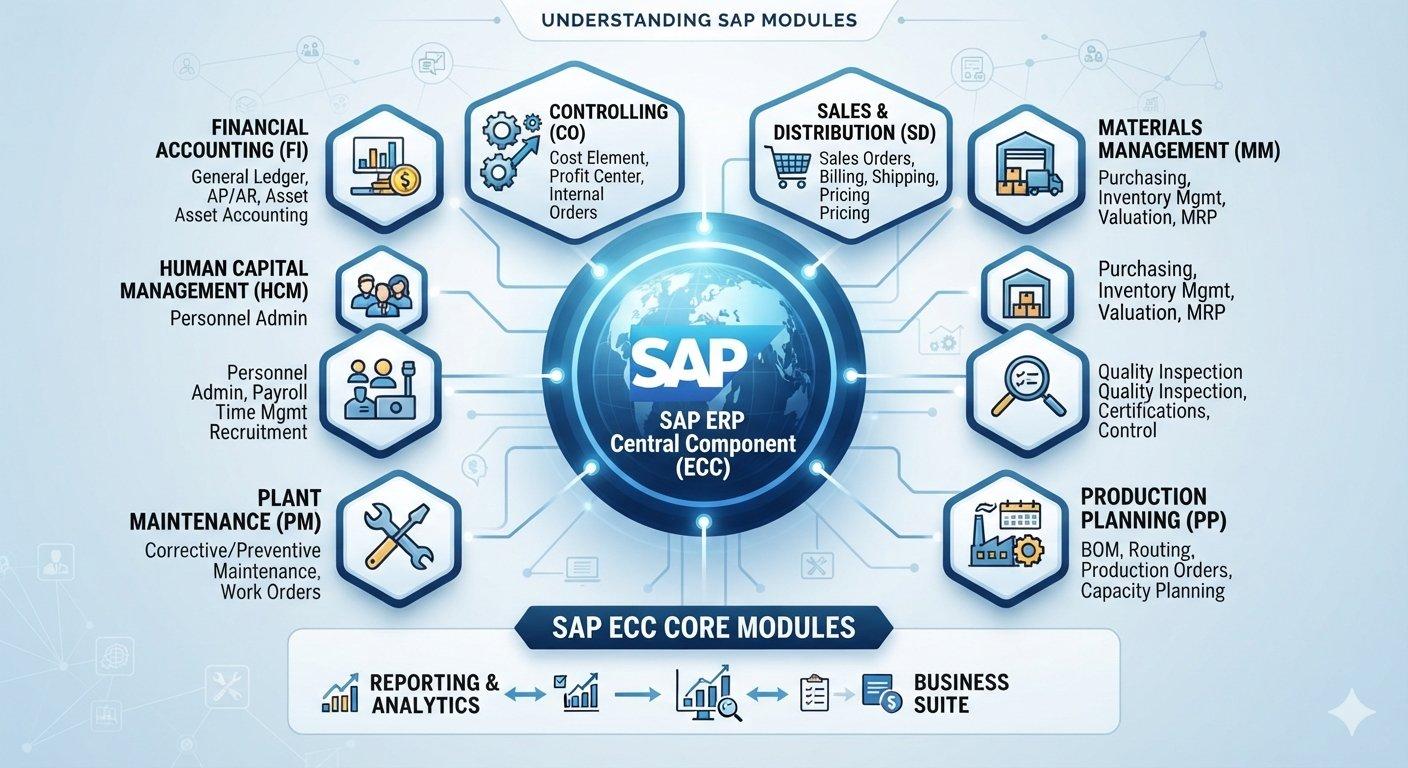
SAP courses train professionals to implement, configure, and manage SAP's enterprise software across finance, logistics, HR, and analytics. In 2026, the most in-demand modules are SAP S/4HANA, SAP FICO, SAP MM, SAP SD, and SAP ABAP. If you want to explore SAP courses seriously, choose a program with hands-on labs, certification prep, and placement support and if you're based in South India, trusted SAP courses in Bangalore offer strong classroom and hybrid options backed by the city's ERP consulting ecosystem.
Why SAP Skills Still Matter in 2026
SAP remains the backbone of enterprise resource planning (ERP) for thousands of large and mid-sized companies worldwide. Manufacturing firms, banks, retailers, and logistics companies rely on SAP to run finance, supply chain, and HR operations from a single system.
As more organizations migrate from legacy SAP ECC to SAP S/4HANA, demand for consultants who understand both the old and new architecture has grown. This migration wave is one reason SAP training continues to attract career switchers, fresh graduates, and working IT professionals alike.
If you're weighing whether to invest time and money in SAP training, here's what matters: SAP consulting is project-based, well-paid, and portable across industries. A finance professional who learns SAP FICO doesn't just gain a technical skill they become employable in accounting, auditing, and ERP implementation roles simultaneously.
Understanding SAP Modules: Where to Start
SAP is not one course it's a suite of modules, each mapped to a business function. Picking the right one depends on your background and career goals.
Functional Modules (Business-Process Focused)
| Module | Full Form | Best For | Typical Prior Background |
|---|---|---|---|
| SAP FICO | Finance & Controlling | Accountants, finance graduates | B.Com, MBA Finance, CA/CMA |
| SAP MM | Materials Management | Procurement, inventory roles | Supply chain, operations |
| SAP SD | Sales & Distribution | Sales, order management | Marketing, commerce grads |
| SAP HCM/HR | Human Capital Management | HR professionals | HR, business administration |
| SAP PP | Production Planning | Manufacturing planners | Mechanical/industrial engineers |
Technical Modules (Development Focused)
| Module | Focus Area | Best For |
|---|---|---|
| SAP ABAP | Programming/customization | Developers, CS/IT grads |
| SAP BASIS | System administration | System admins, infra teams |
| SAP HANA | In-memory database & analytics | Data professionals |
| SAP Fiori/UI5 | Front-end app design | UI/UX and web developers |
The Rising Priority: SAP S/4HANA
SAP S/4HANA isn't a separate module it's the current generation of SAP's core ERP suite, and most functional and technical courses now teach on the S/4HANA version by default. When you explore SAP courses today, check whether the syllabus is S/4HANA-based rather than the older ECC 6.0, since that's what employers are actively hiring for.
How to Choose the Right SAP Course
Before enrolling, run through this checklist:
- Match the module to your background. Finance professionals gravitate toward FICO; engineers toward PP or QM; developers toward ABAP.
- Check if it's S/4HANA-based. Legacy ECC-only courses are less valuable now.
- Look for hands-on system access. Theory without a live SAP server or GUI practice won't build real skill.
- Verify trainer experience. Ask if the trainer has actual implementation project experience, not just teaching experience.
- Confirm certification mapping. The syllabus should align with SAP's official certification exam blueprint.
- Ask about placement support. Some institutes offer interview preparation, resume building, and referrals.
- Compare classroom vs. online formats. Both work; the right choice depends on how you learn best.
Training Formats: Classroom, Online, or Hybrid
| Format | Pros | Consider If |
|---|---|---|
| Classroom | Direct mentor access, structured schedule, peer learning | You prefer in-person accountability |
| Live Online | Flexible location, real-time doubt clearing | You're balancing a job or relocation |
| Self-Paced Online | Lowest cost, learn anytime | You're highly self-motivated |
| Hybrid | Mix of live sessions + recorded content | You want flexibility with some structure |
Trusted SAP Courses in Bangalore: What to Look For
Bangalore has one of India's largest concentrations of SAP implementation partners, IT services firms, and consulting companies, which makes it a practical city for hands-on SAP learning and internships alongside coursework.
When evaluating trusted SAP courses in Bangalore, prioritize institutes that offer:
- SAP-certified or industry-experienced trainers with real project backgrounds, not just academic credentials.
- Live server access for practicing configuration, not just recorded demos.
- Batch sizes small enough for individual doubt-clearing.
- Placement assistance or tie-ups with local IT/ITES and consulting firms, given Bangalore's dense job market for SAP consultants.
- Transparent fee structures with no hidden charges for certification vouchers or extra modules.
- Flexible timings weekend or evening batches for working professionals in the city's IT corridor.
A practical approach: shortlist 3–4 institutes, ask for a trial class, and request to speak with a recent graduate before paying full fees.
SAP Certification: Is It Worth It?
SAP offers official certifications through the SAP Learning Hub and SAP Training platform. These are proctored exams that validate module-specific knowledge.
Certification is worth pursuing if:
- You're early in your SAP career and need proof of skill for your first project.
- Your target employer explicitly lists certification as a requirement.
- You want to specialize deeply in one module (e.g., SAP FICO or S/4HANA Finance).
Certification is less critical if:
- You already have hands-on implementation experience on real client projects.
- You're transitioning modules and need practical exposure more than another credential.
Either way, most recruiters weigh project experience and problem-solving ability more heavily than certification alone treat the certificate as a supporting credential, not a substitute for practice.
A Realistic Learning Path for Beginners
If you're starting from zero, here's a sensible sequence:
- Understand ERP fundamentals what SAP does and why businesses use it.
- Pick one module aligned to your background (don't try to learn five at once).
- Complete a structured course with live practice access.
- Work on 1–2 mini-projects or case studies to apply what you've learned.
- Attempt the relevant SAP certification if it fits your goals.
- Build a project-based resume highlighting configuration tasks you've actually done.
- Apply for support/junior consultant roles to gain real implementation exposure.
Common Mistakes to Avoid
- Enrolling in multiple modules simultaneously without mastering one first.
- Choosing a course purely on price without checking trainer credibility.
- Ignoring whether the course covers S/4HANA.
- Skipping hands-on practice and relying only on video lectures.
- Assuming certification alone guarantees a job offer.
FAQ's
1. Which SAP module is best for beginners with no IT background?
SAP FICO or SAP MM are common starting points for non-technical learners, since they map closely to real-world finance and procurement processes.
2. How long does it take to complete an SAP course?
Most module-specific courses run 2–4 months for functional modules and slightly longer for technical modules like ABAP, depending on pace and prior experience.
3. Do I need a technical background to learn SAP?
No. Functional modules like FICO, SD, and HR are designed for professionals from finance, sales, and HR backgrounds respectively.
4. Is SAP S/4HANA different from regular SAP training?
S/4HANA is the current SAP ERP suite running on the HANA in-memory database. Most modern SAP courses now teach on S/4HANA rather than the older ECC version.
5. What is the difference between SAP certification and an SAP training course?
A training course teaches the module; certification is a separate proctored exam through SAP that validates your knowledge formally.
6. Are online SAP courses as effective as classroom training?
Yes, provided the course includes live system access and instructor interaction the format matters less than the quality of hands-on practice.
7. Which SAP module has the most job openings currently?
SAP S/4HANA Finance, MM, and ABAP consistently see strong demand, though openings vary by region and industry.
8. Can I switch SAP modules after learning one?
Yes, many professionals cross-train into a second module (e.g., FICO to S/4HANA Finance) after gaining experience in their first.
9. Do SAP courses guarantee placement?
No legitimate course can guarantee placement. Look for institutes offering placement assistance and interview preparation instead of guarantees.
10. What should I check before paying for an SAP course in Bangalore?
Verify trainer experience, request a demo class, confirm live system access, and speak to a past student before enrolling.
Final Thoughts
Choosing the right SAP course comes down to three things: picking a module that fits your background, insisting on hands-on practice over passive video lectures, and verifying the institute's real placement and trainer track record. Whether you explore SAP courses online or look specifically for trusted SAP courses in Bangalore, the fundamentals of a good decision don't change practical exposure and credible instruction matter more than flashy marketing. Start with one module, build real project experience, and let certification support your resume rather than replace real skill.
About the Author
[Kodakco] is an SAP-trained ERP consultant and corporate trainer with hands-on experience across SAP FICO and S/4HANA implementation projects. They write about enterprise software careers, training pathways, and practical upskilling strategies for finance and IT professionals.

 English
 Arabic
 French
 Spanish
 Portuguese
 Deutsch
 Turkish
 Dutch
Dutch
 Italiano
 Russian
 Romaian
 Portuguese (Brazil)
