


How HSM Solutions Support Modern Data Protection and Encryption Strategies
Introduction
Data has become one of the most important assets for modern organizations. Businesses today store and process massive volumes of sensitive information, including customer records, financial details, intellectual property, employee information, and confidential business data.
As organizations adopt cloud computing, artificial intelligence, digital applications, and connected technologies, protecting this information has become increasingly challenging. Cybercriminals continue to develop advanced techniques to target valuable data, making traditional security approaches insufficient.
Encryption has become a fundamental security strategy for protecting sensitive information. It ensures that data remains unreadable to unauthorized users by converting it into an encrypted format. However, encryption protection depends heavily on the security of cryptographic keys.
If encryption keys are exposed, attackers may gain access to protected information. Therefore, organizations need secure methods to generate, store, and manage these keys throughout their lifecycle.
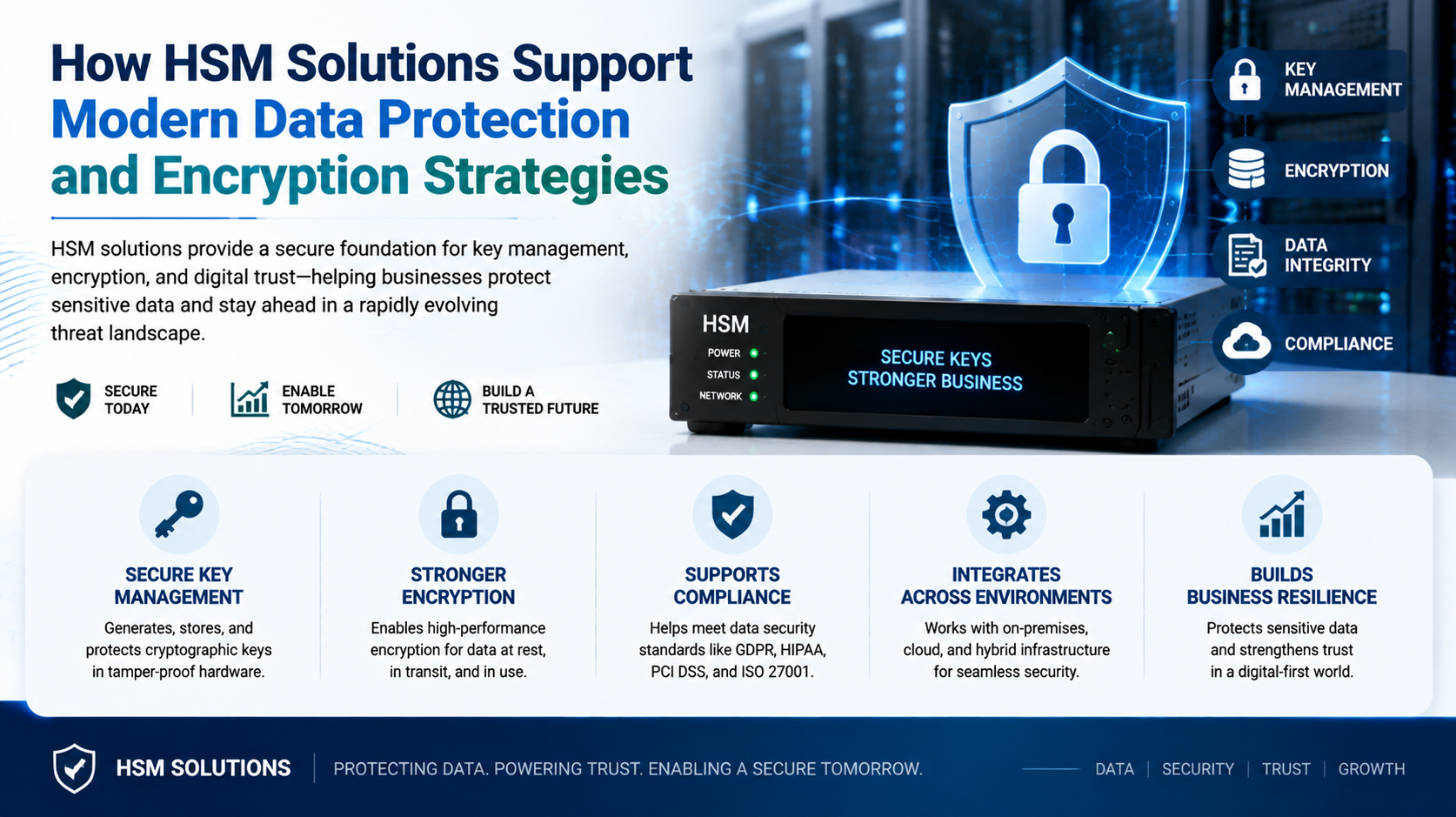
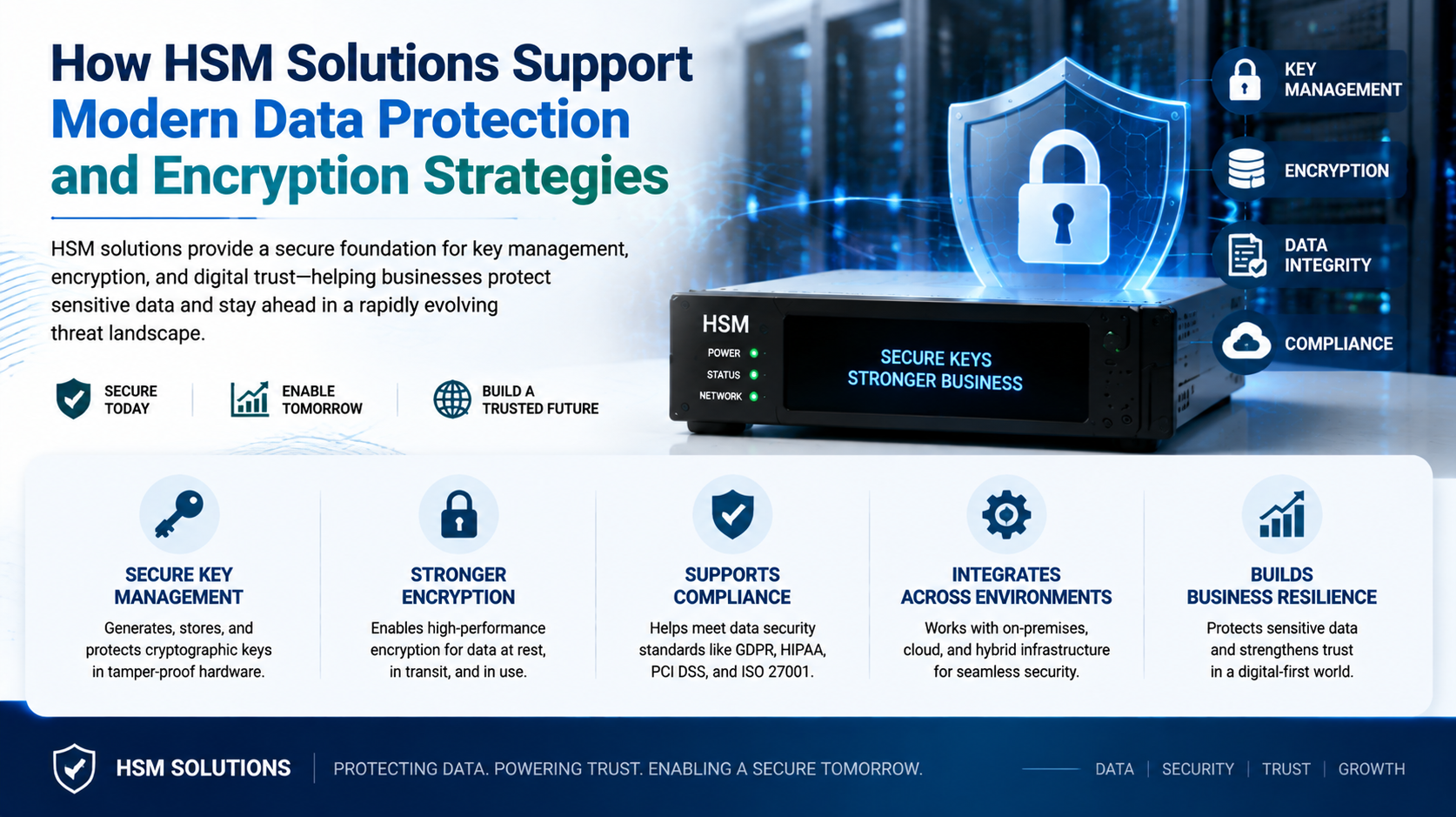
This is where HSM Solutions play a critical role. Hardware Security Modules provide a secure environment for protecting encryption keys and performing sensitive cryptographic operations. By integrating HSM technology with modern encryption strategies, organizations can create stronger data protection frameworks.
Understanding Modern Data Protection Challenges
Organizations operate in complex digital environments that include:
- Cloud infrastructure
- Enterprise applications
- Databases
- Remote work systems
- Mobile platforms
- Hybrid IT environments
While these technologies improve efficiency and scalability, they also expand the potential attack surface.
Modern businesses face several security challenges, including:
Increasing Data Breaches
Attackers frequently target databases and applications containing valuable information. A successful breach can expose sensitive business and customer data.
Complex IT Environments
Managing security across multiple platforms creates challenges related to visibility, access control, and consistent policy enforcement.
Growing Compliance Requirements
Organizations must follow strict regulations and industry requirements to protect sensitive information and maintain customer trust.
Encryption Key Management Challenges
As businesses encrypt more data, the number of encryption keys they manage increases significantly. Without proper control, encryption keys can become a security weakness.
To address these challenges, organizations need advanced solutions that protect both data and the cryptographic keys used to secure it.
The Importance of Encryption in Data Protection Strategies
Encryption is one of the most effective methods for protecting sensitive information. It ensures that even if unauthorized users access stored data, they cannot understand or use it without the correct decryption key.
Organizations use encryption to protect:
- Customer information
- Financial transactions
- Healthcare records
- Business applications
- Database content
- Cloud-based data
However, encryption effectiveness depends on proper management of encryption keys.
This makes Key management an essential part of any modern security strategy.
Effective Key management ensures that organizations can:
- Generate secure encryption keys
- Store keys safely
- Control key access
- Rotate keys regularly
- Monitor key usage
- Retire outdated keys securely
Without strong key protection, even advanced encryption technologies may not provide complete security.
Understanding Key Management in Cryptography
Key management in cryptography refers to the processes and technologies used to securely manage cryptographic keys throughout their lifecycle.
The key lifecycle includes several important stages:
Key Generation
Organizations must generate strong encryption keys using secure methods to prevent unauthorized prediction or duplication.
Key Storage
Encryption keys require secure storage mechanisms to prevent theft or misuse.
Key Distribution
Keys must be delivered securely to authorized applications and users.
Key Rotation
Regular key rotation reduces risks associated with long-term key usage.
Key Retirement
Organizations must securely remove keys that are no longer required.
Managing these processes manually becomes difficult as organizations grow. This is why businesses increasingly rely on advanced solutions such as HSM technology.
What Are HSM Solutions?
HSM Solutions are security technologies designed to protect cryptographic keys and perform sensitive encryption operations within dedicated hardware environments.
A Hardware Security Module provides a secure, tamper-resistant platform where organizations can generate, store, and use encryption keys.
Unlike software-based key storage, HSM Solutions provide additional hardware-level protection.
Organizations use HSM technology for:
- Encryption and decryption
- Digital signatures
- Authentication
- Certificate management
- Secure key generation
- Payment processing security
By keeping cryptographic keys inside protected hardware, HSM Solutions reduce the risk of unauthorized access and key exposure.
The Role of HSM Modules in Modern Encryption Strategies
HSM modules provide the foundation for secure cryptographic operations. They protect encryption keys by ensuring that sensitive operations occur within a controlled hardware environment.
HSM modules help organizations strengthen encryption strategies through:
Secure Key Protection
HSM modules store encryption keys inside dedicated hardware, preventing attackers from extracting them from servers or applications.
Secure Cryptographic Operations
Instead of moving encryption keys between systems, organizations can perform cryptographic operations directly inside the HSM environment.
Strong Access Controls
HSM modules support advanced authentication and authorization mechanisms to control access to cryptographic resources.
Protection Against Internal and External Threats
Hardware-based protection reduces risks caused by malware, compromised systems, and unauthorized users.
How HSM Solutions Support Database Encryption Strategies
Databases often contain the most sensitive information within an organization. Protecting database content requires strong encryption and secure key management.
A database encryption solution protects stored information by converting sensitive data into encrypted formats.
However, database encryption depends on encryption keys. If those keys are poorly protected, attackers may still access encrypted information.
HSM Solutions strengthen database encryption by protecting the encryption keys separately from the database.
The process typically works as follows:
- The database encryption solution encrypts sensitive information.
- Encryption keys are generated and stored securely.
- HSM modules protect these keys from unauthorized access.
- Authorized applications request controlled cryptographic operations.
- Security teams monitor encryption activities.
This layered approach ensures that both data and encryption keys receive strong protection.
The Role of Thales Key Management in Enterprise Security
Large organizations often manage encryption across thousands of applications, databases, and cloud environments. Managing these encryption keys manually can create security risks and operational challenges.
Thales key management solutions help organizations establish centralized control over encryption keys and improve security visibility.
Thales key management supports organizations by enabling:
- Centralized encryption key administration
- Secure key lifecycle management
- Consistent security policies
- Improved compliance reporting
- Protection across multiple environments
By combining Thales key management capabilities with HSM technology, organizations can build a stronger encryption framework.
This approach allows enterprises to maintain control over encryption keys while protecting critical cryptographic operations.
Supporting Data Security Standards With HSM Technology
Organizations across industries must follow strict security requirements to protect sensitive information.
Implementing HSM Solutions helps businesses align their security practices with applicable Data security standards.
Strong data security frameworks typically require organizations to implement:
- Encryption controls
- Secure key management
- Access restrictions
- Monitoring processes
- Security audits
- Data protection policies
HSM technology supports these requirements by providing secure key storage, controlled access, and detailed activity records.
Benefits of Implementing HSM Solutions
Organizations that integrate HSM Solutions into their security strategies gain several benefits.
Enhanced Data Protection
HSM technology protects encryption keys and reduces the risk of unauthorized data access.
Improved Security Control
Organizations gain better visibility and control over cryptographic operations.
Stronger Compliance Support
HSM Solutions help businesses demonstrate secure encryption and key management practices.
Reduced Security Risks
Hardware-based protection minimizes vulnerabilities associated with traditional software-based key storage.
Scalability for Enterprise Growth
HSM technology supports organizations as their encryption requirements increase across applications and environments.
Best Practices for Using HSM Solutions
To maximize the benefits of HSM technology, organizations should follow these best practices:
Create a Strong Key Management Policy
Businesses should define clear processes for key creation, usage, rotation, and retirement.
Protect Critical Keys With HSM Modules
Sensitive encryption keys should receive additional protection through hardware security.
Implement Role-Based Access Control
Only authorized users and systems should perform cryptographic operations.
Monitor Key Activities
Organizations should review cryptographic activities to identify suspicious behavior.
Regularly Review Security Policies
Security frameworks should evolve as technology and threats change.
Future of HSM Solutions in Data Security
As organizations continue adopting cloud computing, artificial intelligence, and digital services, the need for stronger encryption strategies will continue to grow.
Future security environments will require:
- Automated key management
- Cloud-based HSM integration
- Advanced cryptographic protection
- Stronger compliance frameworks
- Improved security automation
HSM Solutions will remain an important technology for protecting encryption keys and supporting secure digital transformation.
Conclusion
Modern data protection requires more than simply encrypting information. Organizations must also protect the cryptographic keys that secure their data.
HSM Solutions provide a secure foundation for modern encryption strategies by protecting encryption keys, supporting cryptographic operations, and improving security control.
Through effective Key management and strong key management in cryptography practices, businesses can maintain better control over their sensitive information. Technologies such as Thales key management, HSM modules, and a secure database encryption solution help organizations create stronger protection frameworks.
By adopting HSM-based security strategies and following appropriate Data security standards, enterprises can reduce cybersecurity risks and build a reliable foundation for protecting critical data in an increasingly digital world.

 English
 Arabic
 French
 Spanish
 Portuguese
 Deutsch
 Turkish
 Dutch
Dutch
 Italiano
 Russian
 Romaian
 Portuguese (Brazil)
