


Non-Dairy Creamers Market to Reach USD 5.2 Billion by 2036
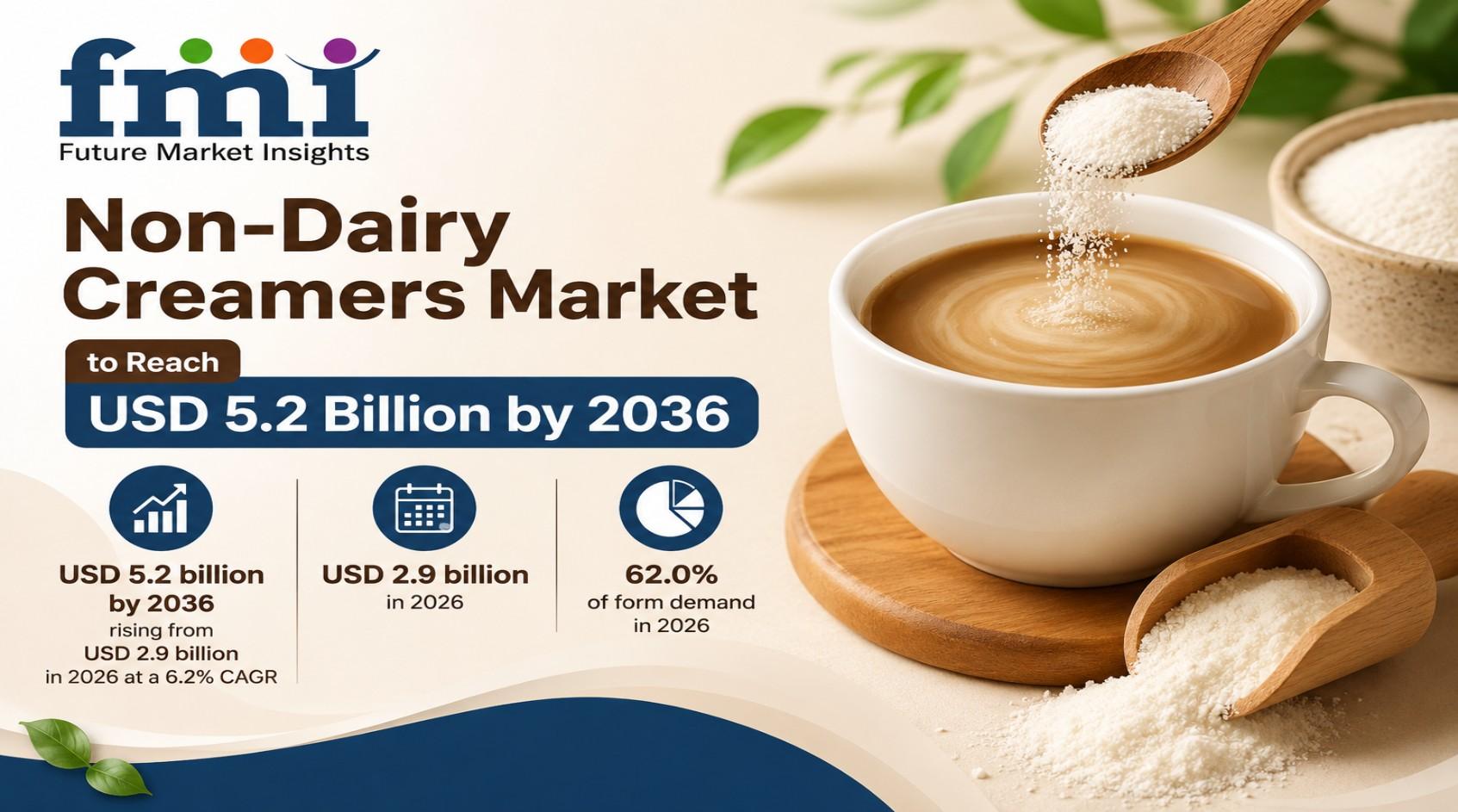
The global non-dairy creamers market is projected to reach USD 5.2 billion by 2036, rising from USD 2.9 billion in 2026 at a 6.2% CAGR, according to latest insights by Future Market Insights. Powder formulations are expected to account for 62.0% of form demand in 2026, while vegetable oil is projected to represent 55.0% of the base segment. Food and beverage processing accounts for 48.0% of end-use demand, with allergen disclosure remaining the primary formulation constraint.
The growth outlook answers a practical question for beverage manufacturers and foodservice operators: where is demand concentrating? FMI data points to recurring out-of-home coffee consumption, shelf-stable powder efficiency, and plant-based recipe development that preserves coffee temperature and mixing stability. South Korea is projected to be the fastest-growing country, recording a 7.6% CAGR through 2036, followed by Poland at 7.2% and the United Kingdom at 6.6%.
Non-Dairy Creamers Market Growth Reflects Recurring Coffee Habits and Ambient Handling Frequent coffee preparation across households, quick-service restaurants, and institutional beverage programs provides a steady foundation for market volume. The National Coffee Association reported in April 2026 that nearly 195 million American adults drink coffee weekly, with 82% of past-day drinkers preparing coffee at home, sustaining demand across both grocery retail aisles and commercial dispensing systems.
Food and beverage processing operations remain central to the non-dairy creamers market. Industrial drink manufacturers and dry-mix formulators require stable whitening, rapid solubility, and predictable fat behavior across high-speed production runs. Food and beverage processing is projected to hold a 48.0% share in 2026.
Powder packaging dominates physical formats. FMI estimates that powder creamers will account for 62.0% share in 2026 because dry spray-dried systems offer an 18-to-24-month shelf life without refrigerated logistics. Formulating with milk-derived sodium caseinate while ensuring transparent dairy-allergen labeling, however, remains a persistent regulatory hurdle for global exporters.
“Creamer economics improve when a formulation survives the customer's actual coffee temperature and mixing process without repeated adjustment.” Nandini Roy Choudhury, Principal Consultant, Future Market Insights. Nandini Roy Choudhury also underscores the importance of operational fit and regulatory compliance. “The strongest commercial offers also reduce label review work while fitting the storage method used by the processor or café,” Nandini Roy Choudhury highlighted in the supplied FMI analysis.
Future Market Insights is a market research firm that analyzes food and beverage ingredient demand, base chemistry splits, country growth rates, and competitive benchmarking across global consumer markets.
Powder Formats and Vegetable Oil Bases Lead Market Segmentation
Powder creamers lead the form category with an estimated 62.0% share in 2026, driven by ambient freight economics, long storage life, and suitability for instant coffee mixes and vending machines. Liquid creamers represent the remaining 38.0%, catering to refrigerated retail and café dispenser platforms.
By base, vegetable oil systems account for 55.0% share in 2026, favored for scalable fat delivery and consistent whitening power. Plant-based milk bases (oat, almond, coconut, and soy) hold 45.0% and are expanding as clean-label reformulations eliminate oils and gums. Indirect sales and B2C channels lead distribution with a 58.0% share, driven by supermarket grocery shelves and e-commerce platforms.
The competitive landscape includes Nestlé S.A., Danone S.A., TreeHouse Foods, Inc., Laird Superfood, Inc., Califia Farms, LLC, CROPP Cooperative (Organic Valley), Flora Food Group B.V., and Rich Products Corporation. Nestlé expanded US capacity with its Glendale, Arizona factory for Coffee mate and Starbucks creamers in January 2025, while Danone opened a USD 65 million line in Jacksonville in June 2025 supporting International Delight.
Specialty and foodservice players are actively innovating: Rich Products introduced an updated screw-cap format for its All-In-One Creamer in June 2026, Califia Farms rolled out Simple & Organic gum-free creamer recipes in January 2026, and Organic Valley introduced nationwide oat-based creamers sourced from organic family farms.
Request Exclusive Sample (Top Performing Strategies (Next 10 years):
https://www.futuremarketinsights.com/reports/sample/rep-gb-8691
South Korea and the United Kingdom Show the Fastest Growth South Korea is projected to record a 7.6% CAGR through 2036. A rapidly growing coffee shop ecosystem, dense convenience-store networks, and an expanding food-processing sector highlighted by a 4.3% annual production increase reported by the Ministry of Food and Drug Safety anchor local demand.
The United Kingdom is forecast to expand at a 6.6% CAGR through 2036, supported by high consumer familiarity with oat and plant-based drinks in everyday hot beverages. Japan tracks at 6.2%, Germany at 5.8%, and the United States at 4.9%.
In Germany, dairy terminology regulations require plant-based creamers to use clear, non-dairy descriptors, while US FDA enforcement mandates strict disclosure of milk-derived proteins such as whey and caseinate to prevent import detentions.
Get More Insights from the Full Research Report: https://www.futuremarketinsights.com/reports/non-dairy-creamer-market
Allergen Transparency and Clean-Label Formulation Guide Market Access Non-dairy creamer manufacturers are navigating stricter enforcement surrounding hidden dairy allergens. Regulatory actions, such as the FDA's updated Import Alert 99-22 targeting undeclared caseinates, require processors to maintain complete foreign supplier verification programs to ensure uninterrupted trade.
At the same time, brands are reformulating to satisfy consumer demand for simpler, gum-free, and oil-free ingredient decks. Suppliers capable of delivering heat-stable, emulsion-safe plant creamers that resist curdling in acidic, high-temperature coffee environments are best positioned to secure premium retail and commercial foodservice contracts.
FMI defines the market as commercially manufactured non-dairy creamer products sold in powder and liquid formats for food processing, foodservice, and household coffee preparation. The scope includes vegetable-oil-based and plant-milk-based creamers across retail grocery, e-commerce, and direct B2B channels. Conventional dairy milk, pure cream, plant-based milk sold strictly as standalone beverages, and non-coffee culinary cooking creams are excluded.
About Future Market Insights Future Market Insights, Inc. is a market research and consulting firm providing syndicated and customized research across global industries. The company’s non-dairy creamers market study covers form, base type, end use, distribution channel, and regional markets across 2026 to 2036. The Non-Dairy Creamers Market report was published on August 28, 2026, and reviewed by Nandini Roy Choudhury. The study covers 400 pages and uses a hybrid bottom-up and top-down methodology cross-referenced against coffee consumption data, food processing output, and regulatory trade compliance records.
For Press & Corporate Inquiries
Rahul Singh AVP - Marketing and Growth Strategy
Future Market Insights,
Inc. +91 8600020075
For Sales - sales@futuremarketinsights.com
For Media - Rahul.singh@futuremarketinsights.com
For web - https://www.futuremarketinsights.com/
For Web - https://www.factmr.com/

 English
 Arabic
 French
 Spanish
 Portuguese
 Deutsch
 Turkish
 Italiano
 Russian
 Romaian
 Portuguese (Brazil)
 Greek
Greek
