


Vegan Supplements Market to Reach USD 18.8 Billion by 2035
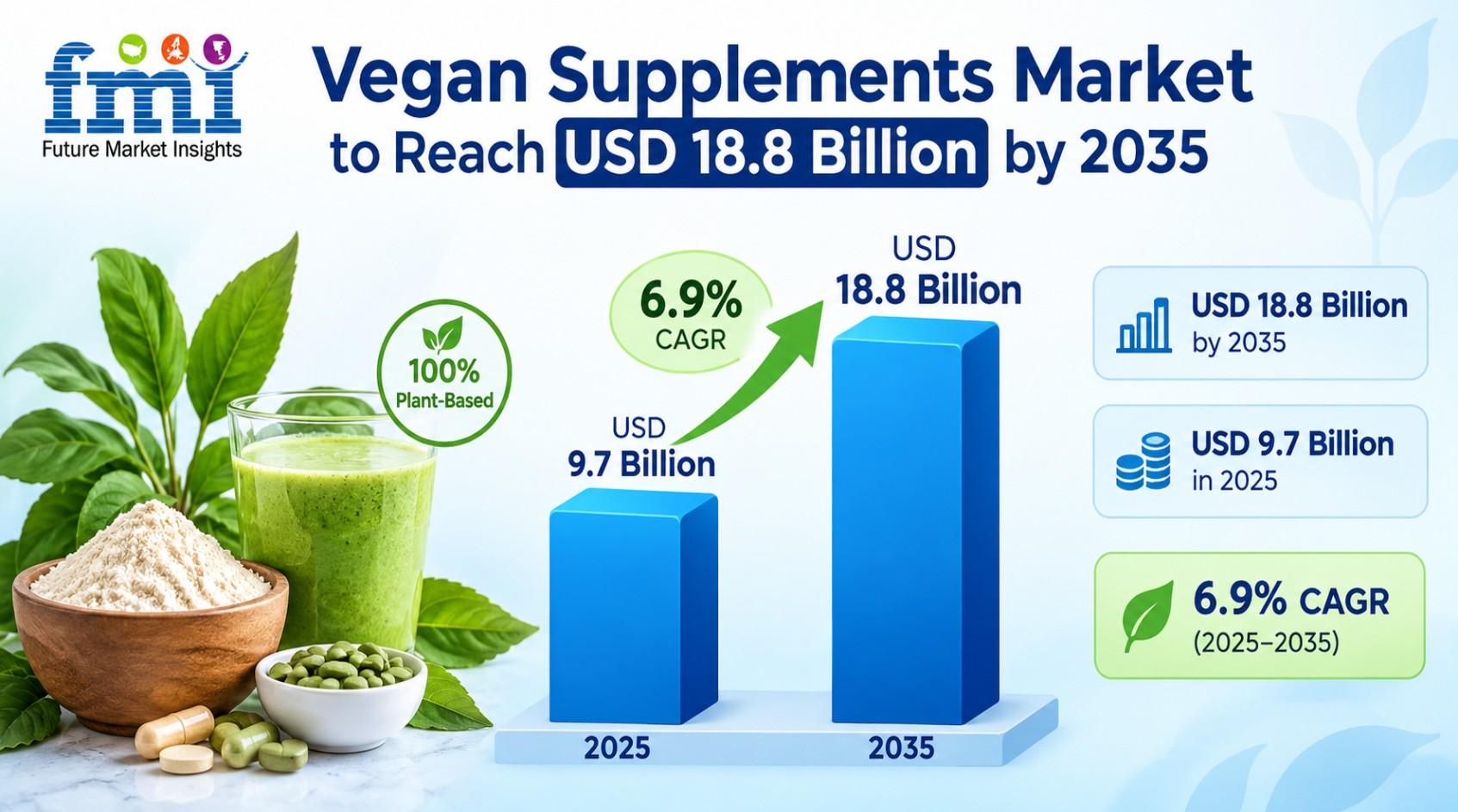
The global vegan supplements market is projected to reach USD 18.8 billion by 2035, rising from USD 9.7 billion in 2025 at a 6.9% CAGR, according to latest insights by Future Market Insights. The sector is transitioning from a niche plant-based segment into mainstream daily preventative healthcare. Protein and amino acids accounted for 71.4% of application demand in 2025, while vitamins, minerals, and herbal supplements represented 28.6% share.
The growth outlook answers a practical question for nutraceutical manufacturers and wellness retailers: where is demand concentrating? FMI data points to bio-fermented proteins, algae-sourced omega-3s, adaptogenic herbal blends, and sustainable zero-waste packaging formats. The United States is projected to be the fastest-growing country among primary markets, recording a 7.1% CAGR through 2035, followed by China at 6.7%.
Vegan Supplements Market Growth Reflects Preventive Clean-Label Routines Health-conscious and flexitarian consumers are accelerating the adoption of non-animal vitamins, sports nutrition, and gut health supplements to address everyday dietary gaps. A 2024 consumer analysis revealed that 62% of vegan consumers emphasize the importance of microbiome wellness, driving a 27% increase in retail sales for plant-derived prebiotics such as inulin, chicory root fiber, and resistant starch.
Protein and amino acid formulations remain central to the vegan supplements market. Plant-based fitness enthusiasts and everyday wellness buyers rely on pea protein, hemp amino acids, and mushroom-based protein complexes for muscle recovery and metabolic support. Protein and amino acids held a dominant 71.4% application share in 2025.
Vitamins, minerals, and botanicals represent another vital growth engine. FMI estimates that vitamins, minerals, and herbal supplements accounted for 28.6% share in 2025, supported by high consumer search volumes for whole-food-derived lichen vitamin D3, fermented B12, and marine algae EPA/DHA. Sourcing transparency and bio-fermentation, however, remain key manufacturing differentiators across premium product tiers.
“The vegan supplements market is likely to move toward cleaner plant-based formulations that address everyday nutrition gaps.” Nandini Roy Choudhury, Principal Consultant for Food and Beverage, Future Market Insights. Nandini Roy Choudhury also identifies certification and ingredient integrity as core purchase determinants. “Companies with stronger protein, vitamin and herbal product lines are expected to gain preference as consumers look for ethical wellness options,” Nandini Roy Choudhury noted in the supplied FMI analysis.
Future Market Insights is a market research firm that analyzes vegan nutraceutical demand, ingredient splits, country growth rates, and competitive benchmarking across global health and wellness markets.
Protein Formulations and Clean-Label Channels Lead Market Segmentation
Protein and amino acids are projected to maintain market leadership, capturing 71.4% share in 2025, propelled by bio-fermented blends that enhance digestive tolerance and bioavailability. Vitamins, minerals, and herbal supplements followed with 28.6% share, driven by demand for adaptogenic stress-relief complexes and plant-based immune boosters.
Online retailing and specialty health and wellness stores lead distribution momentum, supported by bespoke quiz-based subscription models and direct-to-consumer engagement. Powders, capsules, and gummies remain the preferred delivery formats, with post-consumer recycled (PCR) and compostable packaging gaining heavy traction among eco-conscious buyers.
The competitive landscape includes Garden of Life, Vega, Herbalife Nutrition, Sunwarrior, Optimum Nutrition, Ora Organic, MyKind Organics, Clean Machine, Terranova, Future Kind, and Ritual. Garden of Life continues to expand its presence across North America and Europe through NSF-certified, fermented vegan proteins, while Vega has advanced high-potency, algae-based omega-3 nutrition.
Direct brand innovations are addressing targeted physiological needs: Seed Health achieved a 40% subscription increase following the rollout of its plant-based synbiotic, while MyKind Organics transitioned to 100% recyclable glass packaging, eliminating 70% of its plastic footprint.
Request Exclusive Sample (Top Performing Strategies (Next 10 years):
https://www.futuremarketinsights.com/reports/sample/rep-gb-12896
United States and China Show the Fastest Growth The United States is projected to record a 7.1% CAGR through 2035. Expanding flexitarian demographics, non-GMO clean-label mandates, and retail shelf depth across sports nutrition and functional wellness chains continue to anchor US market expansion.
China is forecast to expand at a 6.7% CAGR through 2035. Rising lactose-intolerance awareness combined with traditional herbal medicine integration such as mushroom-derived vitamin D and fermented botanical extracts is driving demand for domestic and cross-border plant nutrition.
India follows at a 6.5% CAGR, supported by Ayurvedic herbal blends and affordable plant proteins. Germany is projected to grow at 5.5% under strict EU organic certification frameworks, while Japan is forecast at 5.0% through 2035.
Get More Insights from the Full Research Report:
https://www.futuremarketinsights.com/reports/vegan-supplements-market#report-description
Ingredient Technology and Bioavailability Shape Product Economics Vegan supplement formulations are shifting from basic synthetic vitamin additions toward bio-fermentation, enzymatic processing, and whole-food extraction. These processing enhancements improve gut digestibility and nutrient absorption but introduce higher research and development costs for clean-label manufacturers.
Packaging sustainability also guides brand positioning. With 48% of vegan shoppers indicating a willingness to switch brands for sustainable packaging, manufacturers are replacing single-use virgin plastics with algae-derived softgel shells, compostable refill pouches, and infinitely recyclable containers.
FMI defines the market as commercially manufactured dietary supplements formulated entirely without animal-derived ingredients. The scope includes plant-based proteins, amino acids, whole-food vitamins, minerals, herbal extracts, algae-based omegas, and probiotic/prebiotic complexes. Animal-derived supplements, synthetic gelatin capsules, and fortified conventional foods without standalone supplement positioning are excluded.
About Future Market
Insights Future Market Insights, Inc. is a market research and consulting firm providing syndicated and customized research across global industries. The company’s vegan supplements market study covers ingredient type, form, customer orientation, health concern, sales channel, and regional markets across 2025 to 2035. The Vegan Supplements Market report was published on May 15, 2026, and reviewed by Nandini Roy Choudhury. The study covers 350 pages and uses a hybrid bottom-up and top-down methodology cross-referenced against raw ingredient sourcing data, trade import-export records, and retail wellness sales tracking.
For Press & Corporate Inquiries
Rahul Singh AVP - Marketing and Growth Strategy
Future Market Insights,
Inc. +91 8600020075
For Sales - sales@futuremarketinsights.com
For Media - Rahul.singh@futuremarketinsights.com
For web - https://www.futuremarketinsights.com/
For Web - https://www.factmr.com/

 English
 Arabic
 French
 Spanish
 Deutsch
 Turkish
 Dutch
Dutch
 Italiano
 Russian
 Romaian
 Portuguese (Brazil)
 Greek
Greek
