


How Do Banks Calculate Personal Loan Eligibility? FOIR, Income & Existing EMIs Explained
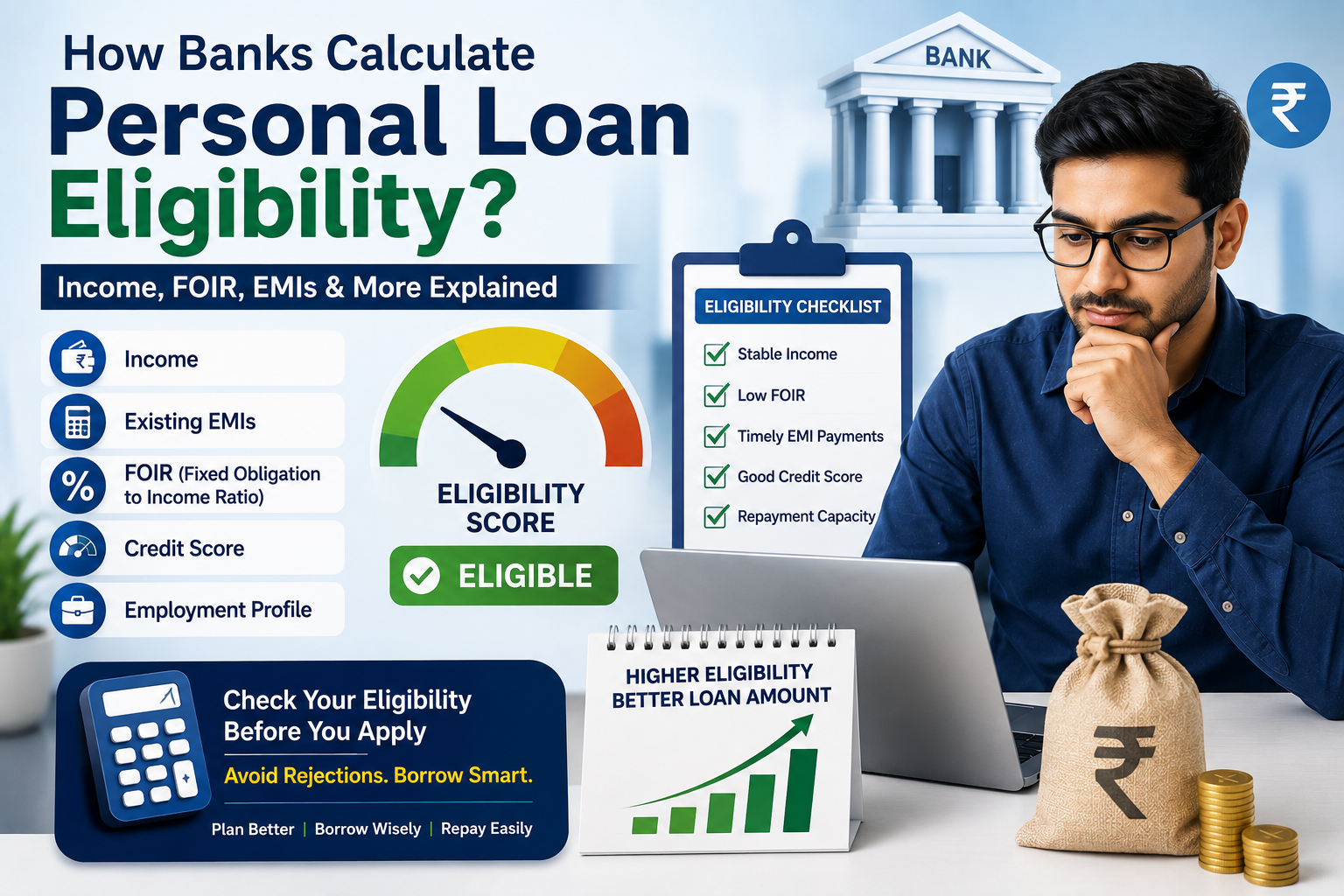
When you apply for a personal loan, one of the first questions you may have is: “How much personal loan can I get?”
Banks do not decide your loan amount based on salary alone. They typically consider several factors, including your monthly income, existing EMIs, FOIR, credit score, employment profile, age, and repayment capacity.
Among these, FOIR (Fixed Obligation to Income Ratio) is particularly important because it helps lenders determine whether your income can comfortably support another EMI.
Understanding how banks calculate personal loan eligibility can help you estimate your potential loan amount before applying and avoid submitting applications for amounts you may not qualify for.
What Is Personal Loan Eligibility?
Personal loan eligibility refers to the criteria a lender uses to determine whether you qualify for a loan and how much you may be able to borrow.
Depending on the lender, eligibility can be influenced by:
- Monthly or annual income
- Existing EMIs and other fixed financial obligations
- FOIR
- Credit score and credit history
- Age
- Employment type
- Employer profile
- Work experience
- Banking relationship with the lender
- Requested loan amount and tenure
- Internal lender policies
Two people earning the same salary may therefore qualify for different loan amounts because their existing financial obligations and credit profiles may be different.
How Do Banks Calculate Personal Loan Eligibility?
Banks generally assess personal loan eligibility by looking at your income and repayment capacity.
A simplified way to understand the calculation is:
Available income for a new EMI = Monthly income × acceptable FOIR − existing monthly obligations
The lender then considers the proposed loan's EMI and determines whether it fits within your repayment capacity.
For example, suppose you earn ₹50,000 per month and your lender considers a maximum FOIR of 50%.
Your total permitted fixed obligations could be:
₹50,000 × 50% = ₹25,000
If you already pay ₹10,000 in EMIs, approximately:
₹25,000 − ₹10,000 = ₹15,000
may be available for the new loan EMI.
This is only an illustration. Actual eligibility depends on the lender's policies, your profile, interest rate, tenure, credit history and other factors.
What Is FOIR in Personal Loan Eligibility?
FOIR stands for Fixed Obligation to Income Ratio.
It measures how much of your monthly income is already committed to fixed financial obligations.
A simplified FOIR formula is:
FOIR = (Existing EMIs + proposed EMI + other fixed obligations) ÷ monthly income × 100
For example:
- Monthly income: ₹60,000
- Existing EMIs: ₹12,000
- Proposed EMI: ₹15,000
- Other fixed obligations considered by lender: ₹3,000
Total obligations:
₹12,000 + ₹15,000 + ₹3,000 = ₹30,000
FOIR:
₹30,000 ÷ ₹60,000 × 100 = 50%
A lower FOIR generally indicates that a larger portion of your income remains available after paying fixed obligations.
Why Is FOIR Important?
Banks use FOIR as a way to assess whether you can manage additional debt.
If a large percentage of your income is already committed to EMIs and other fixed obligations, taking another loan could increase your repayment burden.
For this reason, a borrower with:
- ₹60,000 income and ₹5,000 existing EMI
may have stronger repayment capacity than someone earning:
- ₹60,000 income and ₹25,000 existing EMI.
This is why existing EMIs can significantly affect personal loan eligibility.
How Does Income Affect Personal Loan Eligibility?
Your income is one of the most important factors in determining how much you can borrow.
Generally, a higher stable income can provide greater repayment capacity.
However, lenders may evaluate different types of income differently.
Salaried Applicants
Banks may consider factors such as:
- Monthly salary
- Net or take-home income
- Employment stability
- Employer profile
- Work experience
- Salary-credit history
For salaried applicants, regular salary credits can help demonstrate stable cash flow.
Self-Employed Applicants
For self-employed borrowers, lenders may consider:
- Business income
- Income tax returns
- Bank statements
- Business vintage
- Profitability
- Existing financial obligations
The exact documentation and income assessment method varies between lenders.
How Do Existing EMIs Affect Personal Loan Eligibility?
Existing EMIs are an important part of the eligibility calculation.
Suppose your monthly income is ₹50,000.
If you have no existing EMI, more of your income may be available for a new loan repayment.
But if you already pay:
₹20,000 per month in existing EMIs
your available repayment capacity is reduced.
For example, assuming a lender uses a 50% FOIR for illustration:
Maximum total obligations = ₹50,000 × 50% = ₹25,000
Existing EMI:
₹20,000
Potential amount remaining for a new EMI:
₹25,000 − ₹20,000 = ₹5,000
This demonstrates why borrowers with existing loans may qualify for a smaller additional loan amount.
The actual FOIR threshold used by a lender can differ.
How Is the Maximum Personal Loan Amount Calculated?
Once a lender determines the maximum EMI you can reasonably afford, it can estimate the corresponding loan amount based on the interest rate and loan tenure.
The EMI formula is:
EMI = P × R × (1 + R)ⁿ ÷ [(1 + R)ⁿ − 1]
Where:
- P = Principal loan amount
- R = Monthly interest rate
- N = Number of monthly instalments
For example, if your repayment capacity allows an EMI of ₹10,000, the loan amount you qualify for will depend on the interest rate and tenure offered by the lender.
A longer tenure generally reduces the monthly EMI for the same principal, but it can increase the total interest paid over the life of the loan.
Therefore, loan eligibility and loan affordability are not exactly the same thing.
Does Your CIBIL Score Affect Personal Loan Eligibility?
Yes. Your credit profile can influence both approval and the terms offered by a lender.
A strong credit history can indicate responsible borrowing and repayment behaviour.
Lenders may consider:
- CIBIL score
- Previous loan repayment history
- Credit card payment history
- Outstanding balances
- Recent credit enquiries
- Credit utilisation
- Defaults or overdue payments
A lower credit score does not automatically mean that a personal loan is impossible, but it can make approval more difficult or result in less favourable terms depending on the lender.
Before applying, checking your credit report can help you identify errors, overdue accounts or other issues that may affect your application.
Does Age Affect Personal Loan Eligibility?
Age can also influence personal loan eligibility.
Lenders generally want the borrower to have sufficient earning years remaining to repay the loan.
For example, a lender may assess:
- Applicant's current age
- Employment status
- Retirement age
- Loan tenure
- Existing obligations
The exact age limits vary between lenders.
A younger borrower with stable employment may potentially qualify for a longer repayment period, while an older applicant may have a shorter available tenure depending on the lender's policy.
How Employment Type Affects Eligibility
Your employment profile can influence how lenders assess income stability.
Common categories include:
Private-Sector Employees
Banks may consider:
- Employer reputation
- Salary
- Work experience
- Job stability
- Salary account history
Government Employees
Stable government employment may be viewed favourably by many lenders, although approval still depends on the complete borrower profile.
Self-Employed Professionals and Business Owners
Lenders may examine:
- Business continuity
- Income
- Tax returns
- Bank statements
- Profitability
- Existing liabilities
The exact eligibility rules differ between financial institutions.
Example: Personal Loan Eligibility Based on Salary and Existing EMI
Consider a borrower with:
Monthly income: ₹70,000
Existing EMI: ₹15,000
Illustrative maximum FOIR: 50%
Maximum total monthly obligations:
₹70,000 × 50% = ₹35,000
Existing EMI:
₹15,000
Potential room for a new EMI:
₹35,000 − ₹15,000 = ₹20,000
The lender could then determine the approximate loan amount corresponding to a ₹20,000 EMI based on the applicable interest rate and tenure.
For instance, the same ₹20,000 EMI could correspond to different loan amounts at different interest rates or tenures.
This is why simply asking “How many times my salary can I get as a personal loan?” does not always produce an accurate answer.
FOIR vs Income: Which Is More Important?
Both matter, but they answer different questions.
Income tells the lender how much you earn.
FOIR helps determine how much of that income is already committed to financial obligations.
Consider two borrowers:
| Borrower | Monthly Income | Existing EMI | Illustrative FOIR before new loan |
|---|---|---|---|
| A | ₹50,000 | ₹5,000 | 10% |
| B | ₹50,000 | ₹20,000 | 40% |
Both earn the same amount, but Borrower A has significantly fewer existing obligations.
Therefore, Borrower A may have greater capacity for another EMI, subject to the lender's other eligibility criteria.
What Factors Can Reduce Your Personal Loan Eligibility?
Several factors may reduce the loan amount you qualify for:
1. High Existing EMIs
Multiple loans or credit obligations can reduce available repayment capacity.
2. Low or Unstable Income
Lenders may consider irregular or insufficient income a higher repayment risk.
3. Weak Credit History
Late payments, defaults or high credit utilisation can affect your application.
4. Short Employment History
Recently joining a job may make it harder to meet some lenders' employment criteria.
5. High FOIR
If a large percentage of your income is already committed, the lender may reduce the eligible loan amount.
6. Shorter Available Tenure
A shorter tenure means the same loan amount produces a higher EMI, potentially reducing the amount you can qualify for.
7. Multiple Recent Credit Applications
Frequent hard enquiries may affect how lenders view your credit profile.
How Can You Improve Personal Loan Eligibility?
If you want to increase your potential eligibility, consider these steps:
Pay existing EMIs on time: Consistent repayment supports a healthy credit history.
Reduce outstanding debt: Paying down existing loans or credit card balances can improve repayment capacity.
Avoid unnecessary loan applications: Compare lenders before submitting multiple applications.
Maintain stable employment: Consistent income can strengthen your profile.
Choose an appropriate tenure: A longer tenure can reduce EMI, although it may increase total interest costs.
Check your credit report: Review your credit information for inaccuracies before applying.
Borrow only what you can comfortably repay: Maximum eligibility is not necessarily the ideal loan amount.
Use a Personal Loan EMI Calculator Before Applying
An EMI calculator can help you estimate your monthly repayment before submitting a loan application.
You generally need three inputs:
- Loan amount
- Interest rate
- Loan tenure
For example, changing the tenure from 3 years to 5 years can reduce the monthly EMI, but the total interest paid may increase.
Using an EMI calculator alongside an eligibility calculation can therefore give you a clearer picture of whether the proposed loan fits your monthly budget.
Frequently Asked Questions
How do banks calculate personal loan eligibility?
Banks typically evaluate income, existing EMIs, FOIR, credit history, age, employment profile and other lender-specific criteria. They use these factors to assess repayment capacity and determine a suitable loan amount.
What is FOIR in a personal loan?
FOIR, or Fixed Obligation to Income Ratio, measures the proportion of income committed to existing and proposed fixed financial obligations.
Can I get a personal loan if I already have an EMI?
Yes, having an existing EMI does not automatically make you ineligible. However, the existing EMI reduces your available repayment capacity and may affect the loan amount you can qualify for.
Does a higher salary guarantee a higher personal loan amount?
No. Salary is important, but lenders also consider existing EMIs, FOIR, credit history, employment stability, age and other criteria.
What FOIR is good for a personal loan?
There is no single FOIR threshold applicable to every lender. Different banks and financial institutions use different internal policies and risk criteria.
Can a longer tenure increase personal loan eligibility?
A longer tenure can reduce the EMI for a given loan amount, which may improve affordability and potentially allow a higher principal amount under some eligibility calculations. However, the total interest paid can be higher.
Does CIBIL score affect personal loan eligibility?
Yes. Your credit score and repayment history can influence approval, interest rates and the loan terms offered by a lender.
Final Thoughts
Banks calculate personal loan eligibility by looking beyond your salary. Income, FOIR, existing EMIs, credit history, employment stability, age and loan tenure can all influence the final amount a lender is willing to offer.
The easiest way to understand your potential eligibility is to start with your monthly income, calculate your existing fixed obligations, estimate your FOIR and then determine how much EMI you can comfortably afford.
Remember that maximum eligible loan amount does not mean maximum affordable loan amount. Before borrowing, consider your monthly budget, total interest cost and existing financial commitments.
A responsible borrowing decision is one where the EMI remains manageable even after accounting for your regular expenses and unexpected financial needs.

 English
 French
 Spanish
 Portuguese
 Deutsch
 Turkish
 Dutch
Dutch
 Italiano
 Russian
 Romaian
 Portuguese (Brazil)
 Greek
Greek
