


Ice-Cream Premix and Stabilizers Market to Reach USD 4.29 Billion by 2036
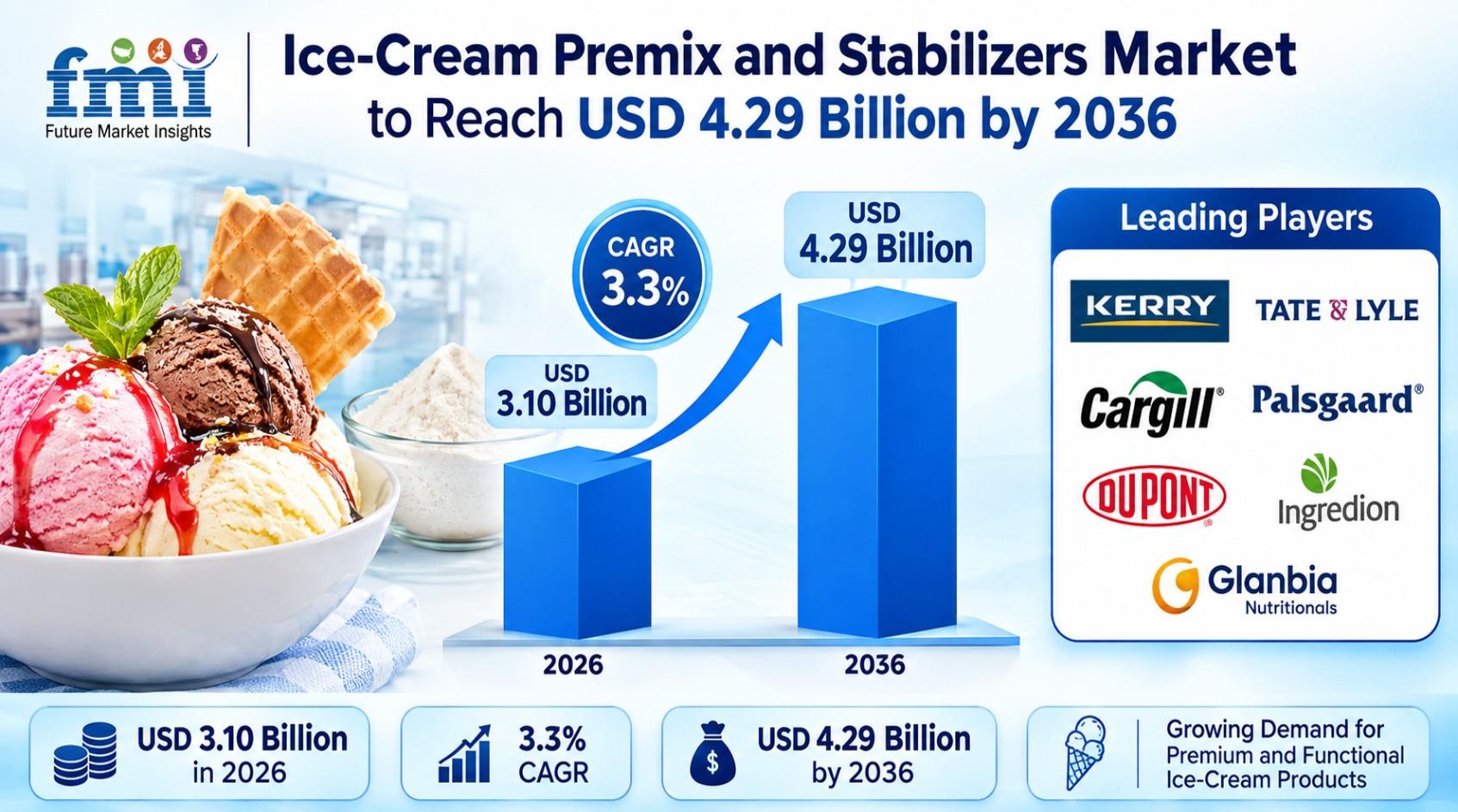
The global ice-cream premix and stabilizers market is experiencing steady, value-driven growth as frozen dessert manufacturers increasingly transition from in-house raw ingredient batching to integrated, multi-functional premix systems, according to latest insights by Future Market Insights. Driven by the need to control overrun, prevent ice crystal growth during freeze-thaw cycles, improve melt resistance, and solve complex formulation challenges in plant-based and reduced-sugar frozen desserts, tailored stabilizer systems are securing essential positions in industrial and artisanal manufacturing lines.
The global market is projected to reach USD 3.10 billion in 2026. Advancing at a Compound Annual Growth Rate (CAGR) of 3.3% over the ten-year forecast period, total market valuation is anticipated to achieve USD 4.29 billion by 2036, delivering an absolute incremental opportunity of USD 1.19 billion.
Request a Sample Report: https://www.futuremarketinsights.com/reports/sample/rep-gb-25947
Market Performance Overview (2026–2036)
To map out the leading product types, core stabilizer hydrocolloids, primary end-use applications, and regional growth vectors guiding this USD 1.19 billion market expansion, key segment allocations highlight where global commercial demand is concentrated:
· Premix Type Segment (56.2% share): Commands product type revenue in 2026, favored by dairy processors and QSR soft-serve chains because all-in-one blends (combining emulsifiers, hydrocolloids, sweeteners, and texturizers) streamline plant operations, reduce batching errors, and guarantee batch-to-batch sensory consistency.
· Gelatin Stabilizer Segment (21.7% share): Leads the standalone stabilizer category in 2026, valued for its proven water-binding capacity, foam stabilization, and smooth melting profile in traditional dairy ice creams.
· Guar Gum, Locust Bean Gum (LBG), Xanthan, & Pectin: Represent fast-growing secondary stabilizer pillars, expanding rapidly as plant-based alternatives for vegan, clean-label, and dairy-free frozen desserts.
· Ice Cream Application Segment (48.9% share): Dominates application demand in 2026, driven by global retail tub packaging, impulse novelty bars, and foodservice scoop-shop distribution.
· China & India Regional Leadership: Lead national expansion rates at 4.5% CAGR and 4.1% CAGR respectively through 2036, driven by rapid retail freezer cabinet installations, rising disposable incomes, and the expansion of modern parlor chains.
Technical Drivers and Formulation Shifts
The commercial expansion and technical integration of ice-cream premixes and stabilizers across frozen dessert production lines are propelled by three primary industry catalysts:
Technical Formulation Lock-In and High Switching Costs
The relationship between ice cream manufacturers and premix suppliers functions as a formulation service partnership. Modifying a stabilizer or emulsifier blend alters ice crystallization kinetics, overrun percentages, and melt curves, requiring 3 to 6 months of pilot runs, sensory panel validations, and freeze-thaw shelf-life stress testing. This technical barrier creates high customer retention for established ingredient houses.
Reduced-Sugar and Calorie-Reduced Reformulation
Removing sucrose from ice cream removes the primary agent responsible for freezing-point depression and bulk solids, resulting in hard, un-scoopable, and icy textures. Ingredient manufacturers deploy complex synergistic hydrocolloid blends (e.g., locust bean gum with guar and carrageenan) paired with soluble fibers to mimic the mouthfeel, creaminess, and scoop-ability of full-sugar formulations without adding calories.
Plant-Based and Dairy-Free Matrix Stabilization
Vegan frozen desserts based on oat, almond, or coconut milks lack native bovine casein and whey proteins, making emulsion stability and air incorporation difficult. Specialized non-dairy premixes utilize functional plant proteins, citrus fibers, and tailored gum systems to stabilize non-dairy lipids, prevent phase separation, and deliver creamy overrun comparable to dairy fat.
Industrial Constraints & Supply Chain Risks
Ingredient refiners, dairy processors, and procurement directors navigate specific operational hurdles:
· Hydrocolloid Agricultural Volatility: Raw material supplies for natural gums (such as locust bean gum harvest cycles in the Mediterranean and guar crop yields in South Asia) experience climate-induced volatility and sharp spot-price spikes, squeezing blender margins.
· Clean-Label E-Number Scrutiny: Tightening European and North American consumer preferences against synthetic emulsifiers (mono- and diglycerides, polysorbate 80) force formulators to engineer natural, clean-label alternatives (egg yolk powder, sunflower lecithin, citrus fiber) that match conventional emulsification performance.
Regional Growth Profile
Regional demand reflects high-velocity cold-chain expansion in Asia alongside clean-label and functional dessert premiumization across European and North American markets:
· China (4.5% CAGR): The global growth frontrunner, driven by booming urban ice cream parlor chains, modern retail e-commerce grocery expansion, and R&D into localized natural stabilizer systems.
· India (4.1% CAGR): Spurring rapid volume expansion as organized dairy brands and quick-service dessert chains expand refrigerated supply chains into tier-two and tier-three cities.
· Germany (3.8% CAGR) & France (3.5% CAGR): Lead European demand, supported by stringent EU food additive regulations, high consumer demand for clean-label/organic formulations, and gourmet artisanal gelato production.
· United Kingdom (3.1% CAGR): Driven by premium supermarket private-label lines, ready-to-make dessert kits, and plant-based frozen novelties.
· United States (2.8% CAGR): Represents a mature, high-volume production powerhouse focused on high-protein, keto/low-carb, and dairy-free frozen dessert innovation.
· Brazil (2.5% CAGR): Growing through the modernization of industrial frozen dessert processing lines and regional foodservice distribution.
Competitive Landscape
The global ice-cream premix and stabilizers landscape features a combination of multinational food ingredient conglomerates, specialized hydrocolloid refiners, and dairy solution blenders.
Key market participants profiled in the report include Kerry Group plc, Tate & Lyle PLC, Cargill, Inc., Palsgaard A/S, DuPont Nutrition & Biosciences (IFF), Ingredion Incorporated, and Glanbia Nutritionals. Leading suppliers compete by maintaining dedicated frozen dessert pilot plants, developing proprietary clean-label emulsifier-stabilizer complexes, optimizing blends for high-temperature short-time (HTST) pasteurization, and providing on-site technical support to industrial dairy processors.
Exclusive Discounts on Full Report: https://www.futuremarketinsights.com/reports/ice-cream-premix-and-stabilizers-market
Frequently Asked Questions
What is the projected valuation of the global ice-cream premix and stabilizers market by 2036?
The global ice-cream premix and stabilizers market is projected to reach USD 4.29 billion by 2036, expanding from an estimated baseline valuation of USD 3.10 billion in 2026 at a CAGR of 3.3%.
Why does the Premix segment dominate with a 56.2% market share?
Premixes lead in 2026 because pre-blended systems eliminate manual weighing errors, streamline plant operations, ensure consistent ingredient hydration, and guarantee batch-to-batch texture and overrun consistency in high-speed manufacturing.
What is the primary functional role of stabilizers in ice cream manufacturing?
Stabilizers (such as gelatin, guar gum, and locust bean gum) bind free water in the ice cream matrix, preventing the growth of coarse ice crystals during temperature fluctuations (heat shock), controlling meltdown rates, and imparting a smooth, creamy mouthfeel.
FMI Custom Research: Strategic Intelligence for Confident Decision-Making
In today's rapidly evolving business environment, leadership teams need clear, actionable intelligence tailored to their strategic objectives. FMI's Custom Research solutions are designed around specific business questions, enabling executives to evaluate growth opportunities, validate investments, assess competitive dynamics, and reduce uncertainty before making critical decisions.
Key Executive Benefits
· Decision-Ready Insights: Research tailored to your specific business challenges, growth plans, and investment priorities.
· Reduced Strategic Risk: Validate market opportunities, customer demand, and competitive positioning before committing resources.
· Market Entry Confidence: Assess opportunity size, regulatory barriers, channel dynamics, and competitive landscapes with precision.
· Competitive Advantage: Gain proprietary intelligence unavailable through syndicated reports or internal datasets.
· Faster Growth Decisions: Accelerate expansion, product development, portfolio optimization, and investment planning.
· Primary Market Validation: Access real-world customer, buyer, and stakeholder insights that support high-confidence decision-making.
Business Impact
FMI helps organizations transform market complexity into strategic clarity, enabling leadership teams to identify growth opportunities faster, optimize resource allocation, strengthen competitive positioning, and make high-stakes business decisions with confidence.
To explore how FMI Custom Research can support your strategic priorities, connect with our team at - sales@futuremarketinsights.com
About Future Market Insights (FMI)
Future Market Insights (FMI) delivers actionable, decision-focused market intelligence that goes beyond traditional research reports. The company provides:
· In-depth pricing and cost benchmarking analysis
· Demand forecasting based on real industry inputs
· Procurement and buyer behavior insights
· Supply chain and trade flow intelligence
· Technology and application trend analysis across industries
FMI follows a robust bottom-up research methodology, combining insights from industry experts, procurement leaders, manufacturers, and technical professionals to ensure accurate and practical market intelligence.

 Arabic
 French
 Spanish
 Portuguese
 Deutsch
 Turkish
 Dutch
Dutch
 Italiano
 Russian
 Romaian
 Portuguese (Brazil)
 Greek
Greek
