


Oyster and Clam Market to Reach USD 244.89 Billion by 2036
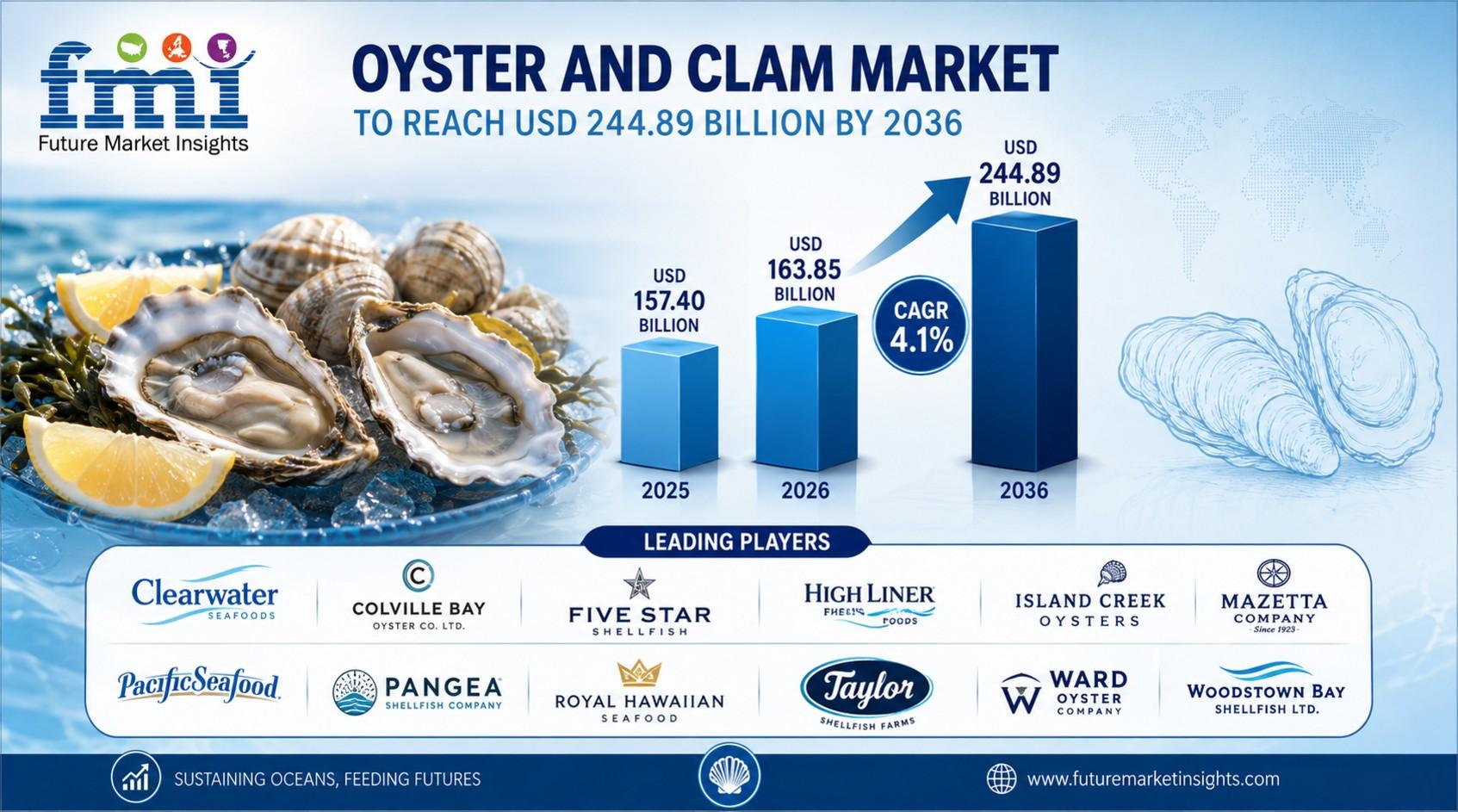
The global oyster and clam market is undergoing steady, value-driven structural growth as edible bivalve mollusks transition from regional coastal seafood into premium, traceable culinary assets across foodservice and retail channels, according to latest insights by Future Market Insights. Driven by rising global demand for nutrient-dense, high-protein marine superfoods, investments in modern selective-breeding hatchery infrastructure, and the expansion of curated raw-bar menus showcasing single-origin flavor profiles (analogous to wine terroir), farm-raised and wild-harvested bivalves are capturing steady consumer and institutional demand.
The global market, valued at USD 157.40 billion in 2025, is projected to reach USD 163.85 billion in 2026. Advancing at a steady Compound Annual Growth Rate (CAGR) of 4.1% over the ten-year forecast period, total market valuation is anticipated to achieve USD 244.89 billion by 2036, delivering an absolute incremental opportunity of USD 81.04 billion.
Request a Sample Report: https://www.futuremarketinsights.com/reports/sample/rep-gb-25980
Market Performance Overview (2026–2036)
To map out the leading commercial bivalve species, primary product forms, dominant distribution channels, and regional growth vectors guiding this USD 81.04 billion market expansion, key segment allocations highlight where global commercial demand is concentrated:
· Slipper Oyster Type Segment (26.7% share): Commands the species category in 2026, favored across Asia-Pacific and coastal markets for its mild flavor, rapid growth rates, high meat yield, and adaptability to cost-effective aquaculture setups.
· Pacific Cupped Oyster, Hard Clam, Taca Clam, & Stimpson Surf Clam: Form vital commercial species pillars, serving diverse raw-bar, chowder, canned, and processed culinary preparations.
· Fresh Form Segment (41.5% share): Dominates product forms in 2026, driven by high-margin raw-bar, half-shell, and live-shellfish dining occasions where freshness perception, brininess, and natural liquor command significant pricing premiums.
· Frozen & Canned Formats (58.5% combined share): Serve high-volume foodservice and industrial food processors requiring portion-controlled shucked meat, half-shell stability, and extended shelf life for soups, chowders, and ready meals.
· Retail Distribution Channel (48.2% share): Represents the primary sales route in 2026, supported by supermarket live-shellfish counters, modified atmosphere packaging (MAP), and the rapid expansion of direct-to-consumer (DTC) cold-shipped oyster subscriptions.
· China & India Regional Leadership: Lead national expansion rates at 5.5% CAGR and 5.1% CAGR respectively through 2036, driven by expanding coastal mariculture operations, modernizing cold-chain infrastructure, and rising seafood consumption among urban middle-class households.
Technical Drivers and Supply Chain Governance
The commercial expansion and premiumization of the oyster and clam industry across retail and hospitality networks are propelled by three primary industry catalysts:
Coastal Aquaculture Licensing and Asset Moats
Unlike land-based agriculture, bivalve production is strictly governed by coastal zone access and environmental spatial planning (such as the EU Maritime Spatial Planning Directive and US state-level shellfish leasing frameworks). Because obtaining new aquaculture leases takes 2 to 5 years of environmental impact assessments, operators holding established permits in clean, phytoplankton-rich waters possess non-replicable spatial assets that protect long-term margins.
Single-Origin Branding and Culinary "Merroir"
Fine-dining restaurants, oyster bars, and seafood purveyors increasingly market oysters by their specific estuarine origin. Factors like water salinity, temperature fluctuations, tidal flows, and local algae species impart distinct mineral and sweet notes, allowing producers to brand their harvest as single-origin luxury delicacies rather than undifferentiated commodities.
End-to-End Shellfish Sanitation and Traceability
Strict food safety regulations (such as the FDA National Shellfish Sanitation Program and EU Regulation 853/2004) mandate complete harvest-to-table tracking tags. Real-time temperature datalogging, water-quality classification monitoring, and rapid depuration (UV water purification) systems protect consumer safety and reinforce market trust in live bivalve consumption.
Industrial Constraints & Environmental Challenges
Shellfish farmers, wild harvesters, and seafood distributors navigate specific operational hurdles:
· Ocean Acidification and Harmful Algal Blooms (HABs): Rising seawater acidity impairs juvenile bivalve calcification (shell development) in hatcheries, while seasonal toxic red tides / HABs can force sudden, prolonged regulatory harvest closures across entire coastal bays.
· Perishability and Cold-Chain Breakdowns: Live bivalves require continuous moist, temperature-controlled transit without submergence in fresh water or melting ice; any logistical delay or temperature spike leads to rapid mortality and total batch loss.
Regional Growth Profile
Regional demand reflects intensive coastal aquaculture expansion in Asia alongside high-value raw-bar hospitality and sustainable harvesting in Western economies:
· China (5.5% CAGR): The global growth frontrunner and largest producer, driven by large-scale mariculture in Shandong and Fujian, expanding urban seafood dining, and government support for coastal ecosystem restoration.
· India (5.1% CAGR): Spurring rapid volume expansion through coastal aquaculture investments, modernized cold-chain logistics, and expanding urban demand for processed and fresh shellfish.
· Germany (4.7% CAGR) & France (4.3% CAGR): Lead European demand, supported by historic oyster-cultivating regions (Normandy, Brittany, Marennes-Oléron), strict EU food safety standards, and strong consumer tradition of raw shellfish consumption.
· United Kingdom (3.9% CAGR): Driven by native and rock oyster aquaculture, expanding gastropub seafood menus, and sustainable fishery certifications.
· United States (3.5% CAGR): Represents a mature, high-value demand center anchored by established shellfish farming in the Pacific Northwest, New England, and the Gulf Coast, coupled with booming direct-to-consumer raw-bar delivery services.
· Brazil (3.1% CAGR): Growing through the development of regional coastal mariculture and expanding seafood availability in metropolitan supermarket chains.
Competitive Landscape
The global oyster and clam landscape features a mix of vertically integrated shellfish farming corporations, artisanal single-origin oyster farms, and multinational seafood processing conglomerates.
Key market participants profiled in the report include Clearwater Seafoods, Colville Bay Oyster Co. Ltd, Five Star Shellfish Inc, High Liner Foods, Island Creek Oysters, Mazetta Company, LLC, Pacific Seafood, Pangea Shellfish Company, Royal Hawaiian Seafood, Taylor Shellfish Farms, Ward Oyster Company, and Woodstown Bay Shellfish Ltd. Leading players compete by securing certified pristine growing leases, investing in modern triploid seed hatcheries, utilizing protective modified-atmosphere retail packaging, and building direct-to-chef supply channels.
Exclusive Discounts on Full Report: https://www.futuremarketinsights.com/reports/oyster-and-clam-market
Frequently Asked Questions
What is the projected valuation of the global oyster and clam market by 2036?
The global oyster and clam market is projected to reach USD 244.89 billion by 2036, expanding from an estimated baseline valuation of USD 163.85 billion in 2026 at a CAGR of 4.1%.
Why does the Fresh form segment hold a 41.5% market share?
Fresh bivalves dominate in 2026 because the raw-bar and half-shell dining occasions value unprocessed, live presentation, briny flavor, and natural liquor, commanding the highest per-unit price points across the entire seafood sector.
What is the primary operational constraint for oyster and clam aquaculture?
The binding constraint is coastal spatial planning and leasing access; strict environmental and regulatory permitting processes (taking 2 to 5 years) create a structural supply lag that limits how quickly new aquaculture acreage can be brought online.
FMI Custom Research: Strategic Intelligence for Confident Decision-Making
In today's rapidly evolving business environment, leadership teams need clear, actionable intelligence tailored to their strategic objectives. FMI's Custom Research solutions are designed around specific business questions, enabling executives to evaluate growth opportunities, validate investments, assess competitive dynamics, and reduce uncertainty before making critical decisions.
Key Executive Benefits
· Decision-Ready Insights: Research tailored to your specific business challenges, growth plans, and investment priorities.
· Reduced Strategic Risk: Validate market opportunities, customer demand, and competitive positioning before committing resources.
· Market Entry Confidence: Assess opportunity size, regulatory barriers, channel dynamics, and competitive landscapes with precision.
· Competitive Advantage: Gain proprietary intelligence unavailable through syndicated reports or internal datasets.
· Faster Growth Decisions: Accelerate expansion, product development, portfolio optimization, and investment planning.
· Primary Market Validation: Access real-world customer, buyer, and stakeholder insights that support high-confidence decision-making.
Business Impact
FMI helps organizations transform market complexity into strategic clarity, enabling leadership teams to identify growth opportunities faster, optimize resource allocation, strengthen competitive positioning, and make high-stakes business decisions with confidence.
To explore how FMI Custom Research can support your strategic priorities, connect with our team at - sales@futuremarketinsights.com
About Future Market Insights (FMI)
Future Market Insights (FMI) delivers actionable, decision-focused market intelligence that goes beyond traditional research reports. The company provides:
· In-depth pricing and cost benchmarking analysis
· Demand forecasting based on real industry inputs
· Procurement and buyer behavior insights
· Supply chain and trade flow intelligence
· Technology and application trend analysis across industries
FMI follows a robust bottom-up research methodology, combining insights from industry experts, procurement leaders, manufacturers, and technical professionals to ensure accurate and practical market intelligence.

 English
 Arabic
 French
 Spanish
 Deutsch
 Turkish
 Dutch
Dutch
 Italiano
 Russian
 Romaian
 Portuguese (Brazil)
 Greek
Greek
