


Eye Color Chart: Understanding Eye Colors and Variations
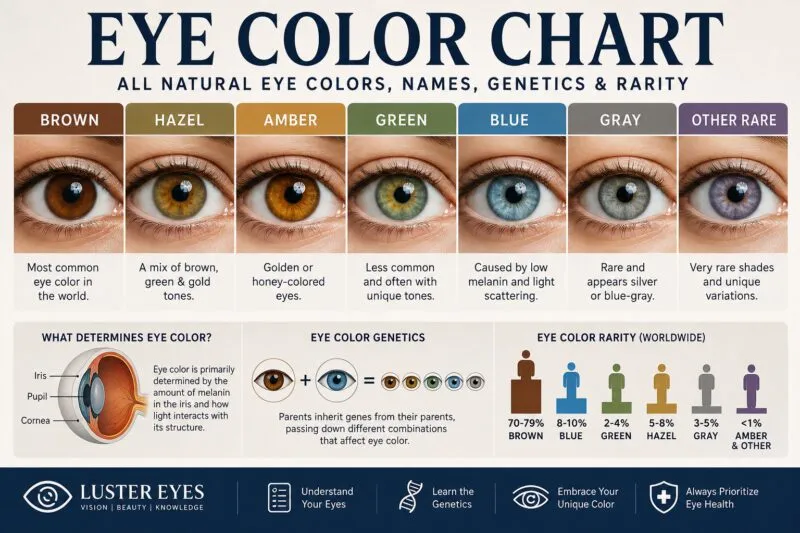
Eye color is one of the most distinctive features of the human face. From deep brown and bright blue to soft gray, green, hazel, and golden amber, natural eyes can appear in countless shades and combinations. An eye color chart provides a useful way to compare these colors and understand the characteristics that make each shade different.
Although people often describe eye color using simple categories such as brown, blue, green, or hazel, the actual appearance of the iris can be much more complex. Many people have more than one visible shade within their eyes, while lighting and surroundings can make the same eye color appear different throughout the day.
This guide explores the major natural eye colors, how eye color is determined, why shades vary, and how you can use an eye color chart to better understand your own eye color.
What Is an Eye Color Chart?
An eye color chart is a visual or descriptive reference that organizes common natural eye colors into recognizable categories. It can help people compare different shades and identify the general color that most closely matches their eyes.
Common categories found on an eye color chart include:
- Brown
- Blue
- Green
- Hazel
- Gray
- Amber
- Blue-gray
- Green-hazel
- Brown-hazel
- Other mixed or unusual variations
These categories are useful for general comparison, but they are not always strict scientific classifications. Natural eye colors exist along a spectrum, so an individual's eyes may contain characteristics associated with two or more categories.
For example, someone may have predominantly green eyes with golden-brown tones near the pupil. Another person may have blue-gray eyes that appear more blue in daylight and more gray under indoor lighting.
What Determines Eye Color?
The primary factor behind natural eye color is pigmentation in the iris. Melanin, the same general pigment involved in skin and hair color, plays an important role in determining how dark or light the eyes appear.
Genetics control many of the characteristics associated with iris pigmentation. Eye color is influenced by multiple genes rather than being controlled by one simple genetic switch.
The amount and distribution of melanin can affect the appearance of the iris. Higher pigmentation generally contributes to darker-looking eyes, while lower pigmentation can contribute to lighter shades.
However, pigmentation is only part of the story. The structure of the iris and the way light interacts with it also influence how an eye appears.
Brown Eyes
Brown is one of the most common natural eye colors worldwide. Brown eyes can range from relatively light brown to rich, dark brown.
The amount of pigmentation in the iris contributes to the depth and intensity of brown eyes. Some brown eyes have warm golden or honey-colored undertones, while others appear closer to chocolate or deep espresso shades.
Common Brown Eye Variations
Brown eyes may include:
- Light brown
- Medium brown
- Dark brown
- Golden brown
- Honey brown
- Reddish-brown
- Brown with amber tones
Brown eyes can also contain subtle variations that become more visible in bright natural lighting.
Because brown is such a broad category, two people with brown eyes can have noticeably different-looking irises.
Blue Eyes
Blue eyes are generally associated with lower levels of melanin in the front portion of the iris. Their appearance is strongly influenced by how light scatters through the eye.
Blue eyes can range from very pale blue to deeper shades that look almost navy under certain lighting conditions.
Common Blue Eye Variations
A general eye color chart may include:
- Light blue
- Sky blue
- Medium blue
- Deep blue
- Blue-gray
- Blue-green
Some blue eyes have darker borders around the iris, while others have lighter areas near the pupil. These patterns can make individual eyes look especially distinctive.
Blue eyes may also appear slightly different depending on the environment. Natural daylight can emphasize blue tones, while indoor lighting may make them appear darker or more gray.
Green Eyes
Green eyes are often considered one of the less common natural eye colors. They can range from pale green to deeper shades with noticeable golden or brown undertones.
The appearance of green eyes results from a combination of pigmentation and the optical properties of the iris.
Some green eyes look relatively uniform, while others contain multiple shades.
Green Eye Variations
Examples include:
- Light green
- Medium green
- Deep green
- Yellow-green
- Green-gray
- Green with golden tones
- Green with brown near the pupil
Because green eyes can contain several colors, they may sometimes be mistaken for hazel.
Hazel Eyes
Hazel is a particularly interesting category because it commonly involves a mixture of colors rather than one uniform shade.
Hazel eyes may combine green, brown, gold, amber, and sometimes gray tones. The balance between these colors varies considerably from person to person.
A person with hazel eyes may notice that their eyes look greener in one environment and more brown or golden in another.
Common Hazel Characteristics
Hazel eyes may have:
- Green outer areas
- Brown or golden tones near the pupil
- Amber sections
- Mixed green and brown pigmentation
- Different-looking colors under different lighting
Because of these combinations, hazel eyes can be challenging to classify using a simple chart.
Gray Eyes
Gray eyes can range from light silver to darker smoky gray. They may also have blue or green undertones.
Like blue eyes, the appearance of gray eyes is influenced by relatively low pigmentation and the interaction of light with the iris.
Some gray eyes look almost silver in bright light, while others have a distinctly blue-gray appearance.
Gray Eye Variations
A chart may describe gray eyes as:
- Light gray
- Silver gray
- Dark gray
- Blue-gray
- Green-gray
- Smoky gray
The presence of secondary colors can make gray eyes difficult to separate from blue or green in photographs.
Amber Eyes
Amber eyes have a warm golden, yellowish, or copper-like appearance. They are generally more consistently golden than hazel eyes.
The exact appearance of amber eyes can vary from pale honey to deeper copper or golden-brown shades.
Amber should not automatically be considered the same as hazel. Hazel commonly includes a mixture of colors, whereas amber is typically characterized by a more consistent golden or yellow-brown appearance.
Blue-Gray Eyes
Blue-gray eyes sit between two familiar color categories. They may look predominantly blue under certain lighting and more gray under others.
The difference can be subtle, which is why photographs are not always reliable for identifying this eye color.
Blue-gray eyes may also have darker edges around the iris or small variations in tone near the pupil.
Green-Hazel Eyes
Green-hazel eyes combine characteristics of green and hazel. They may have a dominant green appearance with brown, gold, or amber areas.
This type of eye color demonstrates why eye colors cannot always be separated into perfectly defined categories.
If the iris contains multiple noticeable shades, the best description may depend on which color is most dominant and how the eyes look under neutral lighting.
Why Does Eye Color Look Different in Different Lighting?
One of the most common reasons people question their eye color is that their eyes can appear different in photographs or different environments.
Lighting affects how we perceive color. Natural sunlight, indoor lighting, shadows, camera flashes, and digital image processing can all change the apparent appearance of an iris.
For example, hazel eyes might appear greener in bright daylight but browner in a room with warm lighting. Gray eyes can sometimes look blue when surrounded by certain colors.
This does not necessarily mean that the actual pigmentation of the iris has changed. Instead, the lighting and surrounding environment can alter how the color is perceived.
The Role of the Iris
The iris is the colored part of the eye surrounding the pupil. It contains patterns and structures that contribute to the unique appearance of each person's eyes.
Even when two people have the same general eye color, their iris patterns may be very different.
Some people have:
- Dark outer rings
- Radial lines
- Speckles
- Rings of different shades
- Golden areas
- Brown patches
- Subtle color transitions
These details make the human iris highly individual.
Can Two People Have the Same Eye Color?
Yes, but their eyes may still look different.
For example, two people can both have brown eyes while one has light honey-brown eyes and the other has very dark brown eyes. Similarly, two people may both be classified as having green eyes while one has gray-green eyes and the other has green eyes with golden tones.
An eye color chart provides broad categories, while natural variation creates the differences within those categories.
How Genetics Influence Eye Color
Eye color is inherited through genetic factors from biological parents. However, it is more complicated than simply saying that one parent determines the child's eye color.
Multiple genes contribute to pigmentation and iris characteristics. Different combinations can produce a wide range of colors and patterns.
This explains why siblings can have different eye colors even though they share the same parents.
Family eye colors can provide useful information about possible traits, but they cannot always predict a person's exact eye color with certainty.
Does Eye Color Change With Age?
Eye color can change in appearance during early childhood as pigmentation develops. This is particularly noticeable in babies whose final eye color may not be immediately obvious.
As people grow older, the basic appearance of their eyes generally remains relatively stable. However, perceived color can vary because of lighting, pupil size, clothing, surrounding colors, photography, and other visual factors.
A sudden or unexplained change in eye appearance later in life is different from normal visual variation. If someone notices a significant unexpected change, they should discuss it with an eye-care professional.
How to Identify Your Eye Color
If you want to use an eye color chart to identify your own eye color, start by examining your eyes under natural, neutral lighting.
Avoid relying exclusively on photographs because cameras can alter color and brightness.
Look at the iris and consider:
- What is the dominant color?
- Are there secondary colors?
- Is the color consistent throughout the iris?
- Is there a darker ring around the outside?
- Are there golden, amber, gray, green, or brown areas?
- Does the color look different in natural and indoor lighting?
If your eyes clearly contain more than one shade, you may fall between two categories such as green-hazel or blue-gray.
Eye Color Chart Comparison
| Eye Color | General Appearance | Common Variations |
|---|---|---|
| Brown | Warm to deep brown | Honey, golden, dark brown |
| Blue | Light to deep blue | Sky blue, deep blue, blue-gray |
| Green | Green with varying intensity | Light green, gray-green, yellow-green |
| Hazel | Mixture of green, brown, and gold | Green-hazel, brown-hazel |
| Gray | Silver or smoky appearance | Blue-gray, green-gray |
| Amber | Golden or yellow-brown | Honey, copper, golden amber |
This comparison is intended as a general guide rather than a strict scientific classification.
Why Are Some Eyes Difficult to Classify?
Some irises contain so many subtle colors that assigning a single label can be difficult.
For example, an eye may have:
- Green around the outer iris
- Brown near the pupil
- Gold between the two areas
- A darker outer ring
Someone might call this hazel, while another person might describe it as green-brown.
Both descriptions may reasonably communicate the eye's appearance.
Natural eye color does not always follow clearly defined boundaries, which is why an eye color chart should be treated as a reference rather than an exact diagnostic tool.
Eye Color and Visual Appearance
The appearance of eye color can also be influenced by surrounding colors. Clothing, makeup, walls, and outdoor environments may create visual contrast that makes certain tones seem stronger.
For example, green tones may appear more noticeable when surrounded by complementary colors, while blue or gray tones may become more prominent in cooler lighting.
This is another reason someone might feel that their eyes "change color" even when the underlying pigmentation remains the same.
Understanding Eye Color Patterns
Beyond the main color, iris patterns can provide additional visual differences.
A darker ring around the outside of the iris is sometimes noticeable in many different eye colors. Other people may have radial streaks extending from the pupil toward the outer edge.
Some eyes have small spots or areas of different pigmentation. These patterns are normal variations that contribute to the uniqueness of individual irises.
An eye color chart may focus mainly on the overall color, but looking at these smaller details can help explain why two eyes within the same category can look completely different.
Are Rare Eye Colors Really Rare?
Some eye colors are less commonly observed than others, but determining exactly how rare a particular shade is can be difficult.
Color categories can overlap, and different studies or populations may classify shades differently. For example, one source may categorize blue-gray eyes as blue, while another may place them under gray.
Therefore, labels such as "rare" should be interpreted carefully. The diversity of human eye color is much broader than a simple list of common and uncommon shades suggests.
Why an Eye Color Chart Is Useful
An eye color chart can be helpful for several reasons. It provides an easy visual reference for comparing natural shades and understanding differences between commonly used color categories.
It can also help people understand why their eyes may not fit perfectly into a single category.
Instead of asking whether an eye is simply brown or green, a chart encourages a closer look at the different tones and patterns within the iris.
Whether you are researching genetics, comparing eye colors, or simply curious about your own eyes, an eye color chart provides an accessible starting point.
Frequently Asked Questions
What is the most common eye color?
Brown is generally considered the most common eye color globally. However, the distribution of eye colors varies significantly among different populations.
Can eye color change naturally?
Eye color can change in appearance because of lighting and other visual factors. Children's eye color can also develop during early life. A significant unexpected change in an older child or adult should be discussed with an eye-care professional.
Are hazel and green eyes the same?
No. Hazel eyes commonly contain a mixture of green, brown, gold, or amber tones, while green eyes are generally dominated by green pigmentation and appearance. However, the categories can overlap visually.
Are gray eyes actually gray?
Yes, gray is commonly used to describe a natural eye color. Gray eyes can have silver, blue, or green undertones, which may make them look different under various lighting conditions.
Why do my eyes look different in pictures?
Camera settings, lighting, exposure, white balance, and image processing can all affect how eye color appears in photographs. A picture may therefore not show the exact appearance of your natural eye color.
Can siblings have different eye colors?
Yes. Because multiple genetic factors influence eye color, siblings can inherit different combinations of traits and therefore have different eye colors.
Final Thoughts
Natural eye color is much more diverse than the basic categories of brown, blue, green, and gray might suggest. An eye color chart makes it easier to understand this diversity by organizing common shades and showing how they can overlap.
Brown eyes can range from honey to deep chocolate, blue eyes can vary from pale blue to deep blue-gray, and green eyes can contain golden or gray undertones. Hazel eyes are especially varied because they commonly combine green, brown, gold, and amber shades. Gray and amber eyes add further examples of the natural diversity found in human irises.
The appearance of eye color is influenced by genetics, pigmentation, iris structure, and lighting. As a result, there is no need for every person's eyes to fit perfectly into one category.
Whether you are trying to identify your own eye color or simply interested in learning about natural eye variations, an eye color chart offers a simple and accessible way to compare shades and appreciate the remarkable variety of human eyes.

 English
 Arabic
 French
 Spanish
 Portuguese
 Deutsch
 Turkish
 Dutch
Dutch
 Italiano
 Romaian
 Portuguese (Brazil)
 Greek
Greek
