


Food Grade Exopolysaccharides Market to Reach USD 2.4 Billion by 2036
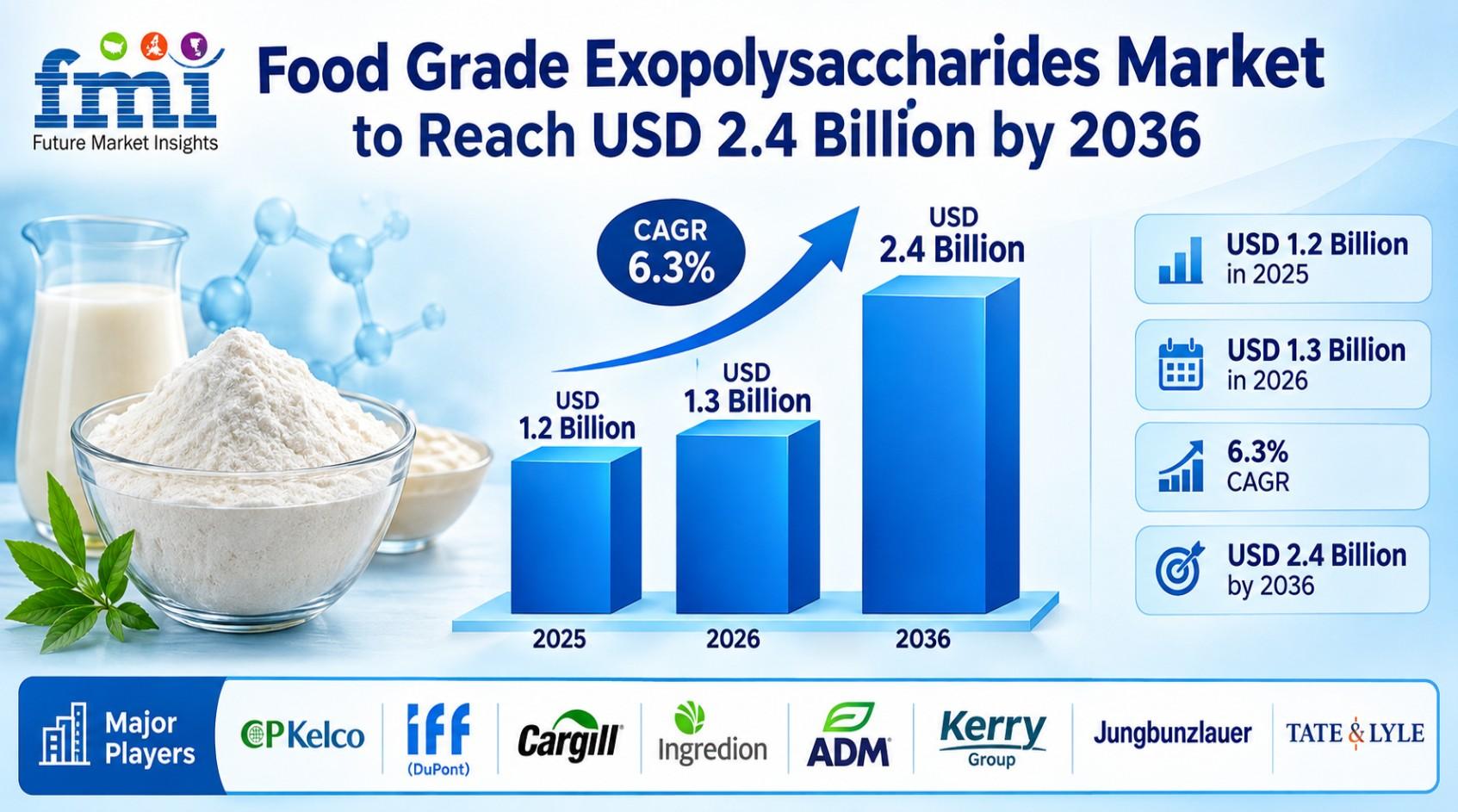
The global food grade exopolysaccharides market is undergoing a structural transformation as food and beverage formulators systematically replace chemically modified starches and synthetic emulsifiers with biologically fermented texturizing biopolymers, according to latest insights by Future Market Insights. Driven by retail clean-label procurement mandates, plant-based dairy suspension requirements, and the need for rheological stability under high-shear ultra-high-temperature (UHT) continuous processing, microbial exopolysaccharides are establishing a core position across commercial formulation decks.
The global market, valued at USD 1.2 billion in 2025, is projected to reach USD 1.3 billion in 2026. Advancing at a Compound Annual Growth Rate (CAGR) of 6.3% over the ten-year forecast period, total market valuation is anticipated to achieve USD 2.4 billion by 2036, delivering an absolute incremental opportunity of USD 1.1 billion.
Request a Sample Report: https://www.futuremarketinsights.com/reports/sample/rep-gb-32318
Market Performance Overview (2026–2036)
To map out the primary biological sources, core product types, dominant application sectors, and regional growth vectors guiding this USD 1.1 billion market expansion, key segment allocations highlight where global commercial demand is concentrated:
· Microbial Source Segment (55.4% share): Commands the source category in 2026, favored over plant and algal extracts because bacterial fermentation guarantees consistent polymer chain length and molecular weight, eliminating harvest and climatic yield volatility.
· Xanthan Gum Product Segment (42.1% share): Dominates product types in 2026 due to its unmatched synergy with secondary galactomannans, delivering high viscosity at ultra-low inclusion rates to reduce overall cost-in-use.
· Gellan Gum, Dextran, & Pullulan: Form high-value secondary biopolymer pillars, targeting clear-fluid particle suspension (gellan), moisture retention, and edible film formation (pullulan).
· Dairy Products Application (34.8% share): Represents the primary application sector in 2026, utilizing exopolysaccharides to mimic the lubricity and mouthfeel of natural milk fat in low-fat dairy and prevent syneresis in plant-based milks.
· India Regional Leadership (9.1% CAGR): Serves as the fastest-growing national market through 2036, driven by rapid formalization of dairy cooperatives and modern high-throughput greenfield processing installations.
Technical Drivers and Formulation Shifts
The commercial expansion of food grade exopolysaccharides across food processing lines is propelled by three primary industry catalysts:
Clean-Label Deck Simplification
Stringent retail buyer standards and front-of-pack consumer scrutiny are penalizing products containing chemical emulsifiers and modified starches. Biologically fermented exopolysaccharides (like xanthan and gellan gum) provide multi-functional stabilization, often allowing formulators to eliminate two to three synthetic texturants from the label.
Thermal and High-Shear Process Survival
Unlike basic agricultural starches that break down under thermal stress, microbial exopolysaccharides maintain stable viscosity across extreme temperature cycles and high-pressure homogenization. This prevents phase separation, protein precipitation, and gelation failure during UHT pasteurization and extended ambient distribution.
Plant-Based Dairy and Meat Moisture Retention
Formulating dairy alternatives and extruded plant-based meats requires replicating animal fat matrices. Exopolysaccharides provide water-binding networks that prevent phase separation in almond/oat beverages while locking in juiciness during high-temperature plant protein extrusion.
Industrial Constraints & Processing Kinetics
Food processors, biomanufacturers, and ingredient procurement teams navigate specific operational hurdles:
· Hydration Kinetics and High-Shear Tooling Costs: Highly functional exopolysaccharide powders are prone to severe lumping if uncalibrated hydration sequences are used. Plant managers must invest capital expenditure in specialized high-shear induction hoppers to ensure full polymer hydration.
· High Bioreactor Energy and Downstream Recovery Costs: Precision fermentation and downstream purification carry higher unit costs per kilogram than commodity starches, requiring suppliers to scale continuous-feed bioreactor systems to achieve cost parity.
Regional Growth Profile
Regional demand reflects rapid greenfield bioprocessing infrastructure across Asia alongside policy-driven reformulation in Western economies:
· India (9.1% CAGR): The global growth frontrunner, driven by greenfield dairy processing facilities adopting microbial gums for ambient-stable, long-haul summer milk distribution.
· China (8.2% CAGR): Spurring rapid volume expansion as large-scale domestic precision fermentation infrastructure lowers local sourcing costs for xanthan and gellan gums.
· Brazil (6.8% CAGR): Driven by large-scale beverage and dairy manufacturing modernization and rising demand for ambient-stable processed foods.
· Germany (6.1% CAGR) & United Kingdom (5.8% CAGR): Lead European demand, where processors proactively adopt fermented biopolymers as regulatory insurance against EFSA chemical emulsifier re-evaluations and post-Brexit freight weight optimization.
· United States (5.4% CAGR): Saturated food CPG landscape where brands adopt clean-label fermented stabilizers to protect premium supermarket shelf placements.
· Japan (4.9% CAGR): Governed by zero-tolerance variance metrics in clinical nutrition and dysphagia thickening formulations.
Competitive Landscape
The global food grade exopolysaccharides landscape is highly concentrated among established biotechnology refiners and multinational food hydrocolloid suppliers.
Key market participants profiled in the report include CP Kelco, IFF (DuPont), Cargill, Ingredion, ADM, Kerry Group, Jungbunzlauer, and Tate & Lyle. Major players compete by engineering proprietary bacterial strains for specific polymer chain lengths, scaling continuous-feed bioreactor assets, and offering multi-gum synergistic blend systems.
Exclusive Discounts on Full Report: https://www.futuremarketinsights.com/reports/food-grade-exopolysaccharides-market
Frequently Asked Questions
What is the projected valuation of the global food grade exopolysaccharides market by 2036?
The global food grade exopolysaccharides market is projected to reach USD 2.4 billion by 2036, expanding from an estimated baseline valuation of USD 1.3 billion in 2026 at a CAGR of 6.3%.
Why do Microbial sources hold a 55.4% market share?
Microbial fermentation leads the source category in 2026 because bacterial bioconversion produces tight, predictable molecular weight distributions that survive harsh thermal processing without the batch variance seen in crop-derived starches.
What application segment leads the consumption of food grade exopolysaccharides?
Dairy products lead with a 34.8% market share in 2026, as dairy and plant-based alternative processors rely on exopolysaccharides to mimic butterfat lubricity and prevent phase separation during ambient shelf life.
FMI Custom Research: Strategic Intelligence for Confident Decision-Making
In today's rapidly evolving business environment, leadership teams need clear, actionable intelligence tailored to their strategic objectives. FMI's Custom Research solutions are designed around specific business questions, enabling executives to evaluate growth opportunities, validate investments, assess competitive dynamics, and reduce uncertainty before making critical decisions.
Key Executive Benefits
· Decision-Ready Insights: Research tailored to your specific business challenges, growth plans, and investment priorities.
· Reduced Strategic Risk: Validate market opportunities, customer demand, and competitive positioning before committing resources.
· Market Entry Confidence: Assess opportunity size, regulatory barriers, channel dynamics, and competitive landscapes with precision.
· Competitive Advantage: Gain proprietary intelligence unavailable through syndicated reports or internal datasets.
· Faster Growth Decisions: Accelerate expansion, product development, portfolio optimization, and investment planning.
· Primary Market Validation: Access real-world customer, buyer, and stakeholder insights that support high-confidence decision-making.
Business Impact
FMI helps organizations transform market complexity into strategic clarity, enabling leadership teams to identify growth opportunities faster, optimize resource allocation, strengthen competitive positioning, and make high-stakes business decisions with confidence.
To explore how FMI Custom Research can support your strategic priorities, connect with our team at - sales@futuremarketinsights.com
About Future Market Insights (FMI)
Future Market Insights (FMI) delivers actionable, decision-focused market intelligence that goes beyond traditional research reports. The company provides:
· In-depth pricing and cost benchmarking analysis
· Demand forecasting based on real industry inputs
· Procurement and buyer behavior insights
· Supply chain and trade flow intelligence
· Technology and application trend analysis across industries
FMI follows a robust bottom-up research methodology, combining insights from industry experts, procurement leaders, manufacturers, and technical professionals to ensure accurate and practical market intelligence.

 English
 Arabic
 French
 Spanish
 Portuguese
 Deutsch
 Turkish
 Dutch
Dutch
 Italiano
 Romaian
 Portuguese (Brazil)
 Greek
Greek
