


Streamlining Automation with CODESYS PLC Development
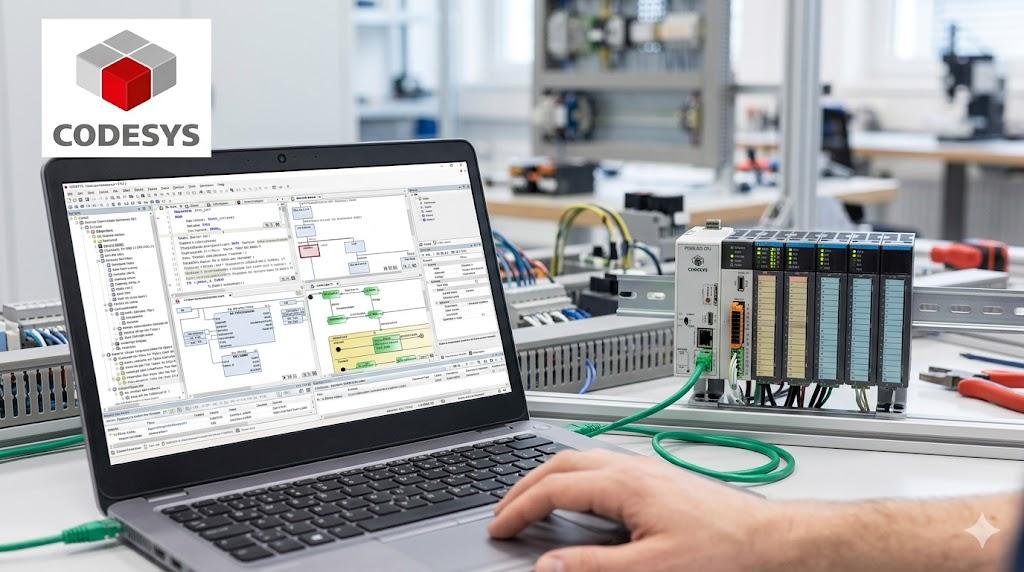
CODESYS PLC (Programmable Logic Controller)
CODESYS (Controller Development System) is a widely used software platform for developing applications for industrial automation systems, especially PLCs (Programmable Logic Controllers). Developed by CODESYS Group, it provides a complete development environment compliant with the IEC 61131-3 standard, which defines programming languages and structures for PLC systems. Because of this compliance, CODESYS has become one of the most flexible and hardware-independent tools in automation engineering.
At its core, a PLC is a specialized industrial computer used to control machines and processes. CODESYS acts as the software layer that allows engineers to program these controllers efficiently. One of the major advantages of CODESYS is that it is hardware-independent. Unlike traditional PLC systems that require proprietary software tied to a specific manufacturer, CODESYS can run on a wide range of devices from different vendors. This openness reduces costs and increases flexibility for industries.
CODESYS supports all five programming languages defined by IEC 61131-3: Ladder Diagram (LD), Structured Text (ST), Function Block Diagram (FBD), Instruction List (IL), and Sequential Function Chart (SFC). Ladder Diagram is popular among electricians due to its resemblance to electrical relay logic, while Structured Text is favored by programmers for its similarity to high-level programming languages like Pascal. Function Block Diagram is useful for visualizing process flows, and Sequential Function Chart helps design step-based control processes. This multi-language support allows engineers from different backgrounds to work comfortably within the same environment.
The development environment in CODESYS is highly integrated and user-friendly. It includes tools for writing code, debugging, simulation, and visualization. Engineers can test their programs using a built-in simulator before deploying them to actual hardware. This reduces errors and improves system reliability. Additionally, CODESYS provides visualization capabilities, enabling developers to design Human-Machine Interfaces (HMIs) directly within the platform. These interfaces allow operators to monitor and control processes in real time.
Another key feature of CODESYS is its support for modular programming through function blocks. Function blocks are reusable code components that encapsulate specific functionality, such as motor control or temperature regulation. By using these blocks, developers can build complex systems more efficiently and maintain them easily. This modular approach also enhances code readability and reusability, which is crucial in large industrial projects.
CODESYS also supports communication with various industrial protocols such as Modbus, CANopen, EtherCAT, and OPC UA. This enables seamless integration with sensors, actuators, and other automation devices. In modern industrial environments, where systems are interconnected, such communication capabilities are essential. CODESYS acts as a bridge between different components, ensuring smooth data exchange and coordination.
In terms of real-time performance, CODESYS PLC systems are designed to execute tasks deterministically. This means that operations occur within predictable time constraints, which is critical in automation systems where delays or inconsistencies can lead to failures or safety hazards. The runtime system of CODESYS ensures that control logic is executed reliably, even in demanding environments.
Security is another important aspect of CODESYS. With the increasing adoption of Industrial Internet of Things (IIoT) technologies, protecting automation systems from cyber threats has become essential. CODESYS includes features such as user management, encrypted communication, and secure access to controllers. These measures help safeguard sensitive industrial processes and data.
CODESYS is also widely used in education and research. Its accessibility and free development environment make it an excellent tool for students learning industrial automation. Many training institutes and universities use CODESYS to teach PLC programming concepts because it closely reflects real-world industrial practices. Furthermore, its simulation capabilities allow learners to experiment without requiring expensive hardware.
Another advantage of CODESYS is its scalability. It can be used for simple control tasks, such as controlling a single machine, as well as complex automation systems involving multiple controllers and distributed architectures. This makes it suitable for industries like manufacturing, energy, automotive, and building automation.
In recent years, CODESYS has evolved to support modern technologies such as cloud connectivity and edge computing. It enables integration with IoT platforms, allowing data from PLCs to be analyzed and monitored remotely. This capability is crucial for predictive maintenance, where data is used to identify potential failures before they occur. By combining traditional control systems with modern data analytics, CODESYS helps industries improve efficiency and reduce downtime.
Despite its many advantages, there are some challenges associated with CODESYS. Since it is highly flexible and supports many features, beginners may find it complex initially. Proper training is required to fully utilize its capabilities. Additionally, while hardware independence is beneficial, compatibility with specific devices may sometimes require additional configuration.
In conclusion, CODESYS PLC is a powerful and versatile platform for industrial automation. Its compliance with IEC 61131-3, multi-language support, hardware independence, and advanced features make it a preferred choice for engineers worldwide. Whether used in small-scale applications or large industrial systems, CODESYS provides the tools needed to design, implement, and maintain reliable control systems. As industries continue to adopt digital transformation and smart manufacturing, CODESYS remains a key technology driving innovation in automation.

 English
 Arabic
 Spanish
 Portuguese
 Deutsch
 Turkish
 Dutch
Dutch
 Italiano
 Russian
 Romaian
 Portuguese (Brazil)
 Greek
Greek
