


Building an AI Usage Policy for HR Teams
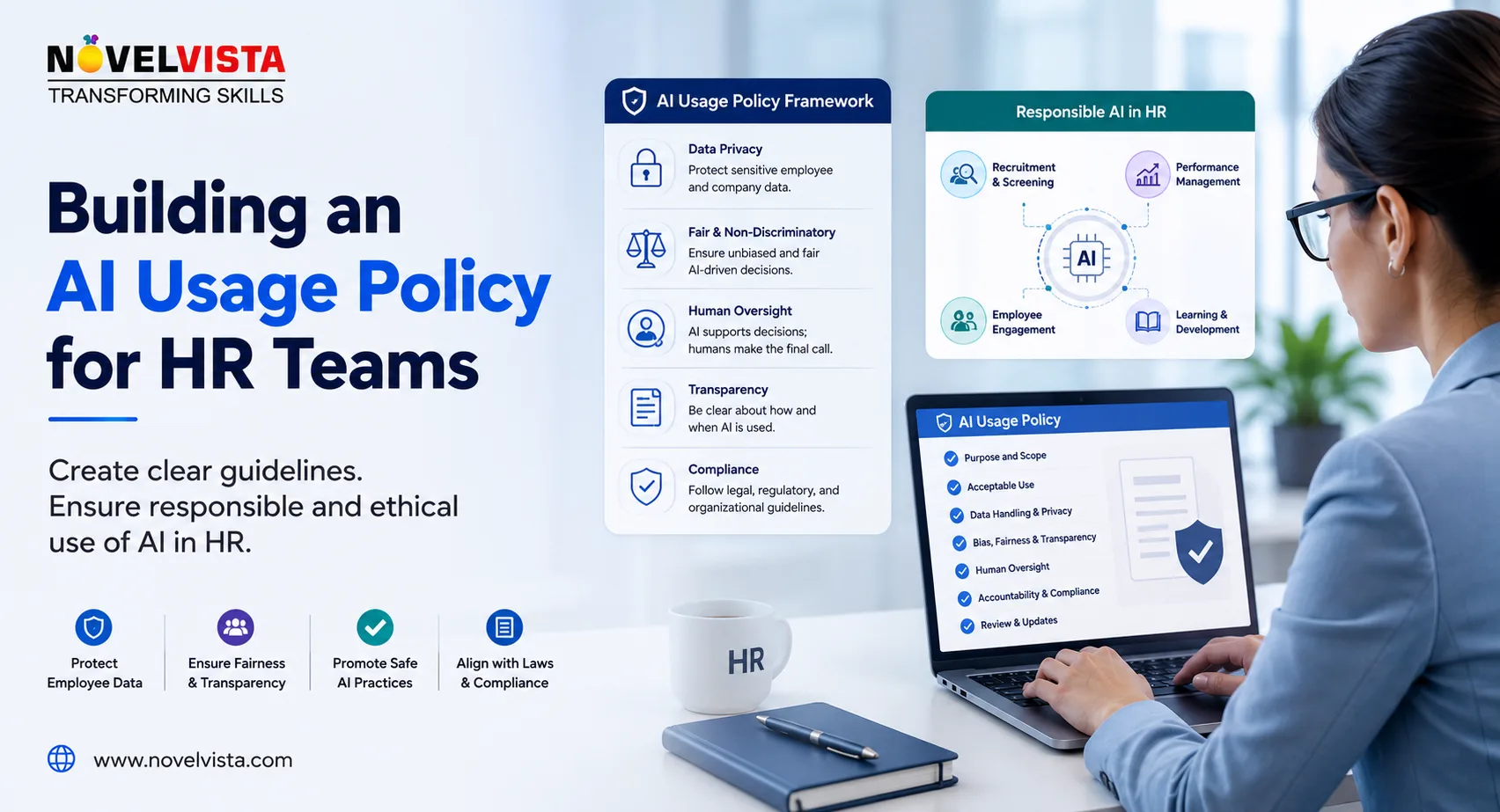
Artificial intelligence is quickly becoming part of everyday HR work. Recruitment teams use AI to screen applications, HR professionals use it to draft job descriptions, managers use it to summarize employee feedback, and learning teams use AI tools to create training material.
The opportunities are significant, but so are the risks.
HR departments work with some of the most sensitive information inside an organization, including employee records, salaries, performance reviews, candidate information, and workplace complaints. Using AI without clear rules can create privacy, fairness, compliance, and security concerns.
That is why organizations need a practical AI usage policy specifically designed for HR teams.
Why HR Needs Clear AI Guidelines
Employees are already experimenting with generative AI tools. Someone may paste a resume into an AI assistant to summarize it, upload employee feedback for analysis, or ask AI to draft a performance review.
The intention may be completely reasonable. The problem is that employees may not understand what information can safely be entered into an AI system.
Without guidelines, every employee makes their own decision about what is acceptable.
An AI usage policy creates consistency.
It should explain where AI can be used, what information must remain protected, which tools are approved, and when human review is required.
The objective should not be to prevent employees from using AI. Instead, the policy should make responsible use easier.
Define Approved AI Use Cases
A good policy starts by identifying acceptable uses of AI within HR.
For example, AI may be appropriate for brainstorming interview questions, improving the wording of job advertisements, summarizing non-sensitive survey results, creating training outlines, or generating ideas for employee communication.
However, organizations may want stronger controls when AI is involved in decisions affecting individuals.
Candidate rejection, promotion recommendations, disciplinary action, compensation decisions, and performance evaluations can have serious consequences.
AI may support these activities, but important employment decisions should not be made automatically without appropriate human oversight.
The policy should clearly distinguish between AI assisting a professional and AI making the decision.
Protect Employee and Candidate Data
Data protection should be one of the strongest sections of an HR AI policy.
HR professionals frequently handle personally identifiable and confidential information. This may include names, contact information, identification documents, salary information, medical information, employment history, and performance data.
Employees should understand that sensitive information must not be copied into unapproved public AI tools.
A simple rule can be effective:
Do not enter confidential employee, candidate, customer, or company information into an AI tool unless the organization has specifically approved the tool for that purpose.
Where enterprise AI systems are approved, the organization should still define what types of information are permitted and what security controls apply.
Address Bias and Fairness
AI systems can produce outputs that appear objective while still reflecting patterns or assumptions within the data they were trained on.
For HR teams, this deserves particular attention.
Imagine an AI tool recommends candidates based on previous successful hires. If historical hiring patterns were unbalanced, the system could unintentionally repeat those patterns.
HR teams should therefore review AI-generated recommendations critically.
The policy should require employees to consider whether AI outputs could unfairly disadvantage candidates or employees because of characteristics unrelated to job performance.
AI recommendations should be treated as input, not unquestionable conclusions.
Require Human Review
Generative AI can sound confident even when its output is inaccurate.
An AI-generated employee policy may contain incorrect legal information. A generated performance summary may exaggerate feedback. A recruitment assistant may incorrectly interpret someone's experience.
For this reason, human review should be mandatory before AI-generated content is used in important HR processes.
The employee using the AI tool should remain responsible for the final output.
A useful principle is:
AI can generate, summarize, suggest, or assist. Humans remain accountable for reviewing and approving the result.
Be Transparent About AI Use
Organizations should also consider when employees and candidates need to know that AI is being used.
For example, if AI plays a significant role in candidate assessment or employee evaluation, transparency becomes increasingly important.
HR teams should understand how the tool works, what data it uses, and what role its recommendations play in the final decision.
Employees should never be placed in a situation where an unexplained algorithm affects their career without meaningful human involvement.
Train HR Teams, Not Just Publish a Policy
A policy document alone will not create responsible AI behavior.
HR teams need practical training.
Employees should see examples of acceptable and unacceptable AI use. They should understand how to remove confidential information from prompts, verify AI-generated content, recognize potential bias, and report problems.
Training should also evolve as new AI tools enter the workplace.
AI governance cannot be treated as a document created once and forgotten.
Creating Responsible AI Adoption in HR
The strongest HR AI policies balance innovation with accountability.
They allow employees to benefit from AI without ignoring privacy, fairness, security, and human responsibility.
Organizations should clearly define approved tools, protect sensitive information, require human review, establish boundaries around employment decisions, and continuously educate HR professionals.
AI can help HR teams work faster and handle information more effectively. But speed should never come at the cost of trust.
When clear policies and responsible practices are in place, AI becomes more than another workplace technology. It becomes a controlled and valuable assistant that helps HR professionals make better decisions while keeping people at the center of the process.

 English
 Arabic
 French
 Spanish
 Portuguese
 Deutsch
 Dutch
Dutch
 Italiano
 Russian
 Romaian
 Portuguese (Brazil)
 Greek
Greek
