


AI Agentic Automation vs RPA: What Should Businesses Choose?
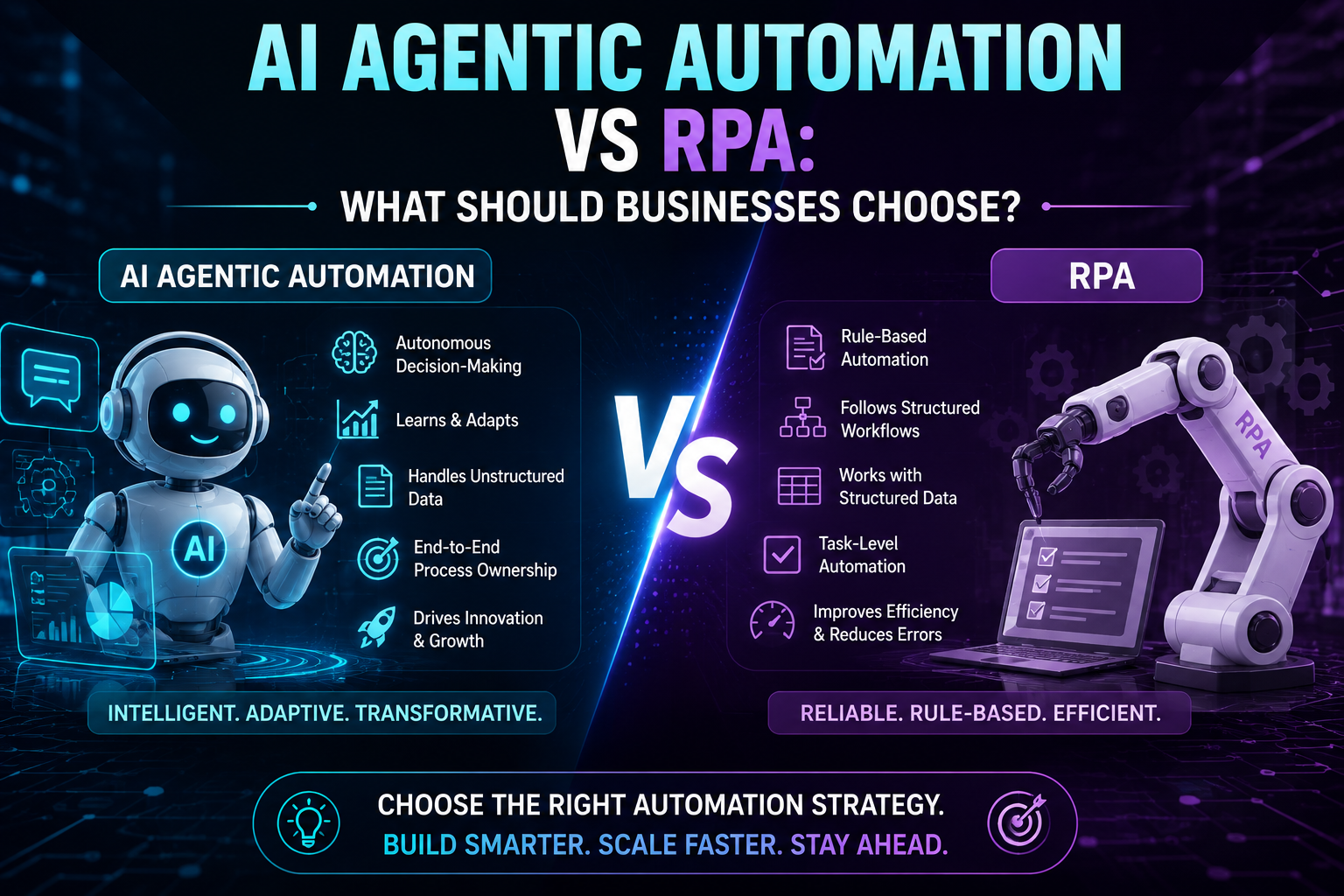
Business automation has evolved significantly. For years, organizations have relied on Robotic Process Automation (RPA) to automate repetitive, rule-based tasks. Today, the rise of generative AI and AI agents is introducing a new approach known as AI agentic automation.
While RPA is highly effective for structured and predictable processes, AI agents can handle more dynamic workflows that require contextual understanding, reasoning, tool usage, and multi-step execution.
But does this mean businesses should replace RPA with AI agents?
Not necessarily.
The better approach is to understand the strengths and limitations of both technologies and determine where each one can deliver the greatest business value.
What Is RPA?
Robotic Process Automation uses software bots to perform repetitive digital tasks based on predefined rules and workflows.
An RPA bot can interact with applications, websites, spreadsheets, databases, and enterprise systems to execute specific instructions.
For example:
Open Email → Download Invoice → Extract Data → Enter Data into ERP → Save Record
The bot follows a predefined sequence and performs the same process consistently.
Common RPA Use Cases
- Data entry
- Invoice processing
- Payroll processing
- Report generation
- Data migration
- Customer onboarding
- Order processing
- Form processing
- Reconciliation
- Legacy system automation
RPA is particularly valuable when the process is repetitive, predictable, and based on structured information.
What Is AI Agentic Automation?
AI agentic automation combines artificial intelligence, AI agents, workflow automation, APIs, and business systems to automate more dynamic processes.
Instead of simply following a fixed sequence, an AI agent can work toward a defined objective and determine the appropriate actions within its available tools and permissions.
For example, consider the goal:
"Process this customer complaint and resolve it according to company policy."
An AI agent could:
- Read the customer's message.
- Understand the complaint.
- Review the customer's account.
- Check company policies.
- Analyze previous interactions.
- Determine an appropriate resolution.
- Update the CRM.
- Draft a response.
- Escalate the issue if required.
The workflow may change depending on the information available.
This ability to work with context makes agentic automation suitable for more complex business processes.
RPA vs AI Agentic Automation: Key Difference
The biggest difference is how the automation handles instructions and decisions.
RPA generally follows:
"Do these predefined steps."
AI agentic automation can work toward:
"Achieve this defined goal using the available tools and information."
| Feature | RPA | AI Agentic Automation |
|---|---|---|
| Approach | Rule-based | Goal-oriented |
| Decision-making | Predefined rules | AI-assisted |
| Data | Structured | Structured + unstructured |
| Adaptability | Limited | Higher |
| Natural language | Limited | Strong |
| Workflow | Fixed | Dynamic |
| AI reasoning | Limited | Core capability |
| Tool usage | Preconfigured | Can use multiple tools |
| Best for | Repetitive tasks | Complex workflows |
| Predictability | Very high | Variable |
| Human oversight | Exception-based | Recommended for high-impact actions |
How RPA Works
A typical RPA workflow looks like this:
Trigger → Execute Rules → Perform Actions → Complete Task
For example, a finance bot could automatically process invoices received through a specific email account.
The bot might:
- Open the email
- Download the attachment
- Extract information
- Enter data into an ERP
- Compare the invoice against predefined rules
- Submit it for approval
If the invoice follows the expected format, the bot can process it automatically.
However, if the invoice contains unexpected information or the process changes, human intervention may be required.
How AI Agentic Automation Works
An agentic workflow can be more flexible:
Goal → Understand Context → Plan → Use Tools → Execute → Evaluate → Escalate or Complete
For example, an AI finance agent could receive an invoice and:
- Identify the vendor
- Understand the invoice
- Extract relevant information
- Compare it with purchase orders
- Check historical transactions
- Identify anomalies
- Determine the appropriate workflow
- Request approval when necessary
- Update financial systems
The agent can potentially adjust its actions based on the information it discovers.
Advantages of RPA
RPA remains highly valuable for many business processes.
1. Highly Predictable
RPA follows predefined rules, making its behavior easier to understand and control.
2. Reliable for Structured Tasks
It works particularly well with structured data and repetitive processes.
3. Easy to Measure
Businesses can clearly measure:
- Processing time
- Number of automated transactions
- Error reduction
- Cost savings
4. Suitable for Legacy Systems
RPA can automate applications that may not have modern APIs.
5. Strong Process Control
Because workflows are predefined, businesses have greater control over what the bot does.
Limitations of RPA
RPA also has limitations.
Limited Adaptability
If the application interface or workflow changes, the bot may require modification.
Difficulty With Unstructured Data
Traditional RPA is not designed to understand complex natural-language content without additional technologies.
Rule Dependency
RPA requires clearly defined instructions.
Exception Handling
Unexpected situations often require human intervention.
Maintenance
Large RPA environments can become difficult to maintain when workflows change frequently.
Advantages of AI Agentic Automation
AI agentic automation introduces several additional capabilities.
1. Contextual Understanding
AI agents can understand natural language, documents, conversations, and other unstructured information.
2. Dynamic Workflows
Agents can adjust their workflow based on context and available information.
3. Multi-System Interaction
An agent can potentially use multiple tools, APIs, databases, and applications to complete a task.
4. Complex Decision Support
AI agents can analyze information and recommend or execute actions within predefined boundaries.
5. End-to-End Automation
Instead of automating one task, agentic systems can coordinate multiple activities within a larger business process.
Limitations of AI Agentic Automation
AI agents also introduce new challenges.
Accuracy
AI systems can produce incorrect outputs or make inappropriate decisions if they lack sufficient context or controls.
Security
Agents may interact with sensitive business systems, making access control and permissions critical.
Governance
Organizations need policies defining what agents can access and what actions they can perform.
Monitoring
Agentic workflows require continuous monitoring to detect unexpected behavior.
Integration Complexity
Connecting agents to CRM, ERP, databases, APIs, and other enterprise systems can require significant development effort.
Cost
AI model usage, infrastructure, integrations, monitoring, and development can increase project costs compared with simple rule-based automation.
RPA vs AI Agents: Which Is Better?
There is no universal winner.
The right technology depends on the process.
Choose RPA When:
- The process is repetitive.
- Rules are clearly defined.
- Data is structured.
- The workflow rarely changes.
- Predictability is important.
- You need to automate legacy applications.
- The task follows a fixed sequence.
Choose AI Agentic Automation When:
- The process involves unstructured data.
- Natural language is involved.
- Workflows vary depending on context.
- Multiple systems need to be coordinated.
- Decisions require contextual analysis.
- The process contains many exceptions.
- The workflow requires dynamic task planning.
When Businesses Should Use Both
In many cases, the best solution is not RPA vs AI agents but RPA + AI agents.
For example:
Customer Email → AI Agent → Understand Request → Determine Workflow → RPA Bot → Update CRM → AI Agent → Generate Response
Here, the AI agent handles interpretation and decision-making while the RPA bot performs predictable system interactions.
This hybrid model can provide both flexibility and reliability.
Real-World Example: Customer Support
Consider a customer requesting a refund.
Traditional RPA Approach
An RPA bot could:
- Receive the request.
- Search for the customer.
- Check order information.
- Apply predefined refund rules.
- Process the refund.
- Send a confirmation.
This works well when refund conditions are simple and predictable.
Agentic Automation Approach
An AI agent could:
- Understand the customer's message.
- Identify the reason for the refund.
- Review previous interactions.
- Check customer history.
- Analyze refund policy.
- Determine whether the request meets the policy.
- Process the refund if authorized.
- Escalate unusual cases.
- Update the CRM.
- Generate a personalized response.
The agent can handle more complex customer situations.
Real-World Example: Accounts Payable
Accounts payable is another area where both technologies can work together.
RPA
RPA can:
- Download invoices
- Move files
- Enter structured information
- Update ERP systems
- Generate reports
AI Agent
AI can:
- Understand invoice content
- Identify vendors
- Analyze exceptions
- Compare information
- Detect unusual transactions
- Decide which workflow should be triggered
Combined Workflow
Invoice Received → AI Agent Analyzes Invoice → Validate Information → RPA Updates ERP → AI Agent Checks Exceptions → Human Approval → Payment Workflow
This hybrid approach can significantly improve automation coverage.
AI Agentic Automation vs RPA: Cost Considerations
Cost should not be the only factor when choosing an automation technology.
RPA projects may have costs associated with:
- Bot development
- Licensing
- Infrastructure
- Maintenance
- Integration
- Monitoring
AI agent projects can additionally involve:
- AI model usage
- Agent development
- Vector databases
- API integrations
- Cloud infrastructure
- Security
- Monitoring
- Evaluation
- Governance
Businesses should compare the total cost of ownership against expected benefits.
Important ROI metrics include:
- Hours saved
- Processing time
- Error reduction
- Cost per transaction
- Employee productivity
- Customer response time
- Revenue impact
Security and Governance Considerations
Agentic automation requires strong governance because AI agents may have access to business systems and sensitive information.
Organizations should define:
Access Controls
Agents should only have access to the systems and information they need.
Permission Boundaries
High-impact actions should require additional authorization.
Human Approval
Financial, legal, or sensitive actions should include human review where appropriate.
Audit Logs
Businesses should maintain records of important agent actions.
Monitoring
Organizations should monitor agent performance and unexpected behavior.
Data Protection
Sensitive customer and business data should be protected throughout the workflow.
How to Transition From RPA to AI Agents
Businesses do not need to replace existing RPA systems overnight.
A gradual approach is more practical.
Step 1: Audit Existing Automation
Identify existing RPA bots and determine which workflows generate the most exceptions.
Step 2: Identify Complex Processes
Find workflows involving:
- Emails
- Documents
- Customer conversations
- Unstructured data
- Frequent exceptions
Step 3: Add AI Capabilities
Introduce AI for document understanding, classification, summarization, or decision support.
Step 4: Connect AI With RPA
Allow AI systems to trigger existing RPA workflows where appropriate.
Step 5: Introduce AI Agents
Use AI agents for workflows requiring dynamic planning and multi-step execution.
Step 6: Establish Governance
Define permissions, escalation rules, human approvals, monitoring, and security policies.
Step 7: Measure Results
Compare automation performance before and after implementation.
How an AI Automation Agency Can Help
Implementing agentic automation requires more than selecting an AI model. Businesses need to understand their existing workflows, applications, data, integrations, security requirements, and business objectives.
An experienced AI automation agency in USA can help organizations:
- Identify automation opportunities
- Design AI-powered workflows
- Develop AI agents
- Integrate RPA and AI
- Connect enterprise applications
- Automate repetitive business processes
- Implement monitoring and governance
- Measure automation ROI
Organizations that require fully customized AI solutions can also work with an AI development company in USA to build AI agents, intelligent applications, and automation platforms tailored to their specific requirements.
For companies requiring broader software integration and enterprise application development, a Software Development Company in Dallas can help integrate AI automation into existing business infrastructure.
What Should Businesses Choose: RPA or AI Agents?
The answer depends on the business process.
| Business Requirement | Recommended Approach |
| Simple repetitive data entry | RPA |
| Structured invoice processing | RPA |
| Legacy application automation | RPA |
| Fixed workflow | RPA |
| Natural-language processing | AI |
| Complex customer support | AI Agents |
| Dynamic workflows | AI Agents |
| Multi-step decision processes | AI Agents |
| Unstructured documents | AI + RPA |
| Enterprise end-to-end automation | AI Agents + RPA |
For most organizations, the strongest long-term strategy will be hybrid automation.
RPA can continue handling predictable tasks, while AI agents handle dynamic processes and exceptions.
The Future of Business Automation
Business automation is moving toward systems where AI agents, RPA bots, APIs, enterprise applications, and employees work together.
Instead of replacing every existing automation technology, organizations can build an intelligent automation ecosystem.
A future workflow might look like:
AI Agent → Analyze Goal → Plan Workflow → Call API → Trigger RPA → Validate Result → Request Human Approval → Complete Process
This model combines the predictability of traditional automation with the flexibility of AI.
The goal is not maximum autonomy. The goal is controlled, secure, measurable automation that delivers business value.
Conclusion
AI agentic automation and RPA serve different purposes.
RPA is highly effective for structured, repetitive, and predictable processes. It provides reliability, consistency, and strong process control.
AI agentic automation is better suited to workflows that involve natural language, unstructured information, contextual decisions, multiple tools, and dynamic execution.
For many businesses, the best strategy is not to choose one technology over the other. Instead, organizations should combine RPA + AI + AI agents + APIs + workflow orchestration + human oversight.
Businesses should start with high-value processes, measure the results, and gradually expand automation as their technology and governance capabilities mature.
The right automation strategy can help organizations reduce manual work, improve productivity, accelerate operations, and create more scalable business processes.
Frequently Asked Questions
Is AI agentic automation better than RPA?
Not always. RPA is better for predictable, rule-based tasks, while AI agentic automation is better for dynamic and context-driven workflows. Many businesses can benefit from using both.
Will AI agents replace RPA?
AI agents are unlikely to make RPA completely obsolete. RPA remains useful for structured tasks and legacy applications, while AI agents can add intelligence and flexibility to broader workflows.
Can RPA and AI agents work together?
Yes. AI agents can interpret information and determine the next action, while RPA bots can execute predictable tasks within existing applications.
Which is more suitable for complex workflows?
AI agentic automation is generally more suitable for workflows involving multiple steps, unstructured information, contextual decisions, and changing conditions.
Is RPA cheaper than AI agent automation?
Simple RPA workflows can be less complex and less expensive to implement. However, total costs depend on integrations, licensing, infrastructure, AI usage, development, maintenance, and business requirements.
How can a business start using AI agents?
Start with one high-value workflow, identify the tasks requiring contextual intelligence, integrate the required business systems, establish permission and approval controls, and measure the results before scaling.
What is hybrid automation?
Hybrid automation combines RPA, AI, AI agents, APIs, workflow automation, and human oversight to automate business processes. It allows each technology to handle the tasks it is best suited for.

 Arabic
 French
 Spanish
 Portuguese
 Deutsch
 Turkish
 Dutch
Dutch
 Italiano
 Russian
 Romaian
 Portuguese (Brazil)
 Greek
Greek
