


ISO 42001 vs. the EU AI Act: How the Frameworks Compare
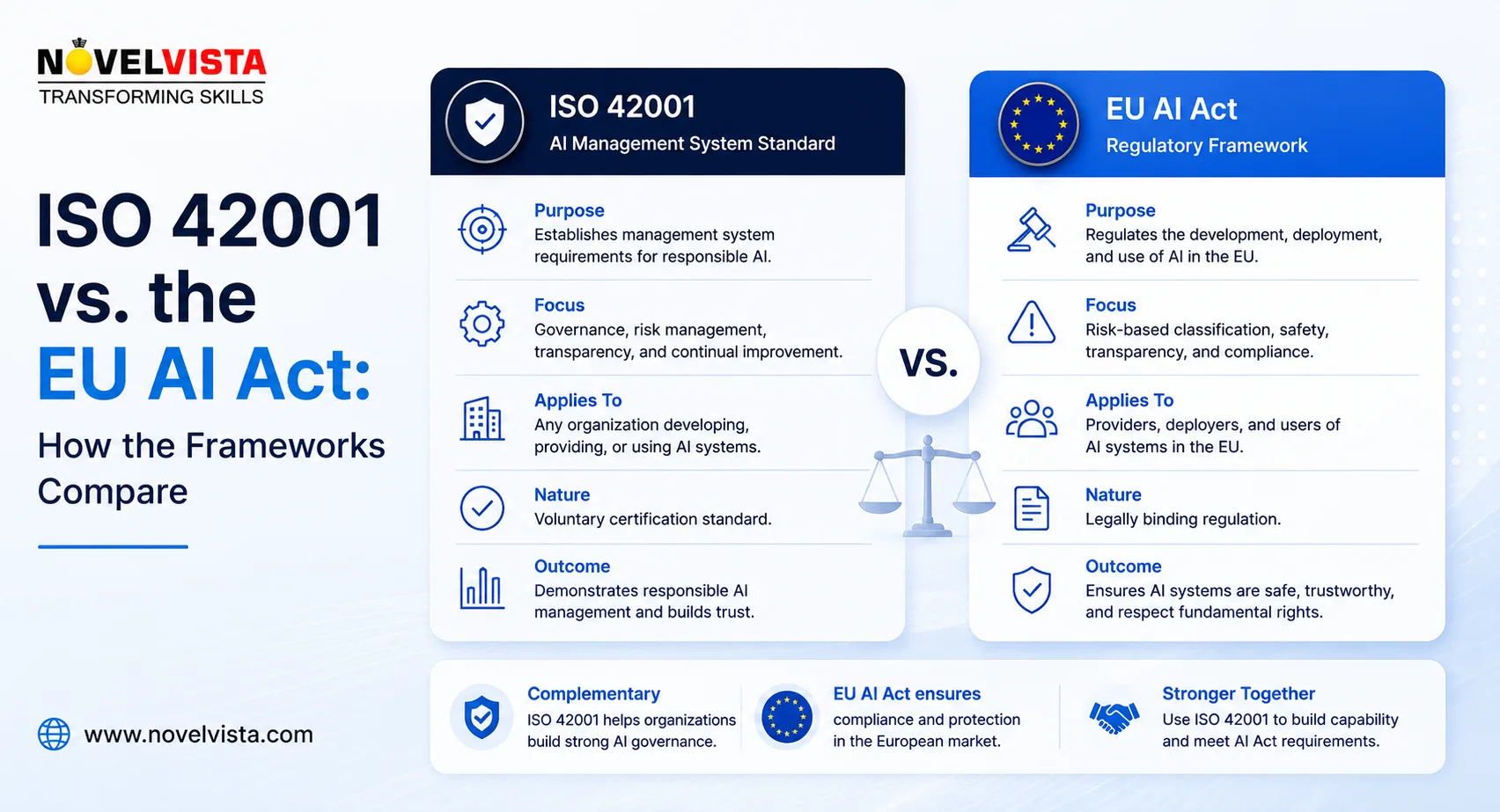
Artificial intelligence governance is moving from a policy discussion to an operational requirement. Two frameworks now receive particular attention: ISO/IEC 42001 and the European Union Artificial Intelligence Act. They share the goal of promoting trustworthy AI, but they are not interchangeable. One is a voluntary international management-system standard; the other is binding European legislation.
Understanding the difference helps organizations avoid a common mistake: treating certification as a substitute for legal compliance.
What Is ISO/IEC 42001?
ISO/IEC 42001:2023 provides requirements for establishing, implementing, maintaining, and continually improving an Artificial Intelligence Management System, or AIMS. It can be used by organizations that develop, provide, or use AI systems, regardless of their size, industry, or location.
The standard focuses on how an organization governs AI across its operations. It expects leadership accountability, defined AI policies, risk and opportunity assessments, documented responsibilities, lifecycle controls, performance monitoring, internal audits, corrective actions, and continual improvement.
Like other ISO management-system standards, ISO 42001 follows the Plan-Do-Check-Act model. This makes it useful for building repeatable governance rather than managing each AI project in isolation. Organizations may also pursue independent certification to demonstrate that their management system conforms to the standard.
What Is the EU AI Act?
The EU AI Act is a legally enforceable regulation. It classifies AI uses according to risk and applies different obligations depending on the system, its purpose, and the organization’s role as a provider, deployer, importer, distributor, or other participant.
Some AI practices are prohibited because they create unacceptable risks. High-risk systems face requirements involving risk management, data governance, technical documentation, record keeping, human oversight, accuracy, robustness, cybersecurity, and post-market monitoring. The Act also establishes transparency rules for certain AI systems and obligations for providers of general-purpose AI models.
The Act entered into force on August 1, 2024, and became broadly applicable on August 2, 2026. Some requirements started earlier, while amended transition periods place major high-risk obligations in December 2027 and August 2028.
Where the Frameworks Align
Both frameworks emphasize risk-based governance, accountability, transparency, documentation, human oversight, monitoring, and continuous control. They encourage organizations to understand where AI is used, who is responsible, what harm could occur, and how problems will be identified and addressed.
An ISO 42001 implementation can therefore create much of the organizational foundation needed for EU AI Act compliance. An AI inventory, governance committee, impact-assessment process, incident procedure, supplier review, audit programme, and documented lifecycle controls can support several regulatory obligations.
Both also move AI governance beyond technical teams. Legal, compliance, security, privacy, procurement, risk, human resources, and business leaders must participate because AI risks rarely remain limited to model performance.
Where They Differ
The most important difference is legal status. ISO 42001 is generally voluntary unless a contract, customer, regulator, or procurement process requires it. The EU AI Act is law, and non-compliance can lead to investigations, corrective measures, market restrictions, and significant financial penalties.
Their scope is also different. ISO 42001 evaluates an organization’s management system. The EU AI Act places detailed obligations on particular AI systems and actors. A company may operate an effective AIMS while still failing a specific legal requirement for a high-risk system.
Certification is another distinction. ISO certification indicates that an audited management system meets the standard’s requirements. It does not automatically prove that every AI system complies with the EU AI Act. Legal compliance depends on the applicable classification, documentation, testing, transparency, conformity assessment, registration, and monitoring obligations.
How Organizations Should Use Both
Organizations should treat the frameworks as complementary. The EU AI Act defines what legally applicable AI systems and organizations must achieve. ISO 42001 provides a structured operating model for managing responsibilities, evidence, controls, audits, and improvement.
A practical approach is to establish an ISO-aligned AIMS, maintain a complete AI inventory, classify systems under the EU AI Act, map regulatory duties to internal controls, assign accountable owners, and retain evidence for audits and authorities.
The strongest strategy is not “ISO or the AI Act.” It is a unified governance programme in which ISO 42001 supplies the management backbone and the EU AI Act supplies the binding regulatory requirements. Together, they help transform responsible AI from a collection of principles into a measurable, auditable, and sustainable business practice.

 English
 Arabic
 French
 Spanish
 Portuguese
 Deutsch
 Dutch
Dutch
 Italiano
 Russian
 Romaian
 Portuguese (Brazil)
 Greek
Greek
