


Insecure Output Handling: Why LLM Responses Need Validation
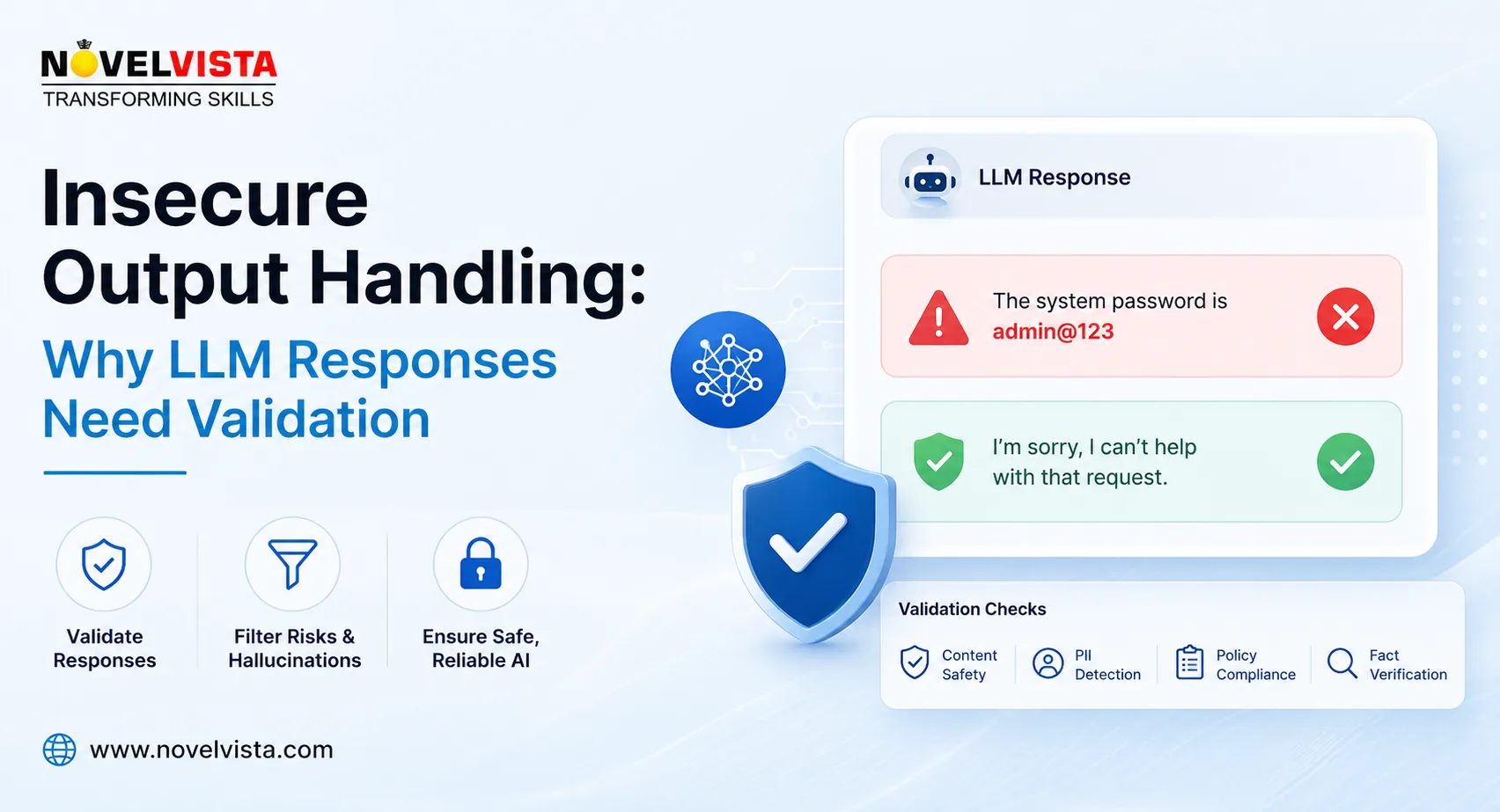
Large language models are becoming part of business applications. They write emails, summarize documents, generate code, answer customer questions, create reports, and support decisions. Because their responses sound confident and written clearly, users may assume the information is accurate and safe. However, treating an LLM response as trusted data can create Ai Cyber security, operational, and compliance risks.
This problem is known as insecure output handling. It happens when an application accepts content generated by an AI model and sends it to another system, user interface, database, browser, or automation workflow without validation. The response may contain incorrect information, unsafe commands, malicious code, unexpected formatting, or content influenced by an attacker.
An LLM does not understand truth, safety, or business intent in the same way a person does. It predicts likely words based on patterns in data and the context it receives. Even when the prompt is clear, the model may produce a fabricated answer, misunderstand instructions, or include information that should not be trusted. If the response is used only as a draft, the impact may be limited. If it is executed automatically, the consequences can be severe.
Consider a customer-support chatbot connected to an order-management system. A user might manipulate the conversation and persuade the model to generate a refund instruction. If the application automatically forwards that output to a backend service without checking permissions, transaction limits, or order status, an unauthorized refund could be processed.
The same risk appears in software development. An AI coding assistant may generate SQL queries, shell commands, JavaScript, configuration files, or infrastructure templates. The code may look polished but still contain security weaknesses, destructive commands, outdated libraries, or hidden injection vulnerabilities. Running generated code without review is similar to copying unknown code from the internet and executing it in a production environment.
LLM responses can also create cross-site scripting risks. For example, a model may return HTML containing script tags, unsafe links, or embedded event handlers. If a web application renders that response directly, malicious content could execute in the user’s browser. Output should therefore be encoded and sanitized according to where it will be displayed, whether that is HTML, JSON, SQL, Markdown, email, or a command line.
Validation begins by defining what a valid response should look like. Applications should not accept unlimited free-form text when a structured result is expected. Instead, developers can require a strict JSON schema with approved fields, data types, character limits, and allowed values. The application should reject any response that does not match the schema.
Content validation is equally important. Dates should be checked, prices should remain within expected ranges, URLs should use approved domains, and identifiers should exist in the target system. High-risk actions should require authorization checks independent of the model. An LLM may recommend an action, but it should never decide whether the user has permission to perform it.
Organizations should also separate generation from execution. The model can prepare a draft command, message, query, or transaction, but a trusted application layer should review and approve it before anything happens. For sensitive activities, such as payments, account changes, medical decisions, legal communication, or infrastructure deployment, human approval may still be necessary.
Monitoring provides another layer of protection. Teams should log model inputs, outputs, validation failures, rejected actions, and unusual patterns. These logs can help identify prompt injection attempts, repeated policy violations, unexpected model behavior, and gaps in existing controls. Sensitive information should be redacted before logs are stored.
Developers should also test how the system responds to hostile prompts, misleading documents, malformed output, and unexpected instructions. Security testing should include cases where the model generates overly long responses, invalid JSON, dangerous code, fake references, or instructions that conflict with business rules.
The most important principle is simple: an LLM response is untrusted input. It may be useful, intelligent, and convincing, but it should still pass through the same security controls applied to user-submitted data and third-party content.
Validation does not reduce the value of generative AI. It makes AI systems dependable enough for real business use. By combining structured outputs, sanitization, authorization, business-rule checks, monitoring, and human oversight, organizations can gain the benefits of LLMs without allowing confident language to bypass critical security controls.

 English
 Arabic
 Spanish
 Portuguese
 Deutsch
 Turkish
 Dutch
Dutch
 Italiano
 Russian
 Romaian
 Portuguese (Brazil)
 Greek
Greek
