


Why Multimodal AI Is the Next Frontier of Artificial Intelligence
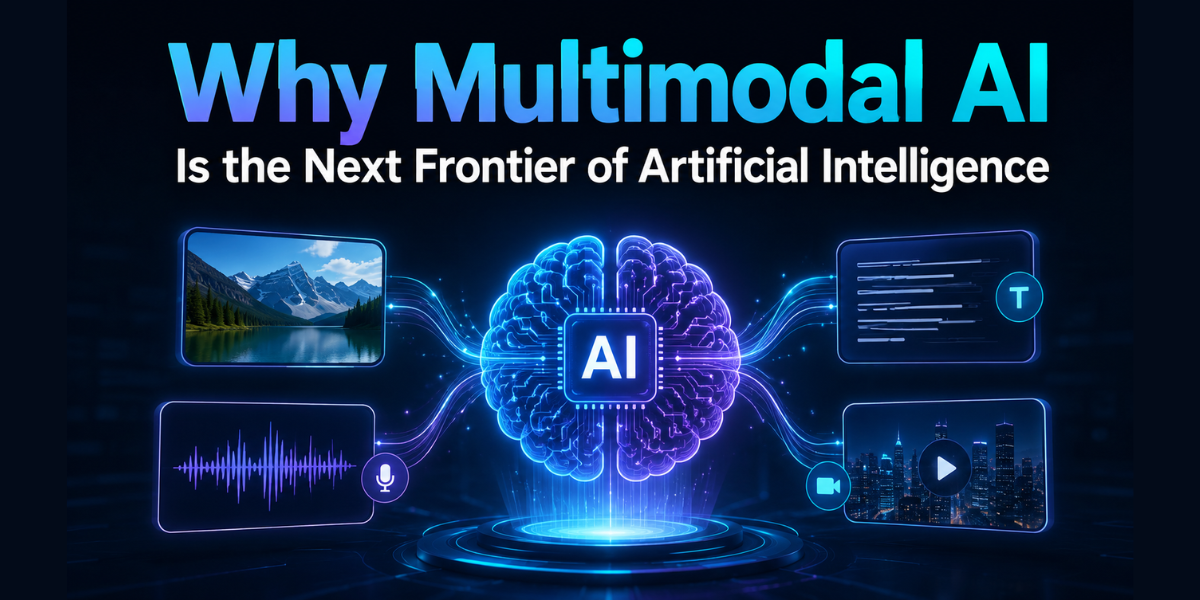
The human brain doesn't process the world in text. It combines what it sees, hears, reads, and senses simultaneously to make sense of any situation. Multimodal AI is the first architecture to seriously attempt something similar. It can read a patient's radiology image, cross-reference the clinical notes, and flag a concern in the same workflow. It can watch a factory floor video, listen for abnormal machine sounds, and trigger a maintenance alert before anything breaks. That's not a future capability. It's running in production environments in 2026.
Multimodal AI processes and integrates multiple data types, including text, images, audio, video, and sensor data, simultaneously. The global multimodal AI market was valued at $2.41 billion in 2025 and is projected to reach $41.95 billion by 2034 at a CAGR of 37.33%, per Fortune Business Insights. Nearly 60% of enterprise applications built in 2026 use models combining two or more modalities, per Market.us research.
This article covers:
-
What separates multimodal AI from single-mode systems
-
The models leading the space in 2026
-
Where industries are deploying it and what it's doing
-
The real challenges holding adoption back
-
5 FAQs on multimodal AI's impact
What Separates Multimodal AI From Everything Before It
A text-only model reads what you write. An image model classifies what it sees. A speech system transcribes what it hears. Each is useful. None can do what a human expert does, walk into a situation, absorb multiple streams of information at once, and make a judgment that draws from all of them.
Multimodal AI closes that gap by fusing different data streams before reasoning across them. The relationship between what's in an image and what's in the accompanying text is understood at the model level, not patched together afterward. Gartner's Emerging Technology Radar 2025 confirmed that multimodal models became mainstream in 2025. Video content alone accounts for more than 53.7% of total internet traffic, which makes video processing not optional for any AI system built to operate in the real world.
The Models Leading in 2026
|
Model |
Developer |
Key Capability |
Best For |
|
GPT-5 |
OpenAI |
Real-time audio, image, text; 128K context |
Complex reasoning, enterprise workflows |
|
Gemini 3.1 Pro |
Google DeepMind |
Native semantic video understanding: 1M token context |
Video analysis, long-document synthesis |
|
Claude Sonnet 4.6 |
Anthropic |
Text, images, charts, diagrams: top long-context reasoning |
Document analysis, research, coding |
|
Llama 4 Scout |
Meta |
Open-source; natively multimodal |
Self-hosted, sensitive data environments |
|
Qwen 3.5 |
Alibaba |
Natively multimodal, low compute cost |
Cost-sensitive agentic workflows |
OpenAI launched GPT-5 in August 2025, excelling across visual, video, spatial, and scientific reasoning benchmarks. Gemini 3.1 Pro is the only frontier model with native semantic video comprehension, not just transcription, making it the clear choice for video-heavy use cases. Cost matters too: GPT-5 and Claude Sonnet carry high compute costs at scale, which is why Qwen 3.5 and Llama 4 are gaining ground in production environments where inference cost is a real constraint.
Where It's Actually Being Used
The sectors that moved fastest are the ones where single-modality systems kept breaking at the last mile, where the data was inherently multi-format and the decision required integrating all of it.
Healthcare is the most visible case. Multimodal systems now analyze radiology images alongside clinical notes and lab results in a single workflow. Healthcare AI is growing at a 36.8% CAGR, the fastest of any sector, driven by exactly these multi-input diagnostic applications.
Manufacturing uses multimodal AI to watch production lines via camera, listen for equipment anomalies through audio sensors, and read operational machinery data, all at once. Predictive maintenance systems built this way catch failure patterns that neither a camera nor a sensor array alone would identify.
Financial services apply it to document-heavy processes, loan underwriting that combines scanned property documents, financial statements, and handwritten forms. A single-mode OCR tool consistently fails here. Text, image, and layout processed together don't.
Autonomous vehicles have the longest-running multimodal deployment: camera feeds, LiDAR, audio, and map data fused in real time. Financial services holds about 18% of multimodal AI adoption, and automotive between 14% and 18%, per Market.us 2026 data.
|
Industry |
Application |
Modalities Combined |
|
Healthcare |
Diagnostic imaging + clinical notes + lab data |
Image, text, structured data |
|
Manufacturing |
Predictive maintenance, quality control |
Video, audio, sensor data |
|
Financial services |
Document processing, fraud detection |
Text, image, video |
|
Automotive |
Autonomous driving, driver assistance |
Video, audio, LiDAR, maps |
|
Retail |
Visual search, recommendations |
Image, text, behavior data |
North America held 48% of the global multimodal AI market in 2024. The U.S. alone expanded at 31.5%. The Asia-Pacific is the fastest-growing region; China, Japan, South Korea, and India are all investing aggressively in multimodal applications.
The Challenges That Still Matter
Wide adoption doesn't mean solved.
Compute cost is the sharpest constraint. Multimodal models cost significantly more to run than text-only systems. That's exactly why Qwen 3.5 and Llama 4 are finding uptake; cost per inference matters when you're running millions of calls daily.
Data fusion complexity is less visible but just as real. Most enterprises have historical data siloed across separate systems, documents here, videos there, and sensor readings somewhere else. The engineering work to feed a multimodal system properly is substantial and often underestimated.
Bias compounds across modalities in ways single-mode systems don't produce. A model trained on biased text and biased images produces outputs where those biases reinforce each other. Governance frameworks for evaluating multimodal accuracy and fairness are still catching up to where the technology already is.
5 FAQs:
What exactly is multimodal AI?
AI systems that process and integrate multiple data types, including text, images, audio, video, and sensor inputs, simultaneously. Unlike single-modality models, multimodal systems understand the relationships between different formats and produce responses drawing from all of them at once.
Which multimodal AI model is leading in 2026?
Depends on the task. Gemini 3.1 Pro leads for video-heavy applications with its native semantic video understanding and 1-million-token context. GPT-5 leads on multi-step reasoning. Claude Sonnet 4.6 is strongest on long-context documents. For cost-sensitive or self-hosted deployments, Llama 4 and Qwen 3.5 dominate.
Why is multimodal AI the future and not just an upgrade?
Because the real world doesn't communicate in one format. Every meaningful decision in medicine, manufacturing, and finance draws from multiple information streams simultaneously. AI limited to one modality always needs humans to bridge the gap. Multimodal AI removes that gap, which makes it architecturally different, not just incrementally better.
Which industries are benefiting most right now?
Healthcare, manufacturing, financial services, and automotive lead in 2026. Healthcare's multimodal diagnostic tools, combining imaging with clinical data, are producing the most measurable outcomes. Manufacturing is close behind with predictive maintenance systems that combine camera, audio, and sensor data.
What's slowing faster adoption?
Three things: compute cost at scale, the complexity of integrating siloed enterprise data across formats, and immature governance frameworks for evaluating bias across multiple modalities. The technology has moved faster than the infrastructure and oversight practices built to support it.

 English
 Arabic
 French
 Spanish
 Portuguese
 Deutsch
 Turkish
 Italiano
 Russian
 Romaian
 Portuguese (Brazil)
 Greek
Greek
