


Transfer Learning: Getting Great Results with Less Data
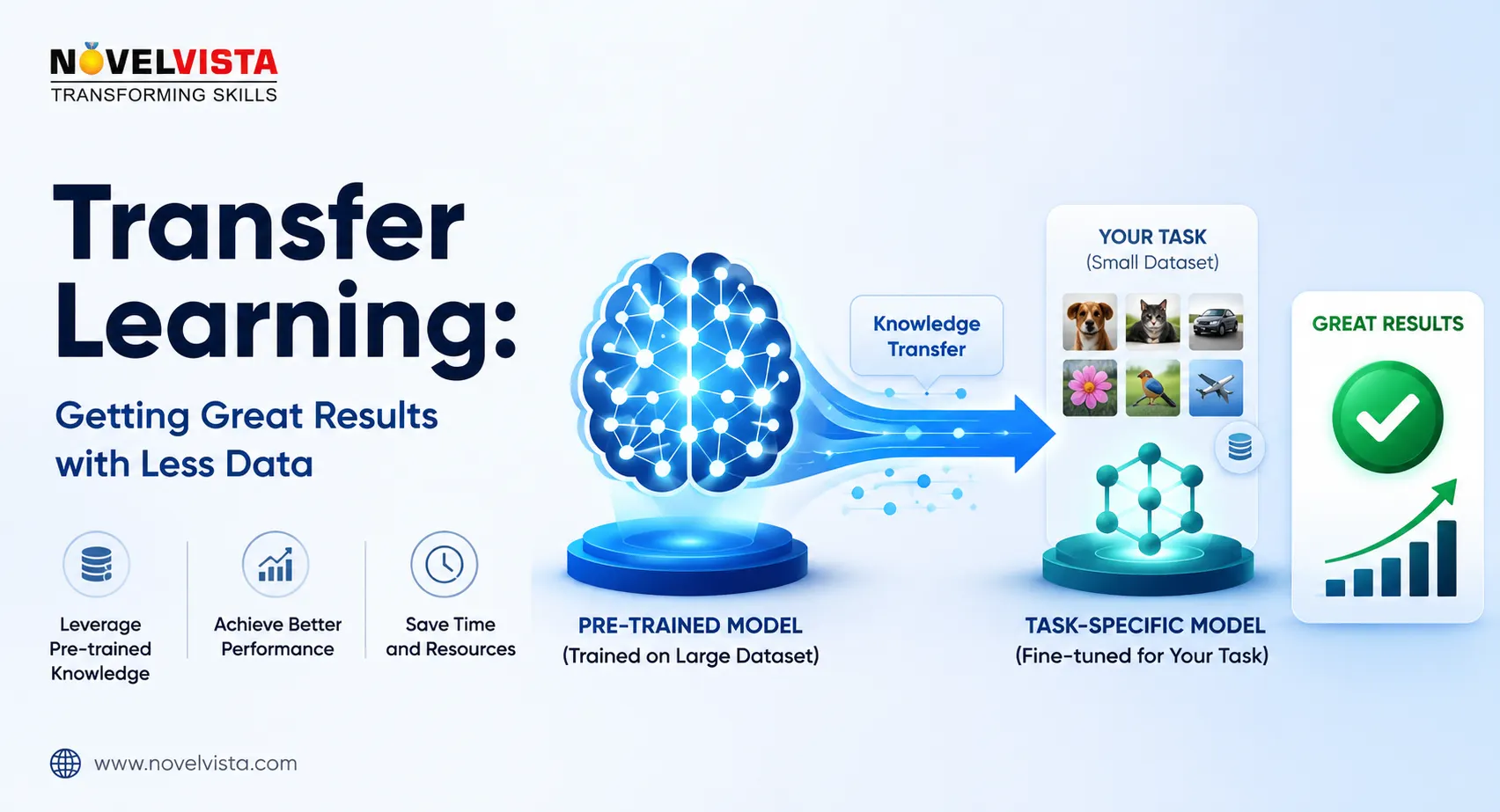
Training an artificial intelligence model from scratch can require enormous amounts of data, computing power, time, and technical expertise. For beginners, this can make machine learning feel expensive and difficult to access. Transfer Deep learning offers a practical alternative. It allows developers to reuse knowledge from an existing trained model and adapt it to a new, related task.
In simple terms, transfer learning means taking a model that has already learned how to solve one problem and using that knowledge as a starting point for another problem. Instead of teaching the model everything from the beginning, we build on what it already knows.
How Transfer Learning Works
Imagine someone who already knows how to ride a bicycle. Learning to ride a motorcycle may still require practice, but the person already understands balance, steering, and road awareness. Those existing skills make the new learning process faster.
Transfer learning works in a similar way.
A machine learning model may first be trained on a very large dataset. During that training, it learns useful patterns, shapes, features, relationships, and structures. The trained model can then be adjusted for a more specific task using a smaller dataset.
For example, an image recognition model trained on millions of general photographs may already understand basic visual features such as:
- Edges
- Colours
- Textures
- Shapes
- Object boundaries
A developer can reuse this model to identify defective products, classify medical images, recognise plant diseases, or detect different types of vehicles.
The model does not need to relearn basic visual patterns. It only needs to learn the specialised features required for the new task.
Pre-Trained Models
Transfer learning usually begins with a pre-trained model. A pre-trained model is an AI model that has already been trained on a large and commonly available dataset.
Popular image-processing models include ResNet, MobileNet, VGG, and EfficientNet. In natural language processing, models such as BERT and other transformer-based models can be adapted for tasks such as sentiment analysis, document classification, and question answering.
These models are useful because their training process has already captured a broad understanding of images or language. Developers can download them through machine learning libraries and customise them for their own use cases.
Feature Extraction
One common transfer learning technique is feature extraction.
In this approach, most of the original model remains unchanged. The model continues to use the general patterns it learned during its earlier training. Only the final part of the model is replaced and trained for the new task.
Suppose a pre-trained image model can recognise thousands of everyday objects. A developer wants to use it to classify three types of flowers. The earlier layers may continue detecting edges, colours, and shapes, while a new final layer learns to distinguish between the three flower categories.
Feature extraction is generally faster and requires less data than training the entire model.
Fine-Tuning
Another technique is fine-tuning.
Fine-tuning involves making small adjustments to some or all of the existing model layers. The model is trained again using the new dataset, usually with a low learning rate. This prevents the model from changing too quickly and losing its previously learned knowledge.
Fine-tuning can produce better results when the new task is closely related to the original task. However, it normally requires more computing resources and careful experimentation than basic feature extraction.
Beginners often start by freezing most model layers, training only the final layers, and then gradually unfreezing selected layers if additional improvement is needed.
Why Transfer Learning Is Valuable
The biggest advantage of transfer learning is that it reduces the amount of labelled data required.
Creating labelled datasets can be costly and time-consuming. Medical images may need to be reviewed by doctors, legal documents may require expert classification, and industrial data may need specialised inspection. Transfer learning helps organisations achieve useful results even when only a limited number of labelled examples are available.
It also provides several other benefits:
- Faster model development
- Lower training costs
- Reduced computing requirements
- Better starting accuracy
- Easier experimentation
- Faster deployment
Because the model already has a strong foundation, developers can focus on adapting it rather than building everything from zero.
Limitations of Transfer Learning
Transfer learning is powerful, but it is not suitable for every situation.
The original task and the new task should usually have some meaningful similarity. A model trained to recognise natural images may not perform well on highly specialised scientific data without significant adjustment.
A pre-trained model may also carry biases or weaknesses from its original training dataset. Developers should test the adapted model carefully and evaluate whether it performs consistently across different groups and conditions.
There is also a risk of overfitting when the new dataset is extremely small. Techniques such as data augmentation, validation testing, regularisation, and early stopping can help reduce this risk.
Getting Started
Beginners can explore transfer learning using frameworks such as TensorFlow, Keras, and PyTorch. These tools provide access to many pre-trained models and allow developers to replace layers, freeze parameters, and fine-tune models with relatively little code.
A simple transfer learning workflow includes selecting a pre-trained model, preparing a small labelled dataset, replacing the output layer, training the new layer, evaluating the results, and fine-tuning the model if necessary.
Transfer learning has made advanced AI development more accessible. It allows students, startups, researchers, and businesses to create effective models without requiring massive datasets or expensive computing infrastructure.
By building on existing knowledge, transfer learning demonstrates an important principle in artificial intelligence: sometimes the fastest way to learn something new is not to start from the beginning.

 English
 Arabic
 French
 Spanish
 Portuguese
 Deutsch
 Dutch
Dutch
 Italiano
 Russian
 Romaian
 Portuguese (Brazil)
 Greek
Greek
