


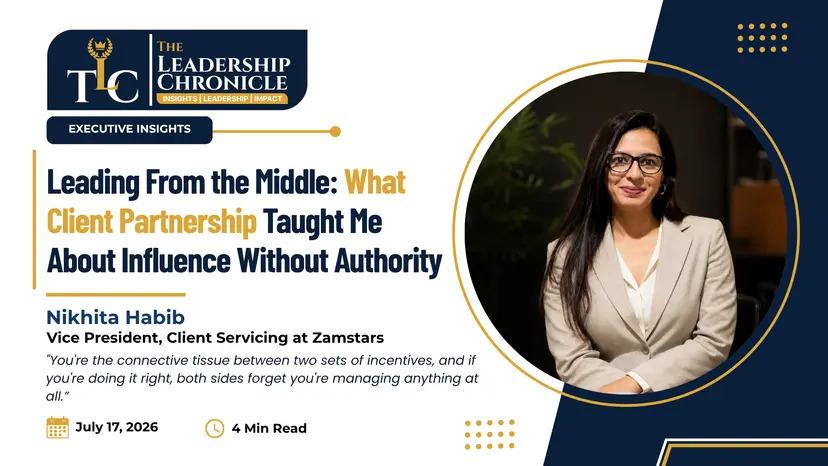
Leading From the Middle: What Client Partnership Taught Me About Influence Without Authority
When I was still a fresher at Time Inc, my job on paper was simple: keep the trackers updated, flag anything on fire, stay out of the way of the real strategy conversations. Those happened on calls with our US counterparts, people who technically had no reason to loop in someone at my level. But I’d noticed something in those first few months: the useful signal about where an account was really headed rarely came from the one point of contact everyone officially spoke to. It came from the people around them. A colleague would mention a shift in priorities almost as an aside. Someone else would casually flag a concern nobody had put on the agenda. So I started building rapport with all of them, not just the person whose name was on the account. Not because anyone asked me to. Somewhere along the way, that stopped being small talk and became something else. I was being asked what I thought, on calls where a fresher had no real business weighing in on strategy. Nobody gave me that seat. I made myself worth having in the room. That, more than any campaign I’ve run since, is the one that taught me what leadership actually looks like when you don’t hold the title.
Early in my career, I thought marketing was a craft you perfected in isolation: better copy, sharper targeting, cleaner analytics. I spent those years inside brand and social teams at organizations like Huawei and Time Inc, learning that discipline: how to read a dashboard, how to brief a campaign, how to defend a budget line. It’s good training. It teaches you rigor, and it rewards being right.
It did not teach me the thing I actually needed once I moved into client partnership: how to get two organizations that don’t report to each other, and don’t report to me, to move in the same direction. That’s a different skill entirely. Nobody on either side of the table has to listen to me. My job is to make it worth their while anyway.
That’s the part of leadership nobody puts on a slide: most of it happens without formal authority. You’re not the client’s boss. You’re not your own team’s boss, half the time. You’re the connective tissue between two sets of incentives, and if you’re doing it right, both sides forget you’re managing anything at all. It just feels like things are working.
“You’re the connective tissue between two sets of incentives, and if you’re doing it right, both sides forget you’re managing anything at all.”
Three things changed how I operate once I understood that.
Translate, don’t just report.
A status update is not a strategy. Clients don’t need more dashboards. They need someone to tell them what the numbers mean for the decision they’re actually facing next quarter. Every report I send now answers one question before anyone has to ask it: so what? If I can’t say what a metric changes about the client’s next move, I cut the slide, not the other way around. I’d rather walk into a meeting with three insights than thirty data points, because thirty data points is a task for the client and three insights is a service to them.
Every partnership eventually hits a moment that requires spending trust: a missed number, a hard recommendation, a fee conversation. The partners who survive those moments aren’t the ones with the best explanation in the room. They’re the ones who’ve been depositing credibility for months before they ever needed to make a withdrawal: flagging risks early, admitting what didn’t work, showing up with the unglamorous update instead of waiting to be asked. Influence without authority is really just trust, accumulated on a schedule, one honest interaction at a time. You can’t build it the week you need it. By then it’s already too late, and the client can tell the difference between a partner who’s earned the benefit of the doubt and one who’s asking for it cold.
“Influence without authority is really just trust, accumulated on a schedule, one honest interaction at a time.”
Say no early, so your yes means something.
It’s tempting, especially early on, to agree to everything a client asks for. It feels like service. It’s actually the opposite. It trains them to stop trusting your judgment, because you never exercise any. The partners clients rely on most are the ones willing to push back on a bad brief or a rushed timeline before it becomes an expensive mistake. Say no to the wrong things fast, and clearly, and your agreement carries real weight when it counts. A partner who pushes back occasionally is worth more than one who never does, because their yes actually means something.
None of this is unique to marketing or client services. Most leadership today happens sideways, across teams, vendors, functions, and organizations where your title buys you nothing. The people who move things forward anyway aren’t the loudest or the most senior in the room. They’re the ones who’ve quietly made themselves the person everyone trusts to tell them the truth.
“The people who move things forward anyway aren’t the loudest or the most senior in the room.”
For more details, visit: https://theleadershipchronicle.com/
If you would like to get featured or want to know more, connect with us at contact@theleadershipchronicle.com
LinkedInn : https://www.linkedin.com/company/the-leadership-chronicle/
Twitter : @TLChronicle

 English
 Arabic
 French
 Spanish
 Portuguese
 Deutsch
 Turkish
 Dutch
Dutch
 Italiano
 Russian
 Romaian
 Portuguese (Brazil)
